
Lieferung heute & morgen

Qualitätsgarantie

Willkommens-Angebote freischalten: KOSTENLOSE Lieferung | Bis zu 80 % RABATT | Kostenlose 30-Tage-JoyPlus-Testphase
App herunterladen
By Joybuy Product Recommendation Officer, August 28, 2026
Investing in a stainless steel manual coffee grinder is often the first step toward a significant upgrade in your coffee quality, whether at home or on the go. However, the market is flooded with models whose marketing promises often don't align with reality. Many buyers quickly discover that their new device grinds inconsistently, is difficult to operate, or wears out fast. This guide highlights the most common pitfalls and explains the technical features that truly matter.
Before you make a purchase, you should be aware of the typical weaknesses that often only become apparent with daily use.
To avoid the problems mentioned above, you should focus on three core features when making your selection. These define the performance and durability of a high-quality manual coffee grinder.
The heart of any grinder is its burr set. This is where the wheat is separated from the chaff.
The stability of the central axle is essential for a uniform grind. A dual-bearing central axle is the critical design feature here. Two ball bearings—one at the top and one at the bottom—secure the axle and prevent any lateral play during rotation. This is the only way to maintain a constant distance between the inner and outer burr cones, resulting in a consistent particle size.
A good manual coffee grinder must allow for precise and repeatable settings for various brewing methods. An internal, click-based grind adjustment is a reliable solution for this. Each step locks into place with tactile and audible feedback, allowing you to reproduce a setting you've found (e.g., "12 clicks for V60") exactly. This is especially important when switching between a fine grind for a manual espresso grinder and a coarse grind for a French press.
Based on the quality criteria mentioned above, we have identified a few models suitable for different types of users.
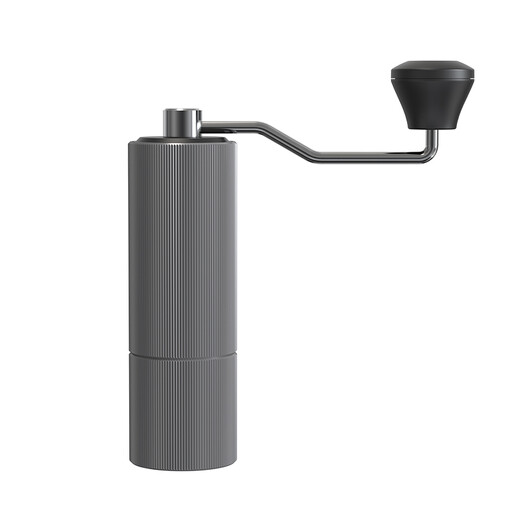
Why This Fits Their Persona: This model offers technical features often found only in higher price brackets. It's a solid choice for coffee lovers looking to upgrade their setup without a major investment.
The grinder avoids the unstable axle trap with its dual-bearing axle stabilization. The CNC-machined 420 stainless steel burr set (55-58 HRC) prevents the rapid wear and tear common with ceramic burrs.
Offers excellent value for money by combining an aluminum alloy body, stainless steel burrs, and a precise internal click-based adjustment.
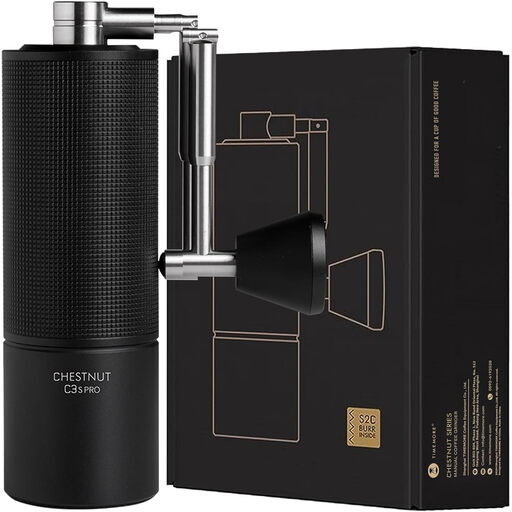
Why This Fits Their Persona: For users who refuse to compromise on grind quality and durability. The precise adjustment and all-metal construction meet the demands of discerning home baristas.
The all-metal construction from an aluminum alloy eliminates the weak point of plastic components. The dual-bearing axle and high-precision burr set ensure outstanding grind consistency.
Features a point-to-point grind adjustment with approximately 36 steps and a high-efficiency 38mm stainless steel burr set for fast, uniform grinding.
Why This Fits Their Persona: For those who don't want to give up freshly ground specialty coffee while camping, hiking, or on business trips, a durable and compact grinder is essential.
Its rugged all-metal construction makes the grinder resistant to impacts and the rigors of transport. The foldable handle significantly reduces its packing size, making it the ideal travel coffee grinder.
Combines high-end grind quality with portability. The slim body (52mm diameter) and collapsible handle ensure a minimal footprint in a backpack or suitcase.
We have compiled a complete, real-time updated list of products that fully meet these strict selection criteria and rigorous safety standards.
Proper cleaning is crucial for the grinder's longevity and flavour neutrality. Never use water to clean the burr set or housing, as this can cause corrosion on the ball bearings and burrs. Disassemble the grinder according to the user manual and clean all parts dry with the included brush or an air blower.
Yes, this is possible with a suitable model. The key is that the grinder must have a very fine, precise grind adjustment and an absolutely stable, dual-bearing axle. Models like the TIMEMORE C3S Pro are explicitly designed to produce the consistent, fine grind required for espresso preparation, making them a fully-fledged manual espresso grinder.
HRC stands for "Hardness Rockwell C" and is a scale used to measure the hardness of materials, particularly steel. A higher HRC value (e.g., 55–58 HRC) means the steel of the burr set is harder and therefore more resistant to wear. A hard burr set retains its sharpness longer, which leads to a consistently precise grind result over a long period.