
Lieferung heute & morgen

Qualitätsgarantie

Willkommens-Angebote freischalten: KOSTENLOSE Lieferung | Bis zu 80 % RABATT | Kostenlose 30-Tage-JoyPlus-Testphase
App herunterladen
Stainless steel mixing bowls are found in many UK households because they can be used for mixing, kneading, washing, portioning and serving. However, a low price or shiny surface does not automatically make a bowl the right choice for your kitchen. The key factors are the material specification, capacity, stability and cleaning instructions.
Not every product description specifies the exact alloy. Information such as 304 stainless steel or suitability for food contact provides more guidance than a general material description. Buyers should also look at the quality of the finish, the rim design and any possible coatings.
A seamlessly formed bowl may have fewer joins where residue can collect. A smoothly rolled rim makes pouring and handling easier. However, these features do not replace checking the specific manufacturer’s information.
A 1-litre bowl is suitable for small portions, sauces or prepared ingredients. For yeast dough, cake batter or a large salad, it can quickly become too small. When mixing with a whisk or hand mixer, the contents also need enough room to move.
The stated capacity does not always correspond to the practically usable amount. When choosing a large mixing bowl, you should therefore leave some space below the rim. This helps minimise splashing when mixing and kneading.
A stainless steel bowl without a non-slip base can move across the worktop when you are mixing vigorously. Silicone, TPR or other rubber bases improve grip on the worktop, but may have their own care instructions. Some models are intended for hand washing, while others are listed as dishwasher-safe.
A set with a lid is not automatically suitable for every type of food storage either. Before buying, check the temperature limits, microwave guidance and whether the lid is actually included in the delivery.
For everyday use, information such as 304 stainless steel, “suitable for food contact” or compliance with the relevant EU requirements is helpful. EU Regulation EC No. 1935/2004 sets out general requirements for materials that come into contact with food. Such information describes the material’s legal suitability, but it is not a quality ranking.
After use, remove salt, acidic substances and food residue promptly. Even stainless steel surfaces can be affected by prolonged contact. Abrasive cleaners, wire wool and hard brushes can cause scratches.
A mixing bowl set is practical if you regularly prepare several ingredients at once. Nesting bowls save space in the kitchen cupboard. Check the following:
A stainless steel bowl set with sizes ranging from around 1 to 3.3 litres will often cover smaller preparation tasks and medium quantities. For families, parties or large salads, a single model with a capacity of 4 to 4.5 litres may be more suitable.
A stainless steel bowl with a non-slip base is particularly useful for whisking, mixing and kneading. The base should sit flat and be suitable for the worktop surface. For silicone or TPR elements, check the maximum temperature and cleaning instructions.
“Dishwasher-safe mixing bowls” should be explicitly described as dishwasher-safe in the product information. If this information is missing, hand washing with mild washing-up liquid and a soft sponge is the more cautious option. A 1-litre bowl from 5five, for example, is listed as not dishwasher-safe, even though it is designed for food preparation.
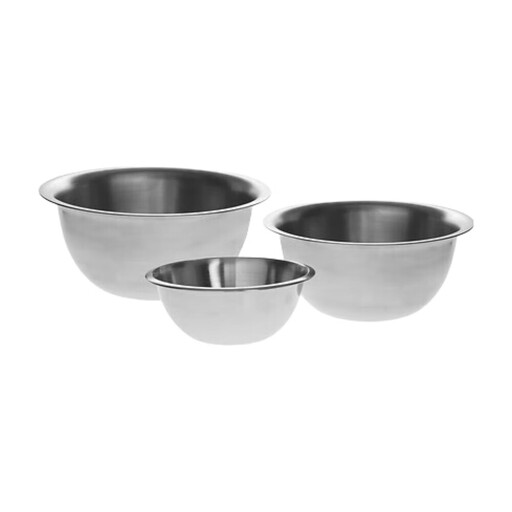
Why this product suits this profile: With 1, 2 and 3.3 litres, this set covers several typical household tasks and can be nested to save cupboard space.
The three clearly specified sizes make it easier to choose the right bowl for small and medium quantities. The non-slip base is designed to provide greater stability when mixing.
Three nesting bowls; listed as dishwasher-safe according to the product information.
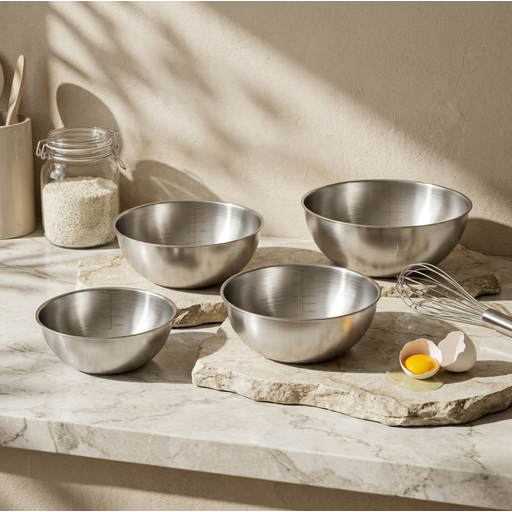
Why this product suits this profile: The four sizes, 19, 22, 25 and 28 cm, are designed for different preparation and serving quantities.
The 304 stainless steel specification and precision-rolled, burr-free rim are more specific than a general claim such as “high quality”.
Four sizes; listed as nesting and dishwasher-safe according to the product information.
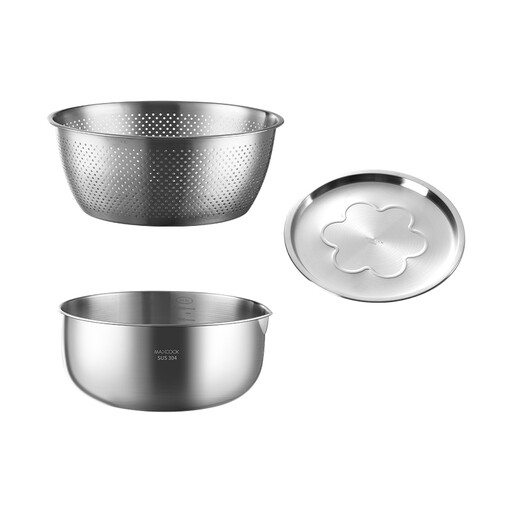
Why this product suits this profile: This model combines mixing, kneading, washing, draining and storage, making it suitable for households with several kitchen routines.
The description specifies a measurement scale, a deep shape to help prevent splashes and a lid. This makes the functions easier to check before buying.
304 stainless steel, double sieve design, measurement scale and stackable construction according to the product information.
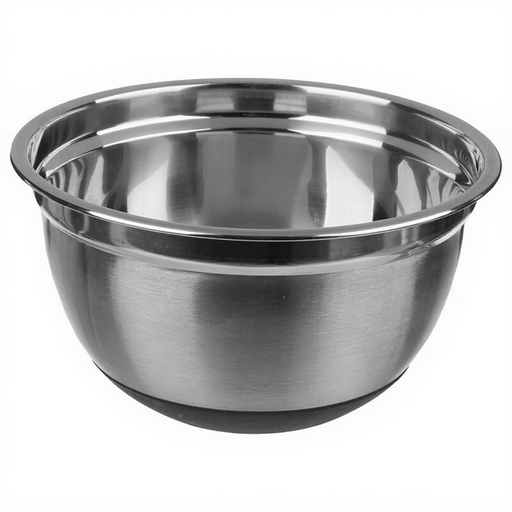
Why this product suits this profile: The 4.5-litre capacity is designed for large salads, pasta and side dishes for several people.
The large capacity reduces the risk of running out of room when combining ingredients. The TPR base is designed to provide greater stability.
4.5-litre capacity and non-slip TPR base; hand washing is recommended.
Before using stainless steel mixing bowls for the first time, clean them with mild washing-up liquid and a soft sponge. After use, rinse them promptly, especially after contact with salt, vinegar or strongly acidic ingredients. Then allow the bowl to dry completely.
For high temperatures, follow the information provided for the individual product. Stainless steel bowls are not automatically suitable for use in a microwave or oven. Lids, silicone bases and TPR elements may have different temperature limits from the bowl itself.
We have put together a complete, regularly updated list of products that fully meet these strict selection criteria and the safety regulations applicable in the EU.
For small quantities of ingredients, around 1 to 2 litres is enough. For doughs, larger salads and family portions, 3 to 4.5 litres is more practical. However, greater capacity also requires more space in the cupboard and dishwasher.
This depends on the individual model. Some sets are explicitly described as dishwasher-safe, while others – particularly versions with non-slip bases – recommend hand washing. The product information should be the deciding factor before you buy.
Their lifespan depends on the material, build quality and care. Prompt cleaning, thorough drying and avoiding wire wool or harsh cleaning products can help protect the surface. Scratches can occur through normal use with metal products and do not automatically indicate a loss of functionality.