
Lieferung heute & morgen

Qualitätsgarantie

Willkommens-Angebote freischalten: KOSTENLOSE Lieferung | Bis zu 80 % RABATT | Kostenlose 30-Tage-JoyPlus-Testphase
App herunterladen
A high-quality stainless steel pan is an investment for years to come. It promises durability, healthy coating-free cooking, and professional searing results. But the market is flooded with products whose marketing promises often fall short in practice. Many buyers soon discover that the pan's base warps, food cooks unevenly, or the material is difficult to clean.
As your Joybuy Product Recommendation Officer, I'm here to help you identify these pitfalls. Instead of falling for exaggerated advertising claims, we will focus on the verifiable facts and technical specifications that define a truly excellent stainless steel frying pan.
The 2 Most Common Pitfalls When Buying a Stainless Steel Pan:
To avoid a bad purchase, you should check three core technical parameters. These determine the performance, durability, and user-friendliness of your future pan.
A high-performance stainless steel pan is not made of one, but multiple layers. The most proven design is 3-ply cookware, also known as multi-ply or clad material.
This sandwich construction ensures fast and, most importantly, even heat distribution from the base all the way up to the rim of the pan.
A good stainless steel pan for induction needs a perfectly flat, warp-resistant base. The multi-ply construction is key to ensuring the pan remains oven-safe and warp-resistant even at high temperatures. This guarantees optimal contact with the hob, efficient energy transfer, and prevents the pan from wobbling. Look for products that are explicitly designated as compatible for all stovetops.
Beyond the basic construction, other features determine the convenience in your daily kitchen routine:
Instead of a one-size-fits-all recommendation, we present products tailored to specific user profiles.
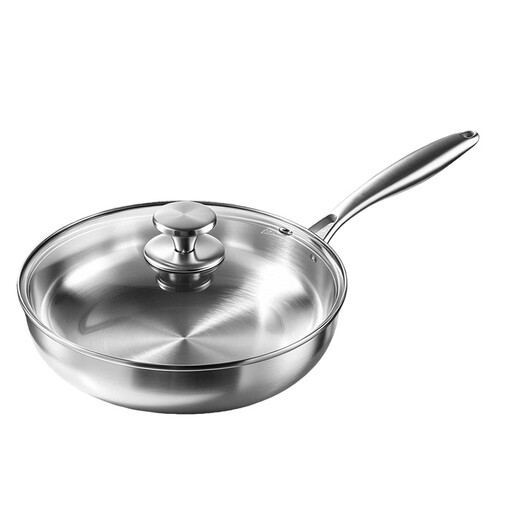
Why it's a great fit: The compact 22 cm size is ideal for cooking eggs, searing vegetables for one person, or for small households. It offers the benefits of a multi-ply pan without the large footprint of a bigger model.
The integrated 3-ply construction (stainless steel-aluminium-stainless steel) ensures dimensional stability and prevents the base from warping, a common problem with cheaper pans.
The uncoated surface made of food-grade 304 stainless steel allows for a hard sear and preserves the pure taste of the ingredients. It is also dishwasher-safe.

Why it's a great fit: With a 28 cm diameter, this pan offers ample space for larger cuts of meat or family-sized meals. The included glass lid expands its versatility to braising and steaming.
The three-layer composite construction (Triple-layer Clad Base) provides demonstrably fast and even heat distribution, preventing the formation of hotspots that cause food to burn in lower-quality pans.
The combination of a generous cooking surface, precise heat control, and the glass lid for visual monitoring makes it a versatile tool for sophisticated dishes.
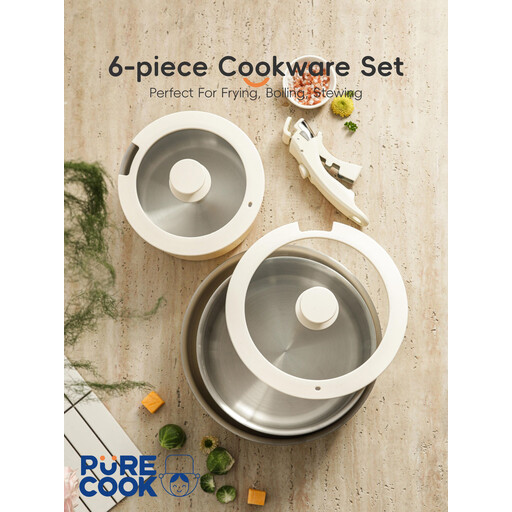
Why it's a great fit: This set is the solution for kitchens with limited storage. It includes a saucepan (18cm), a stockpot (22cm), and a frying pan (26cm), all of which are stackable to save space thanks to the detachable handle.
Instead of buying individual pots and pans of inconsistent quality, this stainless steel pan set offers consistently high material and build quality for all cooking tasks.
Maximum flexibility and space-saving thanks to the detachable handle and stackable design. The set is also oven-safe and dishwasher-safe.
We have compiled a complete, up-to-date list of products that fully meet these strict selection criteria and safety standards.
Cooking with a stainless steel pan requires a different technique than with non-stick pans. The key is the right temperature. Heat the empty, dry pan over medium heat. Do the water drop test: flick a few drops of water into the pan. If the drops sizzle and evaporate, it's not hot enough yet. When the drops dance across the surface as stable beads (the Leidenfrost effect), the pan has reached the correct temperature. Briefly wipe the pan dry, add your oil, and then place your food in the pan.
Yes, the surface of a stainless steel pan is extremely robust compared to non-stick coatings. You can safely use metal utensils like spatulas or spoons. Over time, fine, superficial scratches may appear. However, these are purely cosmetic and do not affect the pan's cooking performance or food safety.
These discolorations are harmless and not a material defect. Rainbow-coloured streaks (heat tint) are caused by a reaction of the chromium in the stainless steel with heat and oxygen. White spots are typically limescale deposits from hard water. Both types of stains can be easily removed with a splash of vinegar or lemon juice and a soft cloth to restore the original shine.