
Lieferung heute & morgen

Qualitätsgarantie

Willkommens-Angebote freischalten: KOSTENLOSE Lieferung | Bis zu 80 % RABATT | Kostenlose 30-Tage-JoyPlus-Testphase
App herunterladen
A stainless steel pot is a staple in many homes, as it can be used for soups, pasta, rice, stews and hot pot dishes. But with so much choice, finding the right model isn’t always straightforward. Pots are often bought based on their shiny finish, supposed ‘non-stick’ properties or a high stated capacity, while important details such as the base construction, usable capacity and cleaning requirements are overlooked.
Stainless steel is a group of materials. When it comes to food contact, the precise alloy, workmanship and product information all matter. Several pots on the market specify 304 stainless steel, also known as SUS304, for the body. However, this shouldn’t be taken as a blanket statement about every product feature.
Also check:
A stainless steel cooking pot without a coating may appeal if you’re looking for a PFAS-, PTFE- and PFOA-free cooking option. With hybrid models, however, check exactly what ceramic coating is used and how it should be cared for.
The outside dimensions can be considerably larger than the usable interior because of the rim, base and handles. For a family, diameter, height and capacity together are therefore more useful guides than the diameter alone.
As a rough guide:
A very tall pot takes up less space on the hob, while a wide stainless steel soup pot may be more practical for browning and stirring.
A cooking pot for all hob types needs a flat, sufficiently magnetic base to work on induction. A simple stainless steel base isn’t automatically induction-compatible. On gas, electric and ceramic hobs, a stable base and even heat distribution are also important.
A tri-ply stainless steel pot often has an aluminium core between layers of stainless steel. This can improve heat distribution, but it doesn’t guarantee a particular cooking result. The key is to check the manufacturer’s specific details about the base construction and hob compatibility.
Uncoated stainless steel doesn’t have a traditional non-stick coating that could be damaged by metal utensils. However, it can discolour at high temperatures, and starchy foods may leave residue. Models with a ceramic hybrid coating can help reduce sticking, but they usually need gentler handling.
Details such as ‘304 stainless steel’, ‘18/10 stainless steel’ or ‘food-safe’ should be included in the product information. For branded claims, bear in mind that according to the manufacturer, the pot body is made from the stated material. This doesn’t in itself support any medical or health claims.
A bonded or multi-layer base is particularly important for induction, gas, electric and ceramic hobs. Check:
For an induction cooking pot, the base shouldn’t be significantly smaller than the induction zone. Otherwise, the heating performance may be reduced or the hob may not detect the pot.
A glass lid makes it easy to keep an eye on your food, while a stainless steel lid may be more robust and less prone to scratches. Look for a sturdy rim and a handle that won’t sit directly above a particularly hot area while you’re cooking.
The term dishwasher-safe cooking pot is convenient, but it doesn’t necessarily mean the finish will remain unchanged after every cycle. Some manufacturers still recommend washing stainless steel models by hand with a soft sponge. Scouring products and metal pads can scratch polished surfaces.
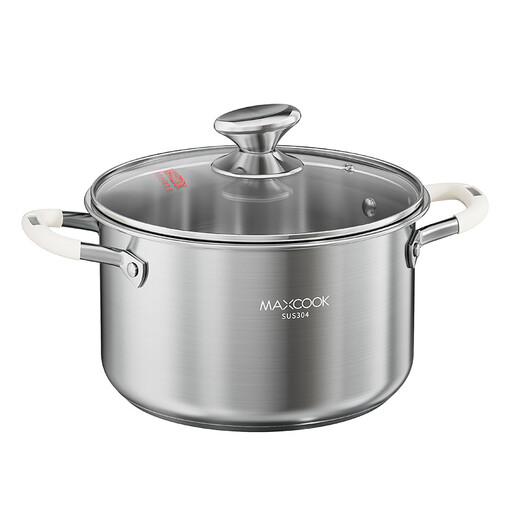
Why this product is a good match: Its compact size is ideal for everyday soups, pasta and stews in smaller households. The manufacturer specifies 304 stainless steel, a bonded base and compatibility with induction, gas, electric and ceramic hobs.
The stated capacity and base construction make it easier to compare with pots of a similar size. The product description specifically recommends hand washing.
3.2-litre capacity, glass lid, silicone handles and a flat composite base for use on several hob types.
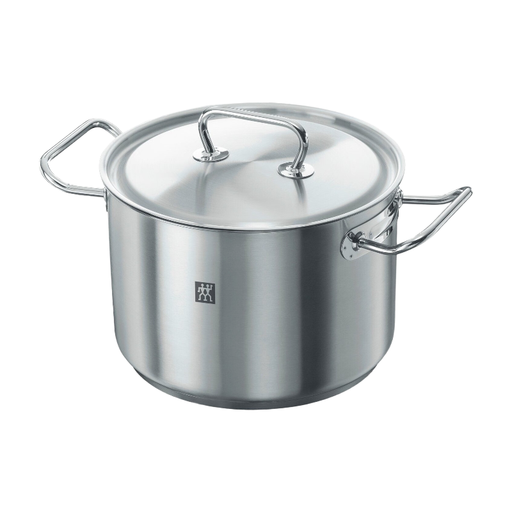
Why this product is a good match: This model combines 18/10 stainless steel with a SIGMA Classic sandwich base, measuring scale and matching lid. It’s designed for households that value clear specifications and versatile use.
Specific details about the material, base type, capacity and compatible hob types mean you don’t have to rely on appearance alone when choosing a pot.
6-litre capacity, 18/10 stainless steel, sandwich base and suitability for induction, gas, electric and ceramic hobs.
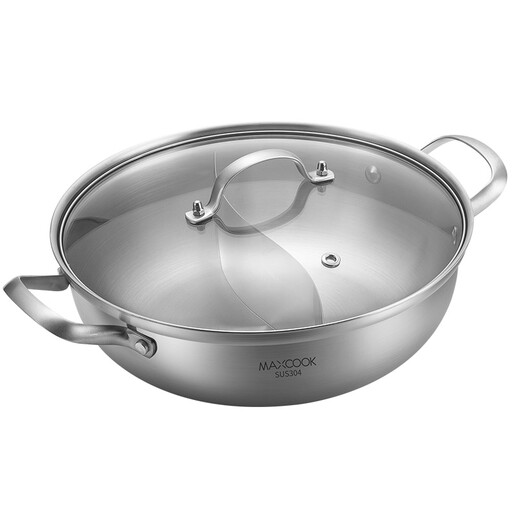
Why this product is a good match: The divided interior is designed for serving two broths or combinations of ingredients at shared meals. Its size is ideal for families and regular hot pot gatherings.
The product details list the interior and exterior diameters, depth, capacity and compatible hob types. This makes it easier to judge how much space you’ll need before buying.
4.6-litre capacity, divided pot, 304 stainless steel and glass lid; the product details state that it’s suitable for induction, gas, electric and ceramic hobs.
We’ve put together a complete, regularly updated list of products that meet these strict selection criteria and fully comply with the safety regulations in force in the EU.
Before using your pot for the first time, wash it with warm water and mild washing-up liquid. Some models may have residue from the polishing process, so follow the manufacturer’s instructions. White spots are often caused by water or starch deposits. Diluted vinegar can help on suitable stainless steel surfaces, but rinse thoroughly afterwards.
If possible, wait until the water is hot before adding salt, as salt can settle on the cold base of the pot if it stays in contact with it for too long. Empty the pot soon after cooking and dry it to help prevent water marks. Avoid exposing glass lids to sudden changes in temperature.
Choose a model with a bonded or encapsulated base that’s specifically stated to be induction-compatible. The manufacturer’s information is more important than the simple ‘stainless steel’ label, as not every stainless steel base is magnetic.
There’s no reliable way to give a set lifespan. It depends on the material thickness, base construction, handles, heat exposure and care. With proper use, uncoated models are less dependent on a non-stick coating that can wear out. Follow the care instructions for coated hybrid pots.
Some models are, while others aren’t. The product description may specify either ‘dishwasher-safe’ or ‘hand wash’. Even when a pot is dishwasher-safe, washing it by hand with a soft sponge can help protect the surface and handles.