
Lieferung heute & morgen

Qualitätsgarantie

Willkommens-Angebote freischalten: KOSTENLOSE Lieferung | Bis zu 80 % RABATT | Kostenlose 30-Tage-JoyPlus-Testphase
App herunterladen
A good stainless steel kitchen sieve is a discreet yet indispensable tool in any kitchen. Whether for draining pasta, washing salad, or sifting flour, its uses are diverse. But even with such a fundamental tool, pitfalls can quickly turn a supposed helper into a nuisance. Many models promise durability but soon reveal themselves to be a poor investment.
As your Joybuy Product Recommendation Officer, I'll help you identify the common pitfalls and make an informed decision based on objective criteria.
Before you add a new sieve to your shopping cart, you should be aware of the three most common flaws that often only become apparent after a few weeks of use:
To avoid these problems, you should check three technical features before buying. These define the quality, durability, and safety of any stainless steel sieve.
Not all stainless steel is created equal. For food contact, 304 stainless steel (often referred to as 18/8 or 18/10) has become the established standard. These numbers describe the percentage of chromium (18%) and nickel (8–10%).
A stainless steel colander made from grade 304 steel is therefore hygienic, flavour-neutral, and resistant to the daily rigours of the kitchen. Products without this specification often use cheaper alloys that tarnish and rust more quickly.
The type of perforation determines its intended use. There are two basic types of construction:
A versatile household often benefits from a sieve set that includes both types in various sizes.
Good design proves itself in use. Look for the following features:
Here are some recommendations tailored to specific user profiles that meet the quality criteria mentioned above.
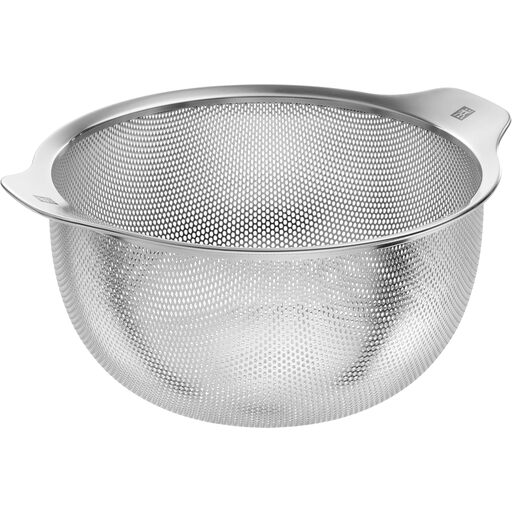
Why This Fits Their Persona: Ideal for families or home cooks who want a single, high-quality tool for the most common tasks, like draining pasta for several people or washing large quantities of salad. A robust all-purpose workhorse.
Made from 18/10 stainless steel with seamless construction to prevent rust and loose parts. The wide base ensures maximum stability in the sink, avoiding the issue of wobbly strainers.
Large diameter (24 cm) for family-sized portions. Integrated, wide handles for secure transport. Perforated design for rapid water drainage.
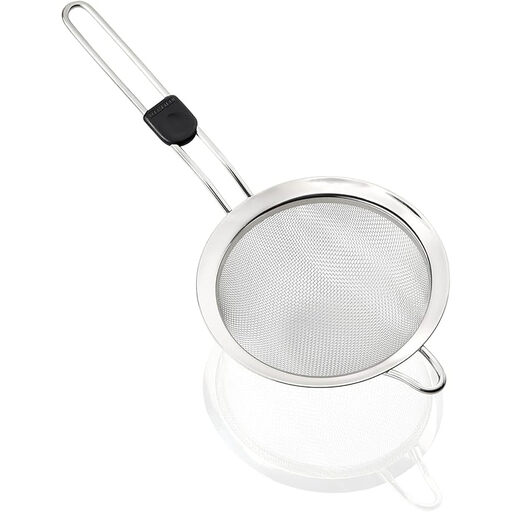
Why This Fits Their Persona: Perfect for anyone who bakes regularly or prepares fine sauces. If you need a reliable flour sifter or fine-mesh strainer that delivers precise results and feels comfortable to hold, this is the one for you.
The fine wire mesh is specifically designed for delicate ingredients, solving the problem of unsuitable mesh sizes. Its high-quality stainless steel construction prevents rust formation.
Ergonomic handle with a thumb rest for comfortable use. Convenient hanging loop for easy storage. Fine mesh (1.5 mm) for powdered sugar and flour.
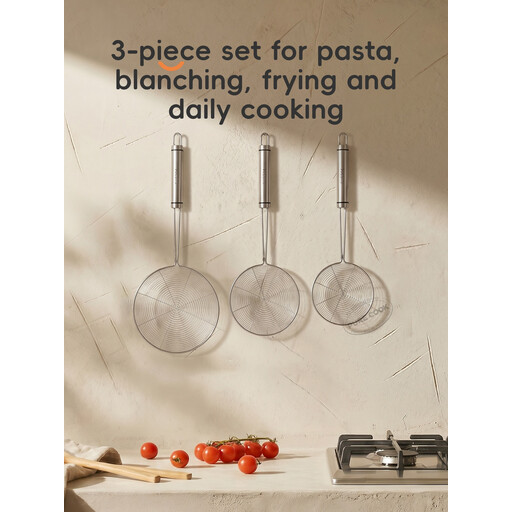
Why This Fits Their Persona: For ambitious cooks who need the right tool for every job. Ideal for deep-frying, blanching, or for fondue and hot pot, where specialized skimmers are required. A complete sieve set for maximum flexibility.
The one-piece forged construction from 304 stainless steel is extremely durable and has no welded seams where rust or dirt can accumulate. This prevents the typical weak points found in cheaper models.
Set of three sizes for various applications. Thickened, tightly woven mesh for fast draining without losing ingredients. Heat-resistant and safe for use in hot oil or boiling water.
We have compiled a complete, up-to-date list of products that fully meet these strict selection criteria and safety regulations.
Most stainless steel sieves are dishwasher-safe. However, with a very fine mesh, small particles can get stuck. In this case, cleaning by hand with a brush and warm, soapy water is more effective. It's important to dry the sieve thoroughly after cleaning to prevent water spots and potential corrosion on any lower-quality areas.
These designations indicate the composition of the steel alloy. "18/10" means the steel contains 18% chromium and 10% nickel. 304 stainless steel is an equivalent standard classification. This high percentage of chromium and nickel makes the material particularly resistant to rust, stains, and food acids, making it a safe and durable choice for kitchen utensils.
A medium-sized, all-purpose sieve can handle many tasks. However, for optimal results, a specialized set is often the better choice. A coarse-mesh colander is unbeatable for pasta and vegetables, while a fine sieve is essential for baking ingredients and clarifying liquids. Investing in a small set with different sizes and mesh types pays off through greater efficiency and better cooking results.