
Lieferung heute & morgen

Qualitätsgarantie

Willkommens-Angebote freischalten: KOSTENLOSE Lieferung | Bis zu 80 % RABATT | Kostenlose 30-Tage-JoyPlus-Testphase
App herunterladen
A good stainless steel kitchen sieve is an unsung hero in any kitchen. It serves as a flour sifter for baking, a colander for pasta, or a strainer for washing fruit. However, buying one is often more problematic than you'd think. Many models that look sturdy quickly turn out to be a poor investment. Before you choose a new sieve, you should be aware of the typical weak points that often only become apparent after a few weeks of use.
As a Joybuy Product Recommendation Officer, I analyse product data to provide you with objective, practical guidance. This guide focuses on the three most common flaws in stainless steel sieves and shows you which technical features to look for to make a durable and functional choice.
The 3 most common flaws of budget-friendly kitchen sieves:
To avoid these problems, a close look at the product specifications is essential. Three parameters are of particular importance.
The term "stainless steel" alone is not a reliable quality indicator. Look for more precise information about the steel alloy, which can often be found in the product details.
A sieve's functionality is determined by its mesh. The mesh size dictates its intended use.
Regardless of the size, the mesh must be stable and firmly attached to the frame. A double-woven or reinforced mesh is more resistant to deformation.
A robust construction is evident in the details. Check the connection between the handle and the sieve basket. Riveted joints are often more durable than simple spot welds. An extra hook or loop on the opposite edge of the sieve is practical for resting the strainer securely on pots or bowls, freeing up your hands.
Based on these objective criteria, we have compiled a selection of products suitable for different user profiles and use cases.
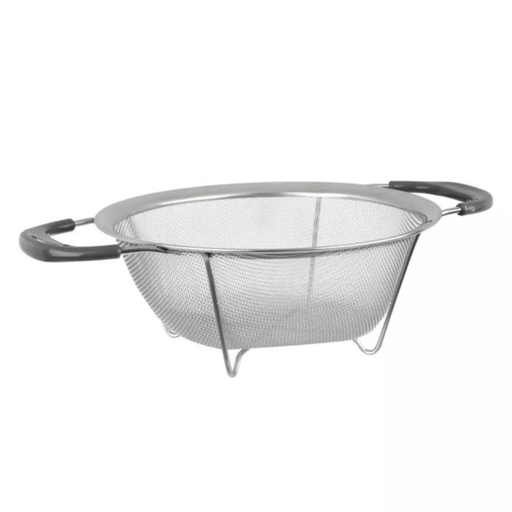
Why it's a great fit: With a 22 cm diameter, this sieve is large enough for family-sized portions of pasta or washing salad. It's a practical all-rounder for the most common kitchen tasks.
According to the manufacturer, the mesh is made of 316 stainless steel, an alloy with very high corrosion resistance. This minimises the risk of rust, even with frequent dishwasher cleaning.
Generous diameter for versatile applications and dishwasher-safe for easy cleaning.
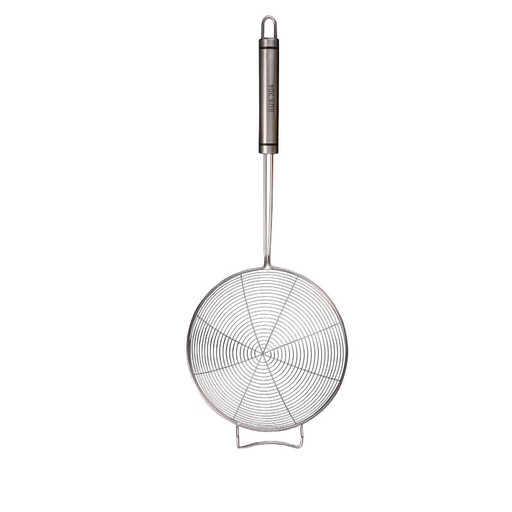
Why it's a great fit: The compact 15 cm size allows for controlled sifting of flour directly into a bowl or precisely dusting cakes with powdered sugar. Ideal for home bakers.
The 304 stainless steel construction and solid frame workmanship prevent the handle from bending. The fine mesh is securely encased, which simplifies cleaning.
A convenient size for precision work and a fine sifting result, made from proven, food-grade stainless steel.
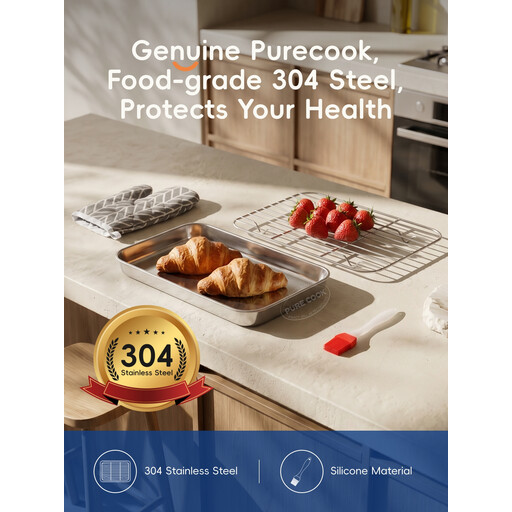
Why it's a great fit: This 2-piece set is more than just a sieve. It serves as a draining rack for fried foods, a cooling rack for baked goods, or for draining vegetables. A multifunctional solution for cooks who value efficiency.
Both the rack and the tray are made from robust 304 stainless steel. This ensures dimensional stability even under heat and prevents rust, a common problem with thin baking sheets.
Combined functionality as a draining rack and cooling rack, which saves space and is highly versatile.
We have compiled a complete, up-to-date list of products that fully meet these strict selection criteria and safety standards.
For high resistance in the dishwasher, you should look for products made from 18/10 stainless steel (Type 304) or 316 stainless steel. These alloys are specifically designed to withstand corrosion from water, heat, and harsh detergents. Cheaper, unspecified types of stainless steel are more prone to developing surface rust.
The key is to clean it immediately after use, before food particles can dry. Rinse the sieve under running water, ideally from the back, to push particles out of the mesh. For stubborn residue, soak it in warm, soapy water and use a soft brush. Many high-quality stainless steel sieves are also dishwasher-safe, which greatly simplifies cleaning.
A flour sifter typically has a very fine wire mesh designed to loosen and aerate flour and other dry ingredients. A strainer (or food mill, often cone-shaped, known as a "chinois"), is usually more robustly built with a slightly coarser but very sturdy mesh. It is used to push soft foods like berries or tomatoes through the mesh (to purée or "pass" them) to remove seeds and skins. Modern, versatile household sieves can often perform both tasks satisfactorily.