
Lieferung heute & morgen

Qualitätsgarantie

Willkommens-Angebote freischalten: KOSTENLOSE Lieferung | Bis zu 80 % RABATT | Kostenlose 30-Tage-JoyPlus-Testphase
App herunterladen
A stainless steel kitchen sieve is a staple in many British homes, but it’s often chosen based only on its diameter or price. That can leave you with a kitchen tool that’s not quite right for the job: a colander that’s too small may overflow, a sieve with large holes may let rice through, and a poorly made sieve could bend the first time you use it with a heavy load.
This buying guide explains what home cooks, families and professional kitchen users should look for. We focus on material, capacity, hole or mesh design, handles and cleaning.
The term stainless steel doesn’t automatically tell you the exact alloy or how well a product is made. For everyday use, details such as 18/10 stainless steel or 304 stainless steel are more helpful. They indicate the grade of material used, but you should still check the edges, handles and joins.
The finish matters too. A smooth, non-porous inner surface is generally easier to clean than a design with hard-to-reach joins.
A 24 cm colander is handy for larger quantities of pasta or vegetables. But it’s unnecessarily large for a small portion of berries, tea or flour. A vegetable sieve, rice sieve or tea strainer should suit both the quantity and the food you’re preparing.
Key things to consider include:
A dishwasher-safe sieve can make cleaning easier. However, high temperatures and strong detergents may affect the finish over time on coated or polished models, or those made partly from plastic. Always follow the manufacturer’s care instructions.
For stainless steel, soft sponges and mild detergents are usually the safest choice. Steel wool and abrasive powders can leave scratches. After washing, dry the sieve thoroughly, especially around handle fixings and folded edges.
When choosing a stainless steel kitchen sieve, look for clear information about the material. Some product descriptions specify 18/10 stainless steel, while others state 304 stainless steel or 18/8. Both refer to stainless steel alloys containing a significant proportion of chromium and nickel.
You should also check the following:
If you plan to use it with boiling water, the entire product should be suitable for that purpose. A colander with a plastic frame may have different temperature recommendations from one made entirely of stainless steel.
Larger models with a wide rim or stable base are a good choice for family-sized portions. The Zwilling Stainless Steel Kitchen Strainer for Pasta, 24 cm is described as having a 24 cm diameter, side handles and a raised base. This means it can rest on a suitable surface while you drain larger quantities.
Compact models are better for individual portions or small ingredients. A sieve with handles can be held directly over a bowl or saucepan, but you’ll need to take care when handling hot liquids.
A colander with larger holes is suitable for pasta, potatoes and larger pieces of vegetables. For flour, icing sugar, tea or fine liquids, you’ll need a fine-mesh sieve. The product description should clearly state whether it has a perforated body, wire mesh or fine filter mesh.
A flour sieve or tea strainer won’t necessarily be a suitable substitute for a colander. Smaller holes hold back finer particles, but may drain more slowly when you’re handling larger quantities.
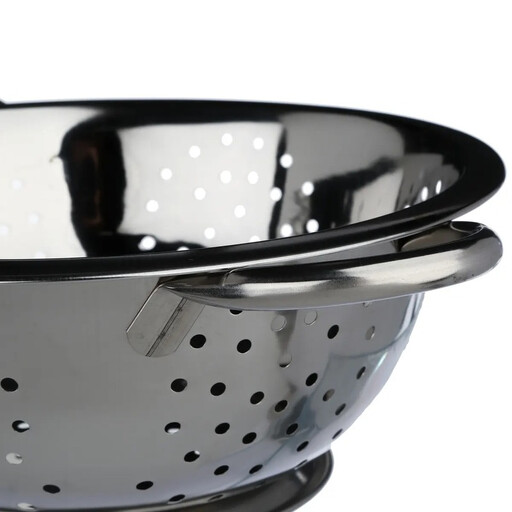
Why it suits this type of user: With a 24 cm diameter and a 2.2-litre capacity, this colander is suitable for everyday tasks such as draining pasta, washing vegetables and rinsing fruit.
The stated size and capacity make it easier to choose than relying on the product photo alone.
24 cm diameter, 2.2-litre capacity and stainless steel construction, according to the product details.
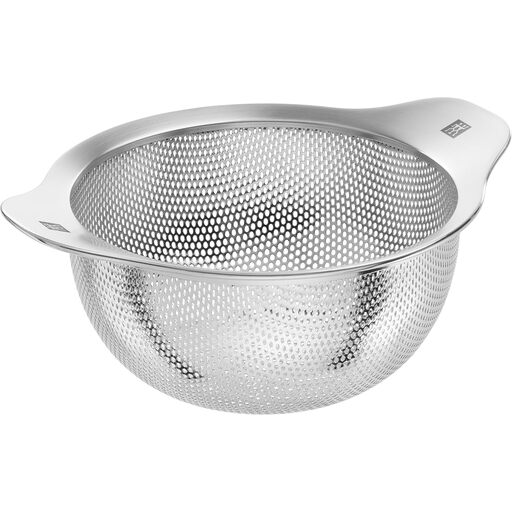
Why it suits this type of user: According to the product description, this 16 cm model combines 18/10 stainless steel construction with two handles, a flat base and a stackable design.
The specific material details and stable base help you avoid vague descriptions that lack technical information.
18/10 stainless steel, two stainless steel handles, a 16 cm diameter and dishwasher-safe, according to the manufacturer.

Why it suits this type of user: This expandable sink strainer is designed to fit sinks of different widths and has a capacity of 3.6 litres, according to the product details.
The adjustable length reduces the risk of buying a sieve that won’t sit securely across your sink.
Expandable design, 3.6-litre capacity and a stated length of 53.5 cm.
We’ve put together a complete, regularly updated list of products that meet these strict selection criteria and fully comply with the safety regulations in force in the EU.
For individual portions, 14 to 18 cm is often enough. Families and frequent users often choose 22 to 27 cm. The key is whether the sieve fits in your sink, over a bowl and in your available storage space.
A colander usually has larger holes to drain water quickly. A fine-mesh sieve catches smaller particles and is better suited to flour, tea, sauces or fine ingredients. One model can do both jobs only if the hole size and intended use are a good match.
Many stainless steel models are dishwasher-safe according to their product details. However, handwashing may be recommended for products with wooden handles, plastic frames or special finishes. Check the care instructions before buying and before the first wash.