
Lieferung heute & morgen

Qualitätsgarantie

Willkommens-Angebote freischalten: KOSTENLOSE Lieferung | Bis zu 80 % RABATT | Kostenlose 30-Tage-JoyPlus-Testphase
App herunterladen
A stainless steel sieve is a staple in many UK kitchens – for draining pasta, rinsing rice and vegetables, or baking. Even so, product descriptions do not always make it easy to choose the right one. A compact fine-mesh kitchen sieve can be ideal for filtering, but is unsuitable for large portions. A roomy colander drains liquids quickly, yet may not reliably hold back fine flour or fruit pulp.
Before buying, you should therefore focus less on general marketing claims and more on material, mesh size, diameter, handle and cleaning.
The description ‘fine sieve’ is of limited value without a measurement in millimetres. Flour, icing sugar and soya milk require a closely woven mesh. When rinsing fruit or rice, however, larger or perforated openings are often more practical because water drains away faster.
If a specific opening size is stated, it is easier to assess whether the sieve is suitable. For example, the Leifheit kitchen sieve has a stated 1.5 mm mesh opening. If this information is missing, product images, technical specifications and the intended use should be considered together.
A large pasta colander needs enough space over the sink and in the kitchen drawer. For a single portion of berries or vegetables, on the other hand, a capacity of several litres is unnecessary. Conversely, a small kitchen sieve with handle can quickly overflow when preparing family-sized portions.
You should therefore consider the specific workflow:
A stainless steel kitchen sieve is generally easy to clean. With combinations of stainless steel mesh and plastic frames, you should also check the temperature guidance. A product may be described as dishwasher-safe, while repeated high-temperature cycles can put greater long-term strain on the plastic.
Thorough drying after cleaning is advisable. Abrasive cleaners, wire wool and hard brushes can damage the surface or sieve mesh.
Stainless steel is easy to care for, retains its shape and is well suited to everyday kitchen use. Stated 304 or 316 stainless steel variants refer to specific material specifications, but they do not replace checking the workmanship, edges and handle connection.
The following details are particularly relevant for everyday use:
A stainless steel strainer with a closely woven mesh is more suitable for liquids, flour and fine ingredients. A perforated draining basket is designed for rice, vegetables and pasta. The two designs should not simply be treated as interchangeable.
Mesh size determines which ingredients are retained. A tightly woven mesh is useful for a flour sieve or a sieve for soya milk. It can hold back suspended matter, pieces of peel and coarser particles. With a juice sieve, the right degree of fineness depends on whether you want to retain the fruit pulp.
For pasta and vegetables, evenly distributed drainage holes are usually more practical than very fine wire mesh. A sieve that is too fine can drain more slowly with starchy foods and may be harder to clean.
A sieve with a stand can be positioned over a bowl, while a long handle makes one-handed use easier. Extendable models can adapt to sinks of different sizes. In smaller kitchens, a compact design or hanging loop can make storage easier.
You should also check whether the sieve is intended for hot liquids. Plastic parts may be more sensitive to heat. With metal mesh, handle the edges carefully and do not subject the sieve to knives or heavy, hard objects.
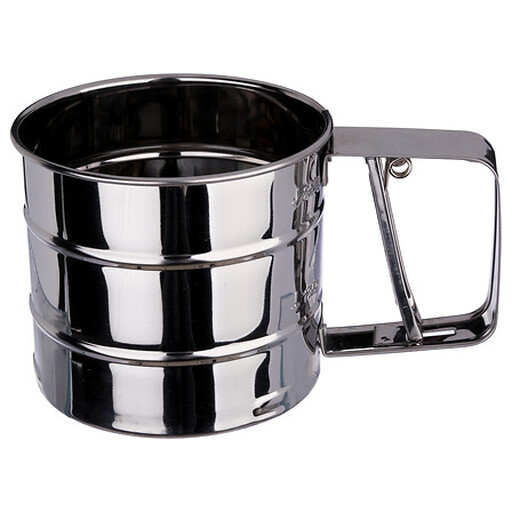
Why this product suits this profile: This compact sieve is designed for everyday tasks such as sifting flour, straining, dusting with icing sugar and rinsing small ingredients.
The compact dimensions of 10.3 × 9.3 × 15.5 cm make the size choice clear and avoid using an oversized sieve for small quantities.
Stainless steel construction, handy format and, according to the product information, suitability for straining, sifting and rinsing small ingredients.
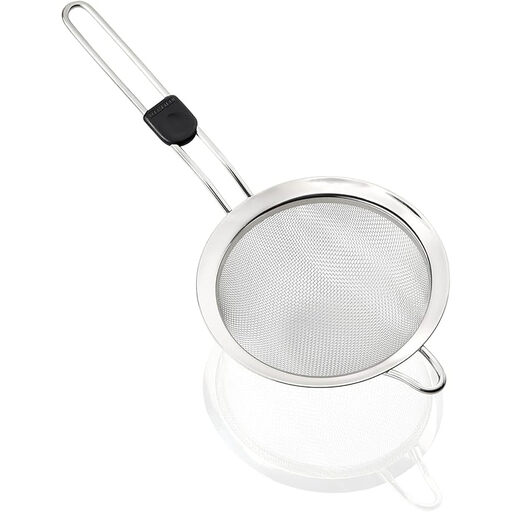
Why this product suits this profile: Keen bakers get a 16 cm sieve with a stated 1.5 mm mesh opening, thumb rest and hanging loop.
The specific mesh measurement replaces the vague description ‘fine’ and helps you choose a sieve for flour, icing sugar and similar dry ingredients.
Stated stainless steel construction, dishwasher-safe, ergonomic thumb rest and hanging loop.
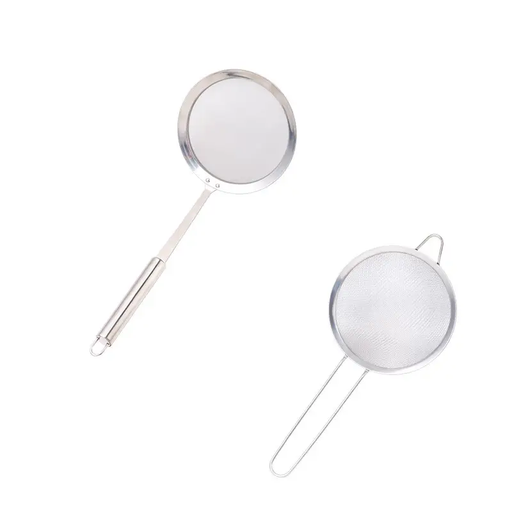
Why this product suits this profile: This two-piece set is for users who want to combine a fine sieve for soya milk, flour and other liquids with a skimmer.
Its intended use for fine filtering is more clearly defined than that of a coarsely perforated colander, which may allow fine particles through.
304 stainless steel according to the product description, plus a two-piece set for fine filtering and skimming foam.

Why this product suits this profile: This extendable sieve is designed for larger quantities of pasta, vegetables or fried foods and can be used over sinks of different widths.
The 3.6-litre capacity and dimensions of 53.5 × 24.7 × 10.5 cm make its suitability for large portions clear.
Extendable design, ergonomic handle and stated suitability for rinsing, draining and filtering.
Wash a new stainless steel sieve with warm water and a mild cleaning product before using it for the first time. Then remove all residue and dry the product thoroughly. With fine mesh, do not use a hard object to push ingredients through, as this can deform the mesh.
A sieve is not automatically suitable for naked flames, hobs or the microwave. With plastic frames, hot liquids should only be added in accordance with the manufacturer’s instructions. Before use, check that the handle, frame and mesh are undamaged.
We have compiled a complete, regularly updated list of products that fully meet these strict selection criteria and the safety regulations applicable in the EU.
For flour and icing sugar, a fine sieve with closely woven mesh is a sensible choice. A specific mesh measurement, such as 1.5 mm, makes choosing easier. A coarsely perforated pasta colander is less suitable for this task.
Many models are described as dishwasher-safe in the product information. Nevertheless, check the material combinations and care instructions. With plastic frames, hand washing with a mild cleaning product can help maintain their shape over the long term. Stainless steel parts should be dried thoroughly after washing.
Its service life depends on the material, workmanship and care. Even mesh, sturdy connections, smooth edges and avoiding wire wool all help reduce typical sources of wear. If the sieve is not overloaded and is stored dry, it can remain useful for a long time with regular kitchen use.