
Lieferung heute & morgen

Qualitätsgarantie

Willkommens-Angebote freischalten: KOSTENLOSE Lieferung | Bis zu 80 % RABATT | Kostenlose 30-Tage-JoyPlus-Testphase
App herunterladen
A stainless steel kitchen strainer is a staple in many British households – for draining pasta, washing fruit and vegetables, or filtering liquids. However, not every stainless steel strainer delivers good results in everyday use. Fine mesh can clog quickly, a handle that is too short becomes impractical when handling hot food, and a large pasta colander may not fit in your existing sink.
Before buying, it is therefore worth looking at the actual product specifications rather than relying on general advertising claims.
Stainless steel is a broad term. For your purchasing decision, details such as 18/10 stainless steel, 304 stainless steel, material thickness, mesh type and build quality are more informative than simply being described as “rust-resistant”. Stainless steel can also suffer surface and mesh damage if cleaned incorrectly, exposed to moisture for long periods or subjected to mechanical damage.
Suitability for food contact is also important. For example, the ZWILLING Z-Cut is stated to comply with EU food-contact regulations. Specific manufacturer information like this is more useful than vague quality claims.
A small fine-mesh sieve is suitable for flour, juices or smaller ingredients, but is not very practical for draining a large saucepan of pasta. Conversely, a 3.6-litre colander takes up more storage space and may be unnecessarily large for individual portions.
Before buying, check:
A dishwasher-safe strainer reduces the cleaning effort, but it does not replace checking the item after the wash cycle. For some models, manufacturers recommend removing the product after the programme and drying it thoroughly. Residue can become trapped in very fine mesh. A damaged strainer or loose handle should no longer be used for food preparation.
For regular use, clear material specifications are relevant. The ZWILLING Z-Cut is made from 18/10 stainless steel and has a satin finish. The BJ model is specified as being made from 304 stainless steel. These details help with comparisons, but alone they say nothing about mesh stability, handle attachment or service life with daily use.
Look for neatly finished edges, a secure connection between the handle and strainer body, and evenly formed holes or mesh. Sharp or bent areas can make the strainer more difficult to handle.
Mesh fineness determines what is retained:
A fine-mesh kitchen strainer is not automatically a good substitute for a traditional colander. For flour or icing sugar, a compact stainless steel sieve is usually more practical; for pasta, you are more likely to need a sturdy, larger strainer body.
A long handle keeps your hands further away from hot water and steam. This is particularly useful with a skimmer, straining spoon or hotpot strainer. A non-slip or heat-insulated handle can make the utensil easier to use, but it does not make the entire tool heatproof. Always follow the manufacturer’s instructions.
For smaller kitchens, an extendable kitchen strainer can be a space-saving solution. Compare its dimensions when fully extended with the width of your sink. An extendable model is only practical if the support surfaces remain stable and the strainer does not move under the weight of the food.
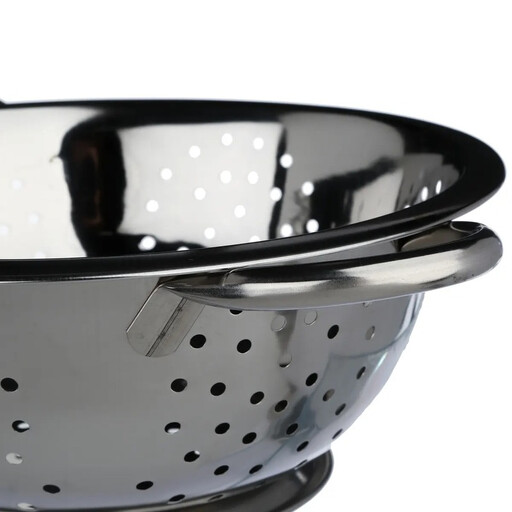
Why this product suits this profile: With a 24 cm strainer body and a capacity of 2.2 litres, it covers everyday household tasks such as preparing pasta, fruit, vegetables and dry ingredients.
The stated dimensions and capacity make the choice clearer than an unspecified size description.
24 cm diameter, 12 cm height and stainless steel construction; suitable for a range of everyday food preparation tasks.
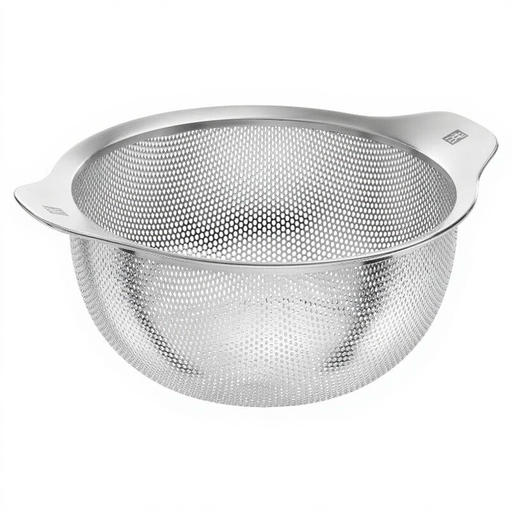
Why this product suits this profile: This 20 cm model combines 18/10 stainless steel, a satin finish and a flat base for controlled food preparation.
The product specifications clearly state the material, diameter, base and dishwasher suitability.
18/10 stainless steel, 20 cm diameter, flat base and dishwasher-safe according to the product description.
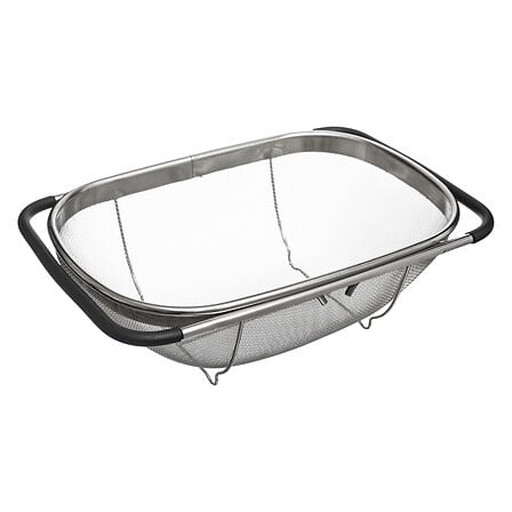
Why this product suits this profile: This extendable stainless steel strainer is designed for larger quantities and sinks of different widths.
The maximum length of 53.5 cm and the extendable design are specified, so you can compare them with your sink before buying.
3.6-litre capacity, extendable design, stainless steel construction and ergonomic handle.
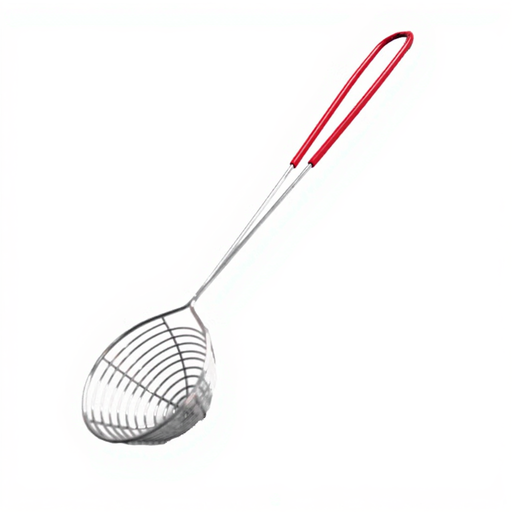
Why this product suits this profile: This 29 cm kitchen utensil with a 7 cm strainer head is designed for hotpot, fondue and removing individual ingredients.
The long handle increases the distance between your hand and the hot liquid; the small strainer head is intended for removing individual portions.
29 cm overall length, 7 cm diameter and fine-mesh stainless steel basket with coated handle.
We have put together a complete, regularly updated list of products that fully meet these strict selection criteria and the safety regulations applicable in the EU.
Rinse a new stainless steel strainer thoroughly before using it for the first time. After straining, remove coarse residue straight away so that it does not dry into the mesh. A soft brush can be helpful for fine-mesh sieves. Abrasive cleaners and harsh scouring pads can scratch satin finishes or deform fine mesh.
Even if a model is described as dishwasher-safe, you should dry it thoroughly afterwards. A dry strainer can be stored more hygienically and is easier to check for damage. Hang models with an integrated hook so that the mesh is not pressed against hard objects.
For individual portions and small ingredients, around 15 to 20 cm is often sufficient. For pasta, salad or larger quantities of vegetables, approximately 22 to 24 cm is more practical. If you regularly drain large quantities, you should also consider the capacity and width of your sink.
No. Stainless steel itself is heat-resistant, but handles, coatings and connections may have different properties. With a straining spoon or hotpot strainer, pay attention to the handle length and safety instructions. A heat-insulated handle does not mean that the entire product is suitable for direct flames or use in a microwave.
Its service life depends on the material thickness, build quality, cleaning method and level of use. A dishwasher-safe strainer can reduce the care required, but it should not be subjected to sharp objects. Regularly check the mesh, edges and handle attachment, and replace the product if you notice any visible damage.