
Lieferung heute & morgen

Qualitätsgarantie

Willkommens-Angebote freischalten: KOSTENLOSE Lieferung | Bis zu 80 % RABATT | Kostenlose 30-Tage-JoyPlus-Testphase
App herunterladen
A stainless steel kitchen strainer is a staple in many British households. It can be used to drain pasta, wash fruit and vegetables, filter liquids or sieve flour. However, models vary considerably in terms of mesh size, capacity, stability and ease of cleaning.
Anyone who focuses only on the diameter or a shiny finish may overlook important details. Three common buying misconceptions occur particularly often:
A stainless steel strainer should be robustly made and should not bend easily during normal use. The marking 18/10 stainless steel refers to an alloy containing approximately 18 per cent chromium and 10 per cent nickel. This material is expressly specified for the Zwilling models mentioned. It is intended for contact with standard foodstuffs and is widely used in kitchen equipment.
The workmanship is important too:
Not every stainless steel strainer is equally suitable for boiling-hot liquids. For products containing plastic components, read the relevant warnings.
For small portions, baking ingredients or straining tea, a compact household strainer with a diameter of around 10 to 16 cm may be sufficient. Anyone who regularly prepares pasta, salad or larger quantities of vegetables will need more capacity.
As a general guide:
A high rim reduces the risk of ingredients falling out while washing or tossing them. A flat base is useful if the strainer needs to stand on the worktop or in a bowl. Side handles and raised feet are helpful when draining heavy portions of pasta.
The mesh size determines which ingredients are retained. A fine flour sieve with openings of, for example, 1.5 mm is suitable for sifting flour, icing sugar or cocoa. A fine sieve can also be useful for rice, delicate herbs or fruit pulp.
A coarsely perforated colander, on the other hand, lets water drain away more quickly and is often more practical as a strainer for draining pasta or potatoes. Before buying, decide what the main task will be:
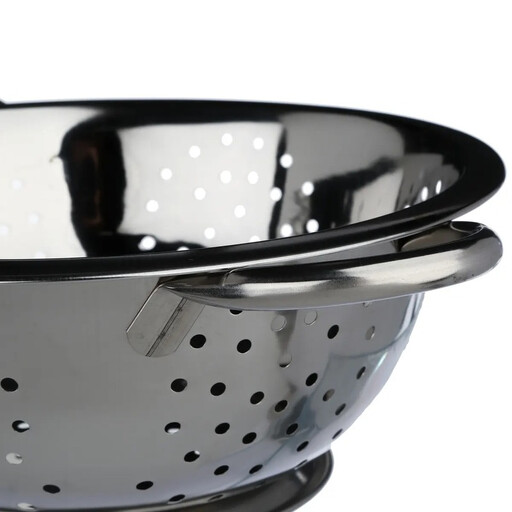
Why this product suits this profile: With a diameter of 24 cm and a capacity of 2.2 litres, this strainer handles everyday household tasks including pasta, vegetables and fruit.
The stated capacity prevents a small strainer from becoming overfilled quickly when handling standard portions.
24 cm diameter, 2.2-litre capacity and a stainless steel body for a wide range of kitchen tasks.
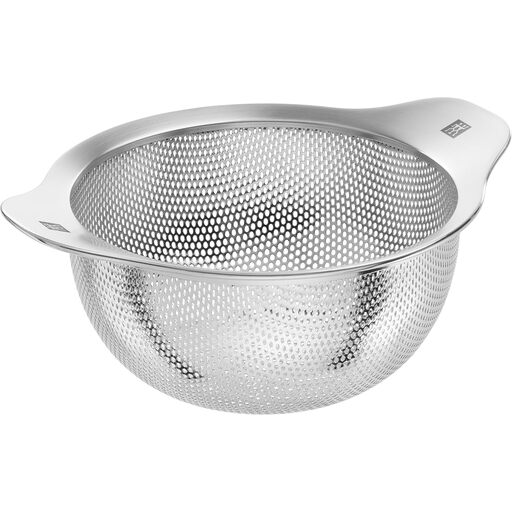
Why this product suits this profile: The 3-in-1 design combines a strainer, colander and bowl. Two stainless steel handles and a flat base make it easier to handle and put down securely.
The stable base and side handles reduce the risk of placing it down insecurely or carrying it with one hand.
18/10 stainless steel, satin finish, 16 cm diameter and stackable sizes of 16, 20 and 24 cm.
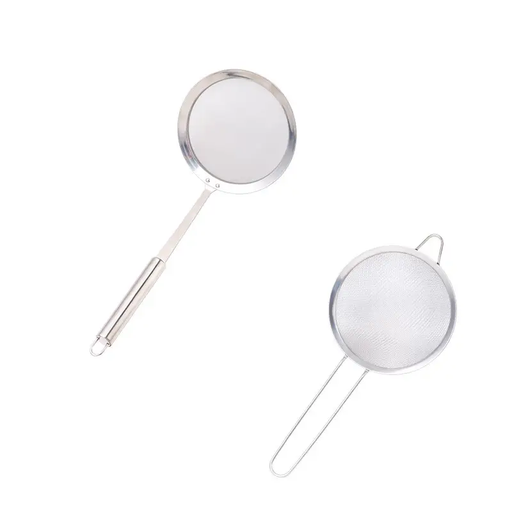
Why this product suits this profile: The two-piece set with fine mesh is designed for users who want to filter liquids and process dry ingredients such as flour.
The fine mesh is clearly designed for filtering and sieving, rather than simply draining larger ingredients.
304 stainless steel and a two-piece set with a filtering function and skimming spoon.
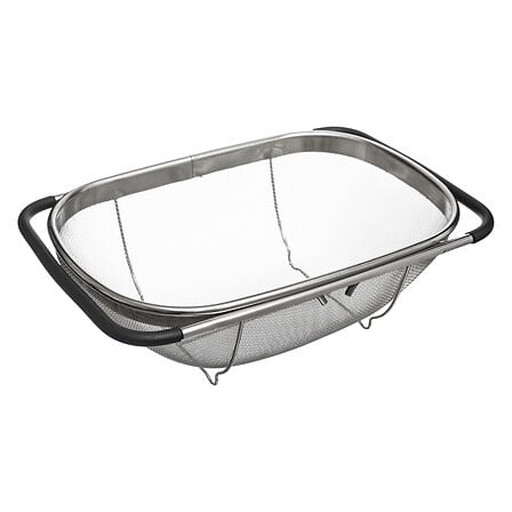
Why this product suits this profile: The extendable design can be used over sinks of different widths and then stored away to save space.
The extendable length of 53.5 cm and 3.6-litre capacity avoid the limitations of a strainer that is too small.
3.6-litre capacity, stainless steel construction and extendable use over sinks of different sizes.
A dishwasher-safe strainer saves time, but you should still follow the manufacturer’s instructions. For stainless steel models:
According to the product information, the Leifheit ProLine kitchen strainer with a diameter of 16 cm features a mesh opening of 1.5 mm, a thumb rest and a hanging loop. It is suitable for cleaning in the dishwasher, but can also be washed by hand to help protect the finish. This design is more practical for flour, icing sugar and baking ingredients than a coarse pasta strainer.
We have put together a complete, regularly updated list of products that fully meet these strict selection criteria and the safety regulations applicable in the EU.
For individual portions or baking ingredients, 10 to 16 cm is often sufficient. A model measuring 20 to 24 cm is more suitable as a pasta strainer, draining strainer or strainer for fruit and vegetables. For large quantities and use over the sink, an extendable strainer with a larger capacity may be a sensible choice.
Many models are described as dishwasher-safe in the product information. Even so, check any combination of materials. On models with plastic frames, intensive hot programmes may affect their service life. Satin-finished stainless steel surfaces often retain their appearance better when cleaned by hand with a soft sponge.
Its service life depends on the material thickness, workmanship and care. A strainer should not be overloaded or exposed to sharp objects, and should be dried after cleaning. Deformed rims, cracked plastic parts or damaged mesh are all reasons to stop using the product.