
Lieferung heute & morgen

Qualitätsgarantie

Willkommens-Angebote freischalten: KOSTENLOSE Lieferung | Bis zu 80 % RABATT | Kostenlose 30-Tage-JoyPlus-Testphase
App herunterladen
A reliable stand mixer can make preparing doughs, creams, and many other dishes significantly easier. Whether for weekly bread baking, elaborate cakes, or quick meal prep, the selection of models is vast and the choice can be difficult. As your Joybuy Product Recommendation Officer, I have analysed the technical specifications and features of various appliances to offer you an objective guide. This guide will help you understand the features relevant to your individual needs in the kitchen.
To find the right appliance, you should consider a few technical aspects. The following points provide a basis for your decision.
The motor's power, measured in watts, is a key indicator of a machine's ability to handle heavy doughs. A high-performance mixer for regular bread baking benefits from a higher wattage (e.g., 1000 watts or more). For lighter tasks like whipping cream or mixing cake batter, models with lower wattage may be sufficient. However, the drive system is also crucial. A planetary mixing action ensures that the mixing attachment not only rotates on its own axis but also moves along the edge of the bowl. This guarantees a thorough and even mixing of all ingredients.
The size of the stand mixer's bowl should match your cooking and baking habits. For a single or two-person household, a bowl with a volume of 4 to 5 litres is often enough. If you regularly bake for a larger family or process large quantities of dough, a model with a 6 or 7-litre capacity is a worthwhile option. Stainless steel mixing bowls are robust, durable, odour- and flavour-neutral, and usually dishwasher-safe, which simplifies cleaning.
The range of functions determines the versatility of your stand mixer. Standard equipment usually includes a whisk (for egg whites and cream), a flat beater (for cake batter and creams), and a dough hook (for yeast and bread dough). This turns the appliance into a multifunctional mixer and dough maker. Some models offer additional features that streamline the workflow, such as a stand mixer with a scale. This allows you to weigh ingredients directly in the bowl, saving time and extra dishes.
Based on the criteria mentioned above, we have compiled a selection of models that cater to different needs and applications.

Why This Model Stands Out: This model offers a solid set of features for beginners and home bakers. With a 5-litre bowl and ten speed settings, it covers the most common applications in the home kitchen.
Advantages:
Who is this model for? Ideal for beginners and occasional bakers looking for a functional and affordable stand mixer for baking to handle basic tasks like making cakes or preparing pizza dough.
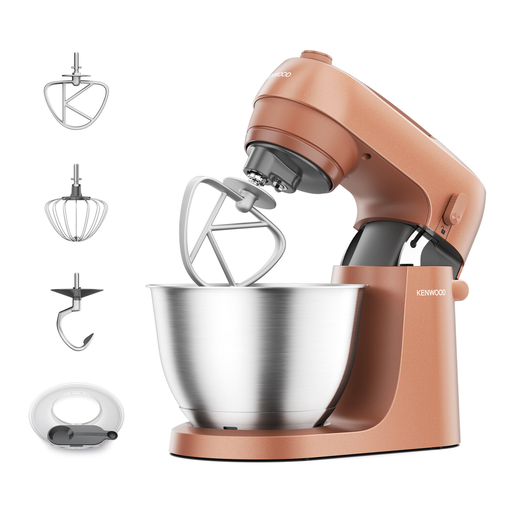
Why This Model Stands Out: The Kenwood Go combines a compact design with the brand's proven quality. At just 30 cm tall, it is specifically designed for kitchens with limited space, without compromising on performance.
Advantages:
Who is this model for? Perfect for users with limited kitchen space who still want the performance and durability of a Kenwood stand mixer.

Why This Model Stands Out: This high-end model is aimed at ambitious home bakers. The integrated scale, powerful motor, and large bowl capacity make it a versatile tool for demanding projects.
Advantages:
Who is this model for? Suitable for passionate and experienced home bakers who value high performance, large capacity, and advanced features like a stand mixer with a scale.
The models presented here are just a snapshot of the available possibilities. Every kitchen and every cook has different requirements. If you want to compare other appliances with different specifications or in other price ranges, you will surely find the right product in our broader selection.
Explore our full range of stand mixers and blenders to compare more models.
1. How many watts should a good stand mixer have? The required wattage depends on the intended use. For kneading heavy bread doughs, models with 1000 watts or more are advantageous as they provide the necessary power without overheating. For lighter tasks like mixing cake batter or whipping cream, 400 to 800 watts is often sufficient, especially if the appliance has an efficient gear system.
2. What is the difference between a dough mixer and a standard mixer? Historically, a dough mixer was specifically for heavy doughs, and a standard mixer was for more liquid mixtures. However, modern stand mixers are multifunctional appliances that perform both tasks. By using different attachments (dough hook, flat beater, whisk), they function as a kneading, mixing, or dough machine as needed.
3. Is a stand mixer with an integrated scale worth it? An integrated scale primarily offers convenience and efficiency. It allows you to weigh ingredients directly in the mixing bowl or in an attachment. This saves time, reduces the number of kitchen utensils needed, and minimises the subsequent cleanup. For users who value precision and a streamlined workflow, this feature can provide significant added value.