
Lieferung heute & morgen

Qualitätsgarantie

Willkommens-Angebote freischalten: KOSTENLOSE Lieferung | Bis zu 80 % RABATT | Kostenlose 30-Tage-JoyPlus-Testphase
App herunterladen
A stand mixer for baking should knead dough, mix ingredients and whisk cream or egg whites without taking up unnecessary space or becoming impractical after a short time. Many product descriptions, however, focus on high wattage, lots of attachments and large bowls. Taken on their own, these details don’t tell you much.
What matters is whether the motor, bowl, attachments and controls suit the recipes you make. This guide will help home bakers, families and keen cooks avoid common buying mistakes and find the right stand mixer with a bowl.
A high rated or peak power output doesn’t automatically mean a mixer can handle every type of dough for long periods. For yeast dough, factors such as power transmission, gearbox design, maximum dough capacity and recommended running time are also important.
Look for specific details such as:
Start a stand mixer with a dough hook at a low speed when working with firm dough. The permitted quantity in the instruction manual matters more than a wattage figure on its own on the product page.
A stand mixer with a stainless steel bowl, for example with a capacity of 5 or 6 litres, offers plenty of room for many household recipes. However, that doesn’t mean you can fill the bowl to the brim with dough. You need to allow for the flour, liquid and the dough expanding as it’s kneaded.
A 4-litre bowl may be more practical for smaller households. Families and people who regularly make bread, pizza and cakes may prefer a capacity of 5 to 7 litres. Also check whether the manufacturer gives a separate figure for the maximum dough capacity.
A multifunction stand mixer may come with a mincer, blender, scales or other attachments. You might not need all of them in everyday use. Extra attachments also need storage space and create more washing-up.
Three tools are essential for most baking recipes:
An electric stand mixer with several speed settings should be suitable for both gentle mixing and powerful kneading. A pulse function can be useful for short, controlled bursts. With delicate mixtures, it’s best to start slowly to stop flour and liquid from splashing out of the bowl.
Noise levels should be given in decibels (dB). It’s also important to know the conditions under which they were measured, such as at a distance of one metre. The stated figure gives you a point of comparison, but it can’t guarantee how noisy the mixer will seem in every kitchen.
A stainless steel bowl is rust-resistant, doesn’t retain much odour and is suitable for a wide range of kitchen tasks. A sturdy handle, secure locking mechanism and splash guard are useful features. For a stand mixer for bread and cakes, the bowl should be large enough for your usual recipes, but not so large that it struggles to reach smaller quantities.
Suction feet or other non-slip features can help stop the mixer moving on a smooth worktop. A sturdy housing is particularly important when kneading firm dough.
Look for:
Before cleaning, switch off the appliance and unplug it from the mains. Never immerse the motor housing in water.

Why it suits this type of user: The 6-litre stainless steel bowl, six speed settings and three standard attachments cover the everyday baking needs of most households.
The product details specify the bowl size, speed settings, pulse function and a noise level of 68–72 dB measured at a distance of one metre.
450-watt DC motor, 6-litre bowl, dough hook, whisk, beater, plus overload and overheating protection.

Why it suits this type of user: This mixer is designed for people who bake often and value an integrated scale and the option of using different bowl sizes.
Rather than focusing only on motor power, this model provides specific details about its features: 1,200 watts, variable speed, EasyWeigh scales, and 7- and 5-litre bowls.
Two stainless steel bowls, integrated scales, K-beater, balloon whisk, dough hook, Flexi beater and splash guard.

Why it suits this type of user: If you want to blend or mince meat as well as bake, this combines a stand mixer, mincer and mixing system.
The attachments are clearly listed: mincer, blender jug, dough hook, beater and whisk. This makes it easier to check whether you’ll use everything before buying.
6.5-quart bowl, 1,300-watt maximum power, eight speed settings with pulse function and a safety cut-off when the head is raised.
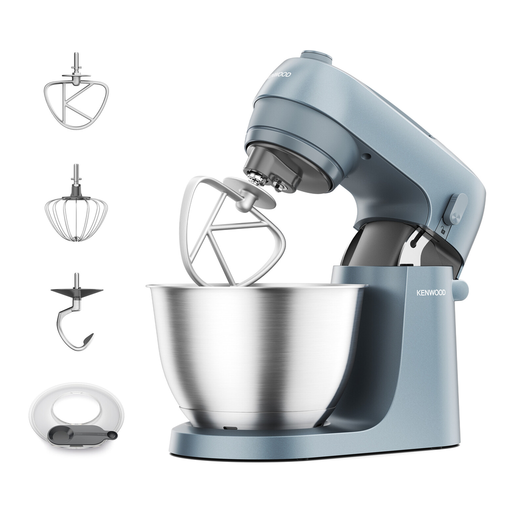
Why it suits this type of user: Its 30 cm height and 4-litre bowl make it a good fit for homes with limited worktop or storage space.
The compact design comes with clear capacity figures: a 4-litre bowl, capacity for up to 1.5 kg of bread dough and six speed settings.
800-watt motor, stainless steel bowl, K-beater, whisk, dough hook, pulse function and parts listed as dishwasher-safe in the product details.
We’ve put together a complete, regularly updated list of products that meet these strict selection criteria and fully comply with the safety regulations in force in the EU.
A 4-litre bowl is often enough for smaller households. Families and anyone who regularly makes bread or pizza dough may prefer a bowl with a capacity of 5 to 7 litres. The manufacturer’s stated maximum dough capacity is what matters—not just the bowl volume.
Look for a stable base, a suitable dough hook, sufficient torque at low speed and documented overload protection. Wattage alone says little about how well a mixer will handle firm dough. The instruction manual should also specify the maximum quantity and running time.
Consumption depends on the motor power, the speed setting and how long you use the mixer for. A 1,200-watt stand mixer used for a short time may consume less energy than a lower-powered model that runs for considerably longer. For a realistic estimate, multiply the power in kilowatts by the running time in hours and the current electricity price.