
Lieferung heute & morgen

Qualitätsgarantie

Willkommens-Angebote freischalten: KOSTENLOSE Lieferung | Bis zu 80 % RABATT | Kostenlose 30-Tage-JoyPlus-Testphase
App herunterladen
A stand mixer with a bowl should knead, mix and whisk reliably. In practice, though, motor power and price aren’t the only things that can lead to a disappointing purchase. Buyers often choose a machine based on headline figures, even when the bowl capacity, maximum dough quantity or attachments aren’t right for their household.
Three common buying mistakes are worth avoiding if you love baking, cook for a family or are an ambitious home cook:
A bowl of around 4 to 5 litres is often enough for a smaller household. Families and anyone who regularly makes bread, pizza and cakes may benefit from a 5.5-litre stand mixer or a 6-litre stand mixer.
The maximum dough quantity is what really matters. Heavy yeast dough puts more strain on the motor than a light cake mixture. According to the product specifications, the Ariete 1589 Moderna’s 5.5-litre bowl can hold up to 1.40 kg of dough. This figure tells you more than the bowl capacity alone.
Look for:
An electric stand mixer needs more power to knead bread and pizza dough than to whisk egg whites. Wattage is therefore only a guide for comparing models. According to the product specifications, the AUCMA 5L has a 400-watt motor, while the Ariete 1589 Moderna is listed at 1,600 watts. These figures shouldn’t be treated as a measure of quality on their own, as the design, gearing and permitted operating time also matter.
Useful features include:
When working with heavy dough, don’t run the machine for longer than the instructions recommend. You may need to let it cool between kneading sessions.
A stand mixer with a dough hook is designed for yeast, bread and pizza dough. The whisk is ideal for cream, egg whites and light creams. Use a flat beater or mixing beater for cake mixtures, buttercream and soft doughs.
Other things to look for:
A blender, on the other hand, is primarily designed for liquids, smoothies, soups and puréed ingredients. It won’t replace a dough mixer if you regularly make bread or pizza.

Why it suits this type of user: According to the product specifications, this model has a 5-litre stainless steel bowl, ten speed settings plus a pulse function, and three basic attachments for mixing, kneading and whisking.
The product specifications give details of the bowl size, motor power, speed settings and overheat protection. This means you can check key points of comparison before buying.
5-litre capacity, ten speed settings, pulse function, dough hook, whisk and mixing beater.
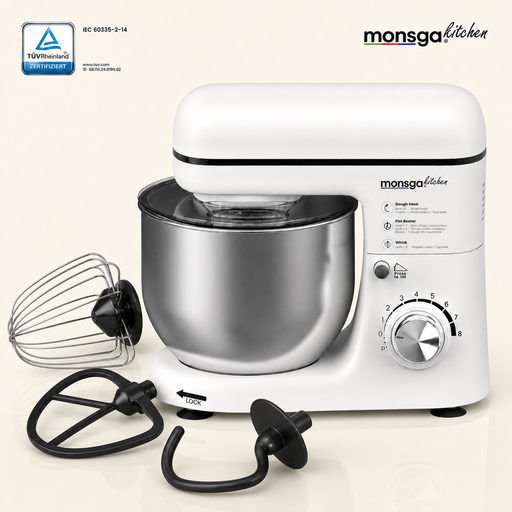
Why it suits this type of user: According to the product specifications, this machine combines a 6-litre stainless steel bowl, eight speed settings, a tilt head and coated attachments.
The recommended usable capacity of 5.0 litres is listed alongside the total capacity of 6.0 litres. This makes it easier to plan realistic quantities for larger batches of dough.
6-litre stainless steel bowl, eight speed settings, overload protection and attachments that are listed as dishwasher-safe.
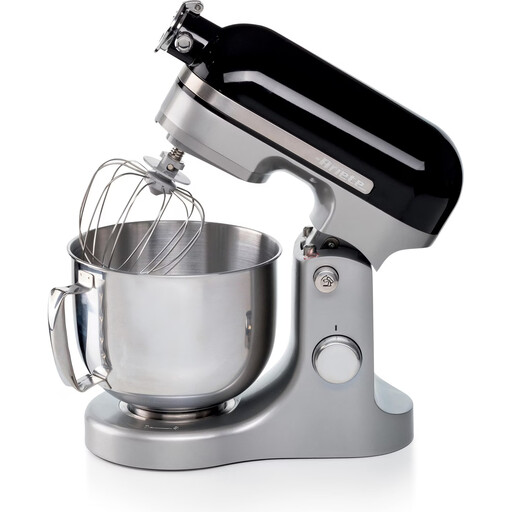
Why it suits this type of user: According to the product specifications, this machine has 1,600 watts of power, eleven speed settings, a 5.5-litre bowl and a stated dough capacity of 1.40 kg.
The maximum dough quantity is clearly stated. The machine also comes with three attachments, eleven speed settings and a splash guard.
Stated dough capacity of 1.40 kg, 5.5-litre stainless steel bowl, dough hook, whisk and flat beater.

Why it suits this type of user: According to the product specifications, this model has a 6.5-quart stainless steel bowl, ten speed settings, three attachments and a tilt head.
The box contents specifically list a dough hook, whisk and mixing beater. According to the product specifications, non-slip suction cups help keep the machine stable.
Large bowl, ten speed settings, three standard attachments and a stated noise level of under 60 dB.
We’ve put together a complete, regularly updated list of products that meet these strict selection criteria and fully comply with the safety regulations applicable in the EU.
Look for a stable base, a dough hook, a low speed setting and a clearly stated maximum dough quantity. A large bowl alone doesn’t tell you much about how well the machine can handle kneading. The instructions should also include guidance on operating time and cooling breaks.
Noise levels depend on the motor, gearing, attachment and speed setting. Product specifications give examples ranging from 70 dB for the Ariete 1588/03 to up to 75 dB for the Monsga SM100 and under 60 dB for the Honinst machine. These figures are only comparable if they were measured under similar conditions.
Use the machine within the specified quantities and speed settings. Clean the bowl and attachments as soon as you’ve finished, keep water away from the motor housing, and only change attachments when the machine is switched off and unplugged. When working with heavy dough, take breaks between batches to help prevent overheating.