
Lieferung heute & morgen

Qualitätsgarantie

Willkommens-Angebote freischalten: KOSTENLOSE Lieferung | Bis zu 80 % RABATT | Kostenlose 30-Tage-JoyPlus-Testphase
App herunterladen
A stand mixer with a bowl can take much of the hard work out of baking and cooking. However, models vary considerably in motor power, usable capacity, attachments and cleaning requirements. If you focus only on a high wattage or an especially large bowl, you could end up with a machine that doesn’t suit your kitchen or your day-to-day needs.
Before buying, home bakers and families should watch out for these three common pitfalls:
For bread, pizza and cake dough, a stand mixer for baking needs enough torque at low speed. A dough mixer with a dough hook should therefore offer more than a wide range of speed settings: it should also have a stable power transmission system and a secure base.
Look out for the following details:
A stand mixer with a stainless steel bowl is a practical choice for many households, as stainless steel is hard-wearing, tends not to retain odours and is generally easy to clean. Check the recommended usable capacity as well as the stated bowl capacity.
A 6-litre stand mixer may suit families and larger batches of baking. According to the product specifications, the monsga SM100 has a maximum capacity of 6.0 litres, but a usable capacity of up to 5.0 litres is recommended. This shows why it’s important to distinguish between total capacity and working capacity.
A more compact appliance may be enough for smaller kitchens. According to the manufacturer, the Kenwood Go has a 4-litre bowl and is 30 centimetres tall. Before buying, consider the space it will take up on your worktop, the clearance beneath your wall cupboards and its weight.
A stand mixer with a dough hook should include at least a dough hook, a mixing or flat beater and a whisk. A splash guard makes it easier to work with liquid ingredients. If you bake frequently, removable, dishwasher-safe attachments are a useful feature.
Treat noise ratings as a guide. The monsga SM100 is listed in the product description as having a noise level below 75 dB. The supplier lists the Honinst model at less than 60 dB. These figures can only be compared directly if the measurement conditions and measurement point are the same.
Multifunction appliances come with extra bowls and blades. These give you more ways to use the appliance, but need additional storage space and require care when cleaning the cutting attachments.
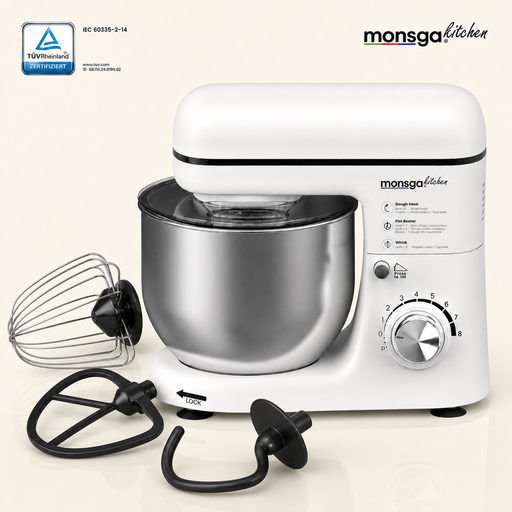
Why it suits this type of user: The 6.0-litre stainless steel bowl, eight speed settings and three basic attachments cover everyday tasks such as mixing, whisking and kneading.
The recommended usable capacity of 5.0 litres is given alongside the total bowl capacity, helping you get a more realistic idea of how much it can hold.
304 stainless steel bowl, eight speed settings, dough hook, flat beater and whisk; the attachments are listed as dishwasher-safe in the product specifications.
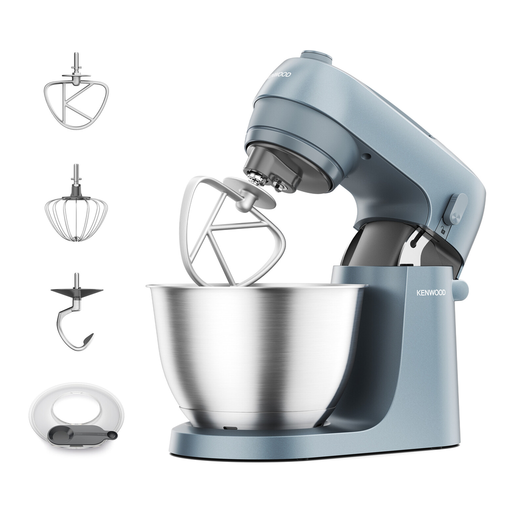
Why it suits this type of user: Its compact metal body, 4-litre bowl and front-facing controls will appeal to anyone who values a space-saving design and clearly specified features.
The manufacturer gives specific maximum quantities for bread and cake dough. This makes it easier to plan, rather than relying on a wattage figure alone.
Rated at 800 watts, with six speed settings and a pulse function, a 4-litre stainless steel bowl, K-beater, whisk and dough hook.

Why it suits this type of user: As well as mixing and kneading, the product description lists a mincer and a blending jug. This could mean you need fewer separate kitchen appliances.
The instructions specify a maximum continuous running time of six minutes. Following this guidance helps you avoid overestimating how long the appliance can run under sustained load.
6-quart stainless steel bowl, eight speed settings plus a pulse function, with attachments for blending, chopping, kneading and whisking.
We’ve put together a comprehensive, regularly updated list of products that meet these strict selection criteria and fully comply with the safety regulations in force in the EU.
If you regularly make cakes, pizza or bread for several people, a bowl with a total capacity of around 5 to 6 litres could be a good choice. The recommended usable capacity is still what matters most. Smaller households can often manage with 4 litres, especially if you want a machine that takes up little space.
There’s no reliable way to give a general lifespan. It depends on the materials, how often you use it, the type of dough you make, how you clean it and whether you follow the recommended operating times. Overloading the appliance, using quantities that are too large or fitting the wrong attachments can put extra strain on the motor and drive components.
Electricity consumption depends on the appliance’s actual power draw and how long it runs. As a rough guide, multiply the power in kilowatts by the usage time in hours. A 0.6-kilowatt appliance running for ten minutes would use around 0.1 kilowatt-hours. Actual power consumption may vary depending on the load.