
Lieferung heute & morgen

Qualitätsgarantie

Willkommens-Angebote freischalten: KOSTENLOSE Lieferung | Bis zu 80 % RABATT | Kostenlose 30-Tage-JoyPlus-Testphase
App herunterladen
A stand mixer with a bowl can make kneading, mixing and whisking much easier than using a hand mixer. But for home bakers, families and keen cooks, a high wattage rating isn’t the only thing that matters. Bowl capacity, attachments, stability, speed settings and the recommended dough capacity are all important.
If you focus only on a high power rating or a particularly long list of accessories, it’s easy to miss important limitations. The following points will help you choose the right stand mixer for baking bread, cakes, pizza and pastries, as well as for everyday cooking.
A high motor rating may sound impressive, but on its own it says little about how well a machine handles heavy yeast dough. The design, gearing, cooling system and manufacturer’s recommended maximum capacity all matter too.
When choosing a dough mixer, check whether the manufacturer gives specific guidance on operating times and dough quantities. A machine shouldn’t be overloaded for long periods. Some models switch the motor off automatically if it overheats, but this doesn’t replace the need to follow the instructions.
A 6-litre bowl doesn’t automatically mean you can mix 6 litres of dough. The usable capacity depends on the ingredients, the consistency of the dough and the attachment you use. For example, the Monsga model lists a maximum bowl capacity of 6.0 litres and a recommended capacity of 5.0 litres.
A very large bowl can also be impractical for small quantities if the whisk or beater can’t reach the ingredients properly. On the other hand, a stand mixer with a 6-litre bowl can be a good choice for family-sized portions and regular bread-making.
A whisk, dough hook and flat beater cover many everyday tasks. Extra attachments are only useful if you’ll actually use them and they’re easy to clean.
A stand mixer with a dough hook is suitable for many firm doughs, while a stand mixer with a whisk is useful for whisking egg whites, cream and lighter mixtures. A blender or hand blender, by contrast, is designed for soups, sauces and puréed ingredients, and won’t replace a traditional mixer for larger quantities of dough.
Stainless steel is a practical choice for a mixing bowl used every day, as it’s low in odour and relatively easy to care for. The machines featured here include bowls made from 304 stainless steel. Choose a capacity that suits the size of your household:
Also check for a splash guard and a handle, and whether the bowl can be removed.
Several speed settings give you more control over mixing. Low speeds are useful for combining flour and liquid, medium speeds for mixing, and higher speeds for whisking. A pulse function can be used for short, controlled bursts.
Depending on the model, AUCMA offers six or ten speed settings, plus a pulse function. Honinst lists ten settings, while Monsga lists eight. These figures are easy to compare, but they don’t tell you on their own how well a machine will suit every recipe.
Kneading heavy dough can make a machine vibrate. Non-slip feet or suction cups can help stop it moving on a clean, dry, level worktop. A tilting motor head also makes it easier to change the bowl and attachments.
Noise levels are often given in decibels. According to the product information, certain AUCMA models reach up to 72 or 75 dB, while Honinst lists less than 60 dB. Always consider these figures in the context of the stated measurement conditions.
For easier cleaning, check whether the bowl and attachments can be removed and whether the manufacturer says they’re dishwasher-safe. Never immerse the motor housing in water.

Why it suits this type of user: The 5-litre stainless steel bowl, ten speed settings and three standard attachments cover everyday baking tasks in the home.
The product information gives specific details on its 5-litre capacity, ten speed settings and pulse function, as well as its overheat and overload protection, rather than relying on vague claims about performance.
400-watt motor, 5-litre bowl, dough hook, whisk, beater and four suction cups, according to the product description.
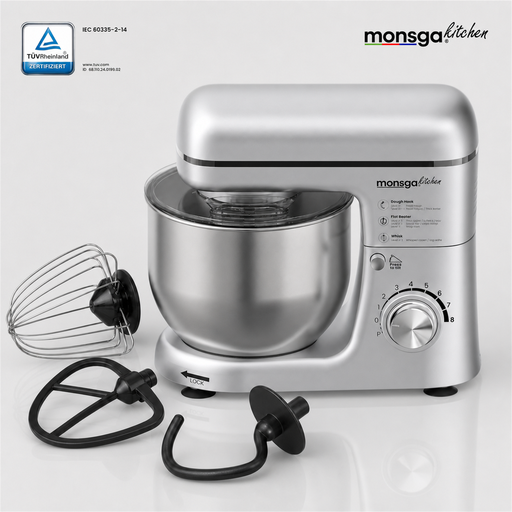
Why it suits this type of user: Its 6-litre bowl, eight speed settings and coated mixing tools make it a good fit for anyone who pays close attention to materials and ease of cleaning.
The product information distinguishes the recommended filling capacity of 5.0 litres from the maximum bowl capacity of 6.0 litres.
600 watts rated power according to the description, eight speed settings, stainless steel bowl and dishwasher-safe attachments.

Why it suits this type of user: According to the product information, the larger bowl is suitable for family-sized portions and bread, pizza and cake doughs.
The product information gives specific figures for bowl capacity, noise levels of 68–72 dB measured within one metre, and six speed settings plus a pulse function.
6-litre stainless steel bowl, 450-watt DC motor, three attachments, splash guard and four suction cups, according to the product description.
We’ve put together a complete, regularly updated list of products that meet these strict selection criteria and fully comply with the safety regulations in force in the EU.
A 4- to 5-litre bowl is often enough for occasional baking. Families and anyone who regularly makes bread, pizza or several cakes may prefer a 6-litre bowl. The recommended filling capacity given by the manufacturer matters just as much as the bowl’s overall volume.
It depends on what you’ll use it for. A stand mixer works hands-free and usually comes with a larger bowl and a dough hook. A hand mixer takes up less storage space and is handy for smaller quantities. Models such as the Philips 5000 Series HR3745/00 have an automatically rotating 3-litre bowl, according to the product information, and can be a space-saving alternative.
There’s no reliable one-size-fits-all answer. Lifespan depends on how often you use the machine, the quantity of dough, how long it runs, and how it’s cleaned and stored. Following the instructions, avoiding overloading the motor and fitting the attachments correctly can help reduce the usual wear and tear of household use.