
Lieferung heute & morgen

Qualitätsgarantie

Willkommens-Angebote freischalten: KOSTENLOSE Lieferung | Bis zu 80 % RABATT | Kostenlose 30-Tage-JoyPlus-Testphase
App herunterladen
A stand mixer with a bowl can make kneading, mixing and whisking much easier at home. However, a glossy housing, a high wattage and numerous speed settings do not automatically guarantee the right choice. For home bakers, families and private households, the key factors are the actual dough capacity, stability, attachments and cleaning effort.
The stated power rating is not always directly comparable. Some manufacturers quote maximum or so-called peak power, while others specify rated power. For example, the Monsga SM100 is listed with 1000 Watt Peak Power, but 600 Watt rated power. For heavy yeast doughs, it is therefore also important to check whether the mixer has a suitable dough hook, a sturdy construction and a recommended maximum dough quantity.
A 6-litre bowl does not necessarily hold 6 litres of dough or ingredients. The manufacturer of the Monsga SM100 recommends using up to 5 litres from its 6-litre total capacity. The Ariete 1589 Moderna specifies a maximum dough quantity of 1.40 kg. These figures are more useful when choosing a stand mixer for kneading than capacity alone.
A stand mixer with a dough hook is more versatile when a whisk and flat beater are also included. A splash guard helps reduce splashes of flour and liquid. At the same time, the bowl and attachments should be easy to remove. As a practical guideline, look for dishwasher-safe parts, while the motor housing should generally only be cleaned with a damp cloth.
A stand mixer with a stainless steel bowl is practical for regular preparation, as stainless steel is odour-neutral and hard-wearing. For households with several people, 5 to 6 litres provide ample room for bread, pizza, cakes and creams. Nevertheless, check the maximum dough quantity and whether the bowl has a handle.
For a baking stand mixer, low speeds are useful for kneading, while higher settings are ideal for whisking. Between six and eleven speed settings allow for more precise adjustment. A pulse function can provide short, powerful bursts. However, wattage should always be considered alongside the intended use: an electric stand mixer for heavy bread doughs requires a different design from a machine intended for occasional cake-batter mixing.
Suction feet, a high net weight and a stable base prevent the machine from moving around while kneading. Noise-level figures should be treated as guidelines, as the measuring distance, attachment and dough consistency all affect operating noise. The models covered here quote figures of up to 75 dB, while the Honinst model has a manufacturer rating of under 60 dB.
A blender in the traditional sense is often designed for liquid ingredients and blending containers. A dough mixer or stand mixer with a bowl, on the other hand, works with dough hooks, beaters and whisks. If you regularly prepare bread and cakes, pay attention to the specific design and the attachments supplied.
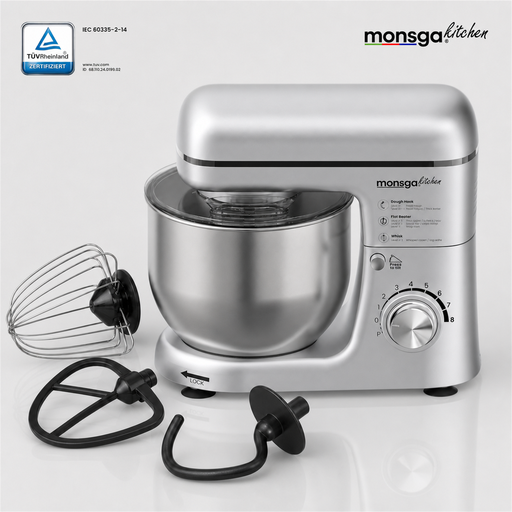
Why this product suits this profile: With a 6.0-litre stainless steel bowl, eight speed settings and three attachments, it covers typical household tasks – from cake batter to yeast dough.
The recommended 5.0-litre usage level is stated alongside the total capacity. This gives you a more realistic idea of the usable filling capacity. The manufacturer also highlights overload protection.
304 stainless steel bowl, eight settings, tilting motor head and dishwasher-safe attachments.
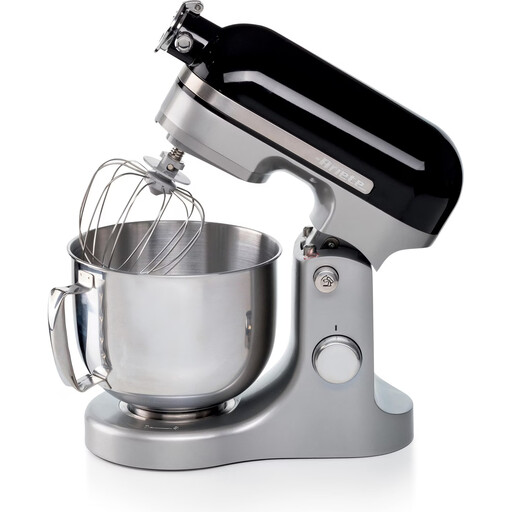
Why this product suits this profile: If you regularly prepare bread, pizza, cakes and whipped cream, this stand mixer offers a 5.5-litre bowl, 11 settings and a specified dough capacity.
The manufacturer’s stated maximum dough quantity of 1.40 kg helps prevent you from equating bowl size with actual kneading performance.
1600 Watt, 11 speed settings, 3D planetary mixing system and dishwasher-safe parts.

Why this product suits this profile: This model is aimed at households that regularly prepare different doughs and mixtures and prefer a larger stainless steel bowl.
The specifications state a 6.0-litre bowl capacity, 450 Watt motor power, 68 to 72 dB and overload and overheating protection. This allows you to assess the space required, noise level and safety features before buying.
Six speed settings plus pulse function, 6-litre stainless steel bowl, dough hook, whisk and beater.
We have put together a complete, regularly updated list of products that fully meet these strict selection criteria and the safety regulations applicable in the EU.
For regular baking, 5 to 6 litres provide a practical capacity. The maximum dough quantity specified by the manufacturer remains the crucial factor, as some of the bowl’s capacity needs to remain free to allow the dough to move and rise.
A stand mixer designed for kneading can handle typical household quantities of bread, pizza and cake dough. However, it cannot necessarily replace a machine intended for very large production volumes. Follow the recommended operating times and filling quantities in the instruction manual.
Consumption depends on the rated power and operating time. A machine with 600 Watt rated power would theoretically use 0.6 kWh after one hour of operation; when kneading or whisking for a short period, actual consumption will be correspondingly lower. The wattage alone is therefore not the deciding factor – what matters is choosing a power rating suited to your intended use.