
Lieferung heute & morgen

Qualitätsgarantie

Willkommens-Angebote freischalten: KOSTENLOSE Lieferung | Bis zu 80 % RABATT | Kostenlose 30-Tage-JoyPlus-Testphase
App herunterladen
A stand mixer with a bowl can take care of much of the manual work involved in baking bread, making pizza dough and cakes, or whipping cream. However, models vary considerably in terms of motor power, usable capacity, accessories and cleaning. If you focus only on a high wattage or large capacity, you may end up with an appliance that is too noisy, unstable or awkward to clean in everyday use.
This guide explains which specifications really matter and which product features hobby bakers, families and private households should check before buying.
The power rating is only meaningful when it is clear whether it refers to rated power or peak power. For example, the monsga SM100 is listed with 1000 watts peak power but 600 watts rated power. For heavy doughs, the figure alone is therefore not decisive. The gearbox, overload protection, torque and the maximum dough quantity specified by the manufacturer are equally important.
A 1000-watt stand mixer may be suitable for family recipes, while another model with a lower rated power may also perform perfectly well. Consumers should therefore assess the technical specifications in relation to how they intend to use the appliance.
A 6-litre stand mixer offers plenty of room for larger portions. However, the maximum fill level should not be confused with the recommended working capacity. The monsga SM100 has a bowl capacity of 6.0 litres, while the recommended usable capacity is 5.0 litres according to the product information.
The permitted dough quantity is also important when making yeast dough. An overfilled bowl can make mixing more difficult and put greater strain on the motor. If you regularly prepare bread or pizza, look specifically for the maximum dough capacity.
A stand mixer with a dough hook, whisk and flat beater can handle a range of tasks:
Before buying, you should also check which parts are dishwasher-safe. The motor housing should never be immersed in water. Stainless steel parts should be dried thoroughly after cleaning to prevent water marks and deposits.
A stand mixer for kneading needs a controlled low to medium speed for firm dough. Multiple settings allow for finer adjustment: slow mixing, even kneading and fast whisking can be separated more effectively.
For example, a stand mixer with 8 speed settings offers more adjustment options than a model with six speeds. However, this does not automatically mean greater kneading performance. The combination of motor, planetary mixing system, overload protection and recommended quantities is what matters when choosing a model.
A 4-litre bowl may be more space-efficient for a small household. Families or people who often prepare several portions may benefit from capacities of 5.5 to 7 litres. A stainless steel bowl is durable, resistant to odours and easy to clean on many models.
Also consider the amount of space available. Appliances with a large bowl often require more room in terms of both depth and height. A tilting head can make operation easier, but it should be securely locked during use.
The term “quiet stand mixer” should be assessed using a specific decibel rating. However, figures from different manufacturers can only be compared directly if the measuring distance, speed and test conditions are the same. The monsga SM100 is listed at under 75 dB, while the Honinst model is stated as below 60 dB. These values come from the respective product details and should not be interpreted as results from a standardised laboratory test.
Suction feet, non-slip bases and a sturdy housing help to limit movement on the worktop. Even so, when handling heavy doughs, the appliance should be placed on a level, dry and sufficiently strong surface.

Why this product suits this profile: The 6-litre stainless steel bowl and six speed settings cover typical household tasks such as mixing, whisking and kneading.
The product details specify 450 watts, six speeds, a pulse function, overheating and overload protection, as well as a splash guard. This makes it easier to assess the equipment than by looking at wattage in isolation.
Suction feet, tilting head and three standard attachments; the stated noise level is 68 to 72 dB within one metre.

Why this product suits this profile: Anyone who bakes frequently and prefers precise workflows gets an integrated scale, two bowls with capacities of 7 and 5 litres, and several attachments.
The DuoBowl solution reduces the need for additional bowls. According to the product description, the scale is built directly into the machine, allowing ingredients to be weighed straight into the bowl.
1200-watt ChefMotor, variable speed control, Flexi beater, dough hook, whisk and splash guard.
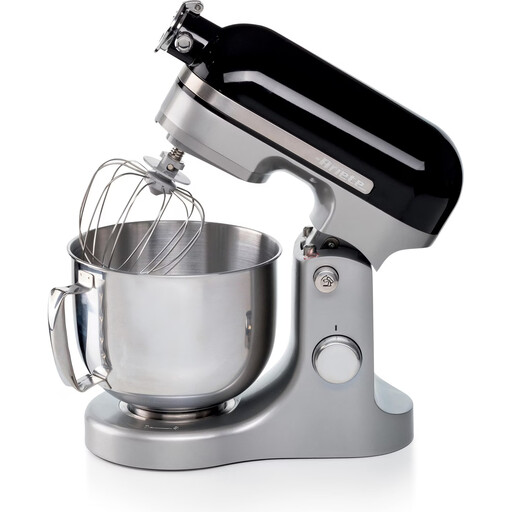
Why this product suits this profile: For regular bread and pizza dough kneading, as well as larger batches of baking, it offers a 5.5-litre bowl and a stated dough capacity of 1.40 kg.
The specified dough capacity prevents the bowl size from being used as the only benchmark. The manufacturer also states a maximum bowl quantity and recommends taking breaks during extended use.
1600 watts, 11 speed settings, 3D planetary mixing system, five accessories and dishwasher-safe parts according to the product description.
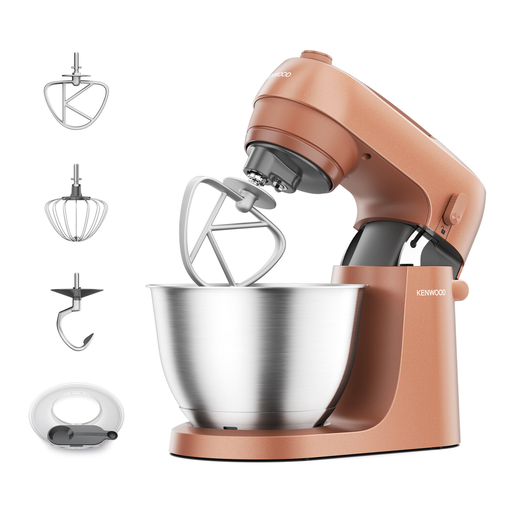
Why this product suits this profile: Its compact design, with a 4-litre bowl and a height of 30 cm, is suitable for households with limited worktop and storage space.
The appliance height and footprint are clearly specified. This allows you to check before buying whether the mixer will fit beneath wall units or inside a cupboard.
800-watt motor, six speeds plus pulse function, 4-litre stainless steel bowl and dishwasher-safe parts according to the product details.
For firm doughs, a low to medium setting is generally recommended. Ingredients should be added gradually, and the maximum dough quantity stated in the instructions should be observed. Before changing the dough hook, whisk or beater, the appliance must be switched off and unplugged from the mains.
A splash guard reduces mess, but it does not replace cleaning after every use. Look for:
Power consumption depends on rated power, running time and the recipe. A higher wattage does not automatically lead to higher costs with every use, but it can affect consumption when the appliance is used frequently or for long periods. For a realistic estimate, the actual operating time matters more than the advertised figure alone.
We have put together a complete, regularly updated list of products that fully meet these strict selection criteria and the safety regulations applicable in the EU.
For occasional baking, 4 litres is often sufficient. Families and regular hobby bakers may prefer 5.5 to 7 litres. The permitted dough quantity is also important, as a large bowl is not automatically designed for large quantities of firm dough.
For bread and pizza, a sturdy dough hook, a low speed setting, sufficient torque and a stable base are important. Before buying, check the stated maximum dough capacity and follow the recommended breaks in the user manual.
A splash guard helps keep flour and liquid inside the bowl. The bowl and accessories should be removable and, where approved by the manufacturer, dishwasher-safe. Clean the motor housing only with a slightly damp cloth, then dry it.