
Lieferung heute & morgen

Qualitätsgarantie

Willkommens-Angebote freischalten: KOSTENLOSE Lieferung | Bis zu 80 % RABATT | Kostenlose 30-Tage-JoyPlus-Testphase
App herunterladen
Choosing a new stand mixer can be a challenge, given the vast array of models, features, and price points. Whether you're baking bread daily, whipping cream, or preparing complex doughs, the right electric kitchen helper saves you time and effort. This guide serves to orient you, presenting a selection of appliances with different specialities to make your purchasing decision easier.
To find the right appliance for your needs, you should consider several technical features and equipment details. The following points provide a basis for your considerations before you buy a stand mixer.
The wattage indicates the motor's power consumption, but it isn't the sole factor determining a machine's effectiveness. A well-engineered 800-watt motor can be more efficient than a poorly designed 1200-watt one. What's more important is how the power is transferred to the mixing tools.
A planetary mixing action is an established standard in this regard. This means the mixing tool not only rotates on its own axis but also moves along the edge of the bowl. This ensures all ingredients are evenly incorporated from the bottom to the sides—a crucial advantage for creating homogeneous doughs and batters.
The capacity of the mixing bowl, measured in litres, should match the size of your household and your cooking habits.
Many models can be expanded with accessories. A stand mixer with a meat grinder, pasta attachments, or a blender attachment can replace several individual appliances, saving space in your kitchen. Before buying, check which accessories are included and what upgrade options are available.
The housing of a mixer is usually made of plastic or metal. Metal housings are generally more durable and provide more stability due to their higher weight, which is particularly advantageous when processing heavy doughs as a dough kneader or dough machine. Suction cup feet on the bottom of the unit also contribute to a secure footing on the work surface.
Here is a selection of models that cater to different needs—from the multi-functional all-rounder to the compact space-saver.

Why it stands out: This model integrates several kitchen appliances into one. With attachments for a meat grinder and blender, it covers a wide range of tasks that go far beyond simple mixing and kneading.
Pros:
Who it's for: For users looking for a versatile all-in-one solution who want to process meat or make smoothies in addition to baking, without needing to purchase multiple appliances.

Why it stands out: The monsga SM100 combines a powerful motor with comparatively quiet operation. According to the manufacturer, the noise level is below 75 decibels, making kitchen work more pleasant.
Pros:
Who it's for: For home cooks and families who need a powerful appliance for regular use but value a quieter kitchen environment.
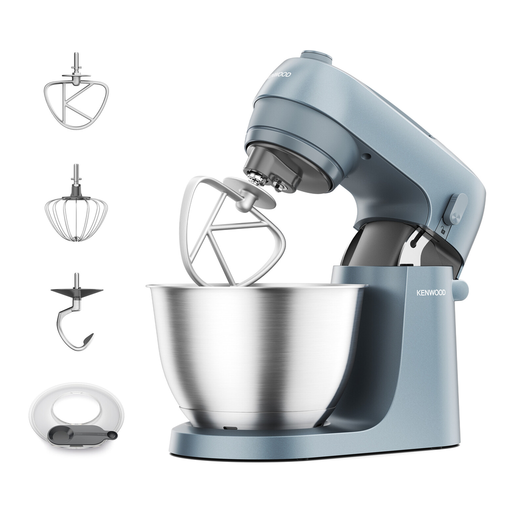
Why it stands out: At a height of just 30 cm, the Kenwood Go is designed to be particularly space-saving. Despite its compact dimensions, it features a robust metal body that promises durability and stability.
Pros:
Who it's for: For users with limited space who don't want to compromise on the quality and stability of a metal body. Ideal for smaller households or as a second appliance.
If the models presented don't exactly match your requirements or if you're looking for more specific accessories, there is a wide range of other appliances and tools that can complement your kitchen setup.
Discover more electric kitchen helpers and accessories in our category for Cake Whisks.
With a planetary mixing system, the mixing tool (e.g., the dough hook) rotates on its own axis while simultaneously moving along the inner edge of the mixing bowl. This dual motion ensures that all ingredients, including those at the edge and bottom of the bowl, are thoroughly incorporated into a homogeneous mixture.
For light batters like sponge or cake mix, motors with lower power are sufficient. However, if you plan to regularly process heavy yeast or bread doughs as a bread making machine, a power rating of 800 watts or more is recommended. In addition to the pure wattage, the quality of the gearbox and the stability of the appliance are crucial for transferring power effectively and safely.
Not every stand mixer is suitable as a dough machine for heavy doughs. Models with low power, a lightweight plastic housing, or without a robust dough hook can reach their limits or become unstable when processing firm dough. Look for sufficient motor power, a high dead weight for stability, and a metal dough hook specifically designed for heavy doughs.