
Lieferung heute & morgen

Qualitätsgarantie

Willkommens-Angebote freischalten: KOSTENLOSE Lieferung | Bis zu 80 % RABATT | Kostenlose 30-Tage-JoyPlus-Testphase
App herunterladen
Choosing the right stand mixer can significantly simplify your cooking and baking. However, the market is flooded with appliances whose marketing promises often create more confusion than clarity. Many buyers invest in a model that doesn't meet their needs or shows defects after a short time. As your Joybuy Product Recommendation Officer, I'll help you identify the crucial features and steer clear of common purchasing traps.
Two widespread problems frequently lead to disappointment:
To make an informed decision, it's essential to focus on the technical fundamentals rather than on exaggerated advertising claims.
Before you decide on a model, you should examine three core aspects. These will determine whether an appliance will be a long-term asset or a short-term frustration.
The raw wattage is only half the story. What's crucial is how the power is transferred to the mixing attachment.
Look for the combination of motor type and a robust metal gearbox, which transfers power reliably and with minimal loss.
Different types of appliances and attachments are relevant depending on your intended use.
The standard accessories for a good stand mixer include a dough hook for heavy doughs, a whisk for egg whites and cream, and a flat beater for cake batter and frostings. Pay attention to material quality: accessories made of stainless steel or with a high-quality Teflon coating are more durable and easier to clean than simple plastic or aluminium parts.
The size of the mixing bowl should suit your household. For a family of four, a capacity of 4.5 to 6 litres is generally sufficient. A bowl that is too small limits the preparation quantity, while an oversized bowl often mixes small quantities inadequately.
Stability is a critical safety feature. A high dead weight and non-slip suction feet prevent the machine from shifting while processing heavy dough. A solid housing made of metal or high-quality ABS plastic also contributes to durability and stability.
Here are some recommendations tailored to specific user profiles that meet the quality criteria mentioned above.
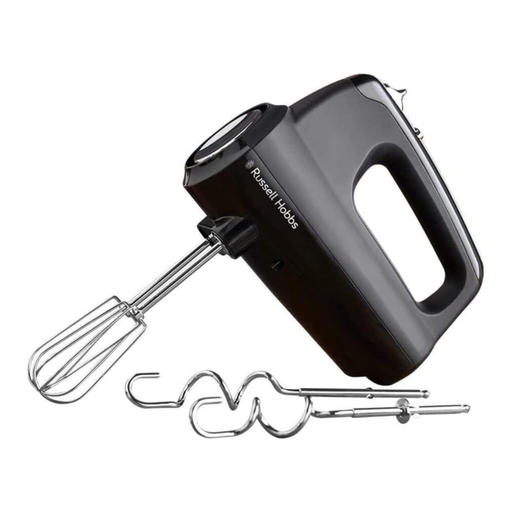
Why This Fits Their Persona: Ideal for anyone needing a compact, ready-to-go mixer for everyday tasks like whipping cream, beating egg whites, or mixing light cake batters. Perfect for smaller kitchens and straightforward storage.
This device avoids the wattage trap by being specifically designed for light to medium tasks with its 350 watts. It doesn't promise performance it can't deliver and focuses on its core competency as a hand mixer.
Five speed settings plus a turbo function offer precise control. The dishwasher-safe chrome beaters and dough hooks are robust and easy to clean.

Why This Fits Their Persona: Perfect for home bakers who regularly prepare bread or pizza dough and need a reliable, high-capacity dough mixer. The planetary mixing action ensures consistent results.
This model relies on a 450W pure copper DC motor that delivers high torque at a low noise level (≤72dB). Strong suction feet on the base effectively prevent the machine from slipping, thus avoiding the unstable construction trap.
The large 6-litre stainless steel bowl is ideal for family-sized portions. The tilt-head design makes it easy to access the bowl and change accessories.
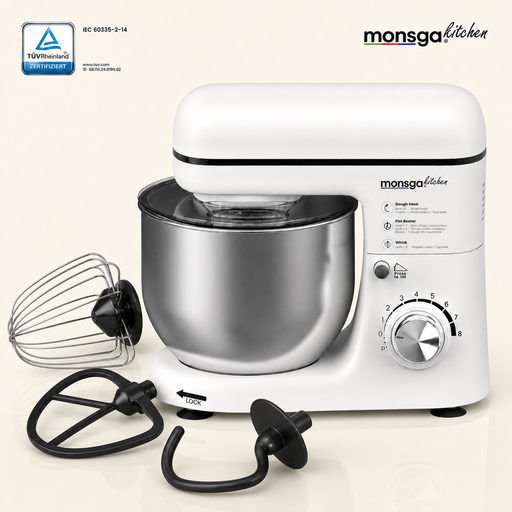
Why This Fits Their Persona: For ambitious cooks and bakers who regularly process large quantities and value powerful, easy-to-clean accessories. The high motor power handles even the most demanding tasks.
This model avoids the low-quality accessory trap by using dough hooks and flat beaters with a Teflon non-stick coating. Dough residue is less likely to stick, which significantly simplifies cleaning and increases durability.
The 1000W motor combined with 8 speed settings provides a high performance reserve. The 6-litre stainless steel bowl with a handle is designed for large families or big baking projects.
We have compiled a complete, up-to-date list of products that fully meet these strict selection criteria and German safety regulations.
1. How many watts does a good stand mixer need? Wattage alone is not the deciding factor. For a hand mixer, 300–400 watts is sufficient. For a stand mixer, the motor type is more important. An efficient DC motor with 400–500 watts can outperform a simple AC motor with 1000 watts. Focus on the combination of the motor, gearbox, and intended use.
2. Can a stand mixer completely replace a hand mixer? For most tasks, yes. A stand mixer can whip, stir, and knead. However, a hand mixer remains unbeatable in terms of flexibility and quick readiness for small quantities or when you need to work in different pots and bowls. For puréeing soups, an immersion blender is the more practical choice.
3. How do I properly clean my stand mixer and its accessories? Always unplug the appliance from the power source before cleaning. The motor housing should only be wiped with a damp cloth and never submerged in water. Most stainless steel mixing bowls and accessories are dishwasher-safe. For coated parts (e.g., Teflon) or aluminium, hand washing is often gentler and extends their lifespan. Always follow the manufacturer's specific cleaning instructions.