
Lieferung heute & morgen

Qualitätsgarantie

Willkommens-Angebote freischalten: KOSTENLOSE Lieferung | Bis zu 80 % RABATT | Kostenlose 30-Tage-JoyPlus-Testphase
App herunterladen
Investing in a stand mixer is a decision that can significantly simplify your daily kitchen routine. Whether you're kneading heavy bread dough, whipping up fluffy cream, or preparing cakes, the right appliance saves time and effort. However, the market offers a vast array of models that vary greatly in power, size, and functionality. This variety can make choosing the right one a challenge.
This article serves as your guide. We'll introduce objective criteria that are relevant to your purchasing decision and present a selection of models for different use cases. Our goal is to provide you with the information you need to make an informed choice that fits your needs.
To find the right appliance, it's helpful to define your own requirements. The following three criteria are essential.
Wattage alone isn't always the definitive measure of a stand mixer's performance. A high-quality motor, such as a direct current (DC) motor, can deliver high efficiency and strong torque at low speeds even with a lower wattage, which is particularly important for a dough mixer. Plus, these motors often run more quietly. A planetary mixing action, where the attachment spins on its own axis while also rotating around the bowl, ensures all ingredients are mixed evenly and thoroughly.
The capacity of the mixing bowl should match your household size and typical batch sizes. For occasional baking in a small household, a 4-litre bowl may be sufficient. If you regularly bake for a family or process large quantities of dough, you'll benefit from a bowl with a 5 to 6-litre capacity. Stainless steel bowls are a durable, hygienic, and easy-to-clean choice. A compact stand mixer is ideal for kitchens with limited counter space.
The standard attachments for a stand mixer for baking typically include a dough hook, a whisk, and a flat beater. This basic set covers most baking and cooking needs. Some models also offer expandable functions. A stand mixer with a meat grinder, blender, or pasta-making attachments transforms the appliance into a multifunctional assistant, potentially eliminating the need to buy several separate devices.
Based on the criteria mentioned, we've compiled a selection of models that each focus on different strengths.

What makes this model stand out: The AUCMA stand mixer combines a large capacity with quiet operation. The 450-watt pure copper DC motor is designed for durability and efficiency. It delivers high torque at low speeds, which is ideal for kneading heavy doughs. According to the manufacturer, the noise level remains relatively low at 68–72 dB from a distance of one metre.
Benefits at a Glance:
Who is this model for? This model is a great choice for home bakers who regularly process large quantities of dough or batter and value quiet operation. As a dough mixer for bread and pizza dough, it is well-suited thanks to its high-torque motor.
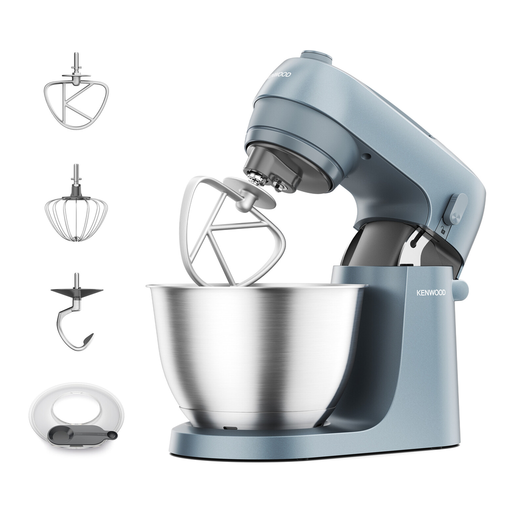
What makes this model stand out: The Kenwood Go is designed as a compact stand mixer without compromising on performance. At just 30 cm tall, it fits easily under wall cabinets or in deeper drawers. The robust metal body and 800-watt motor make it a durable and powerful partner in the kitchen. The controls are conveniently located on the front for space-saving operation.
Benefits at a Glance:
Who is this model for? This appliance is aimed at users who live in a smaller kitchen but don't want to sacrifice the performance and quality of a solid mixer. It's a great solution for anyone who values durability and a well-thought-out design.

What makes this model stand out: The HONINST stand mixer is an all-rounder that combines several kitchen appliances into one. In addition to the classic functions of a stand mixer for baking, it offers an integrated meat grinder and a blender attachment. With a 1300-watt motor and a 6.2-litre bowl, it's equipped for demanding tasks and large quantities.
Benefits at a Glance:
Who is this model for? This model is ideal for ambitious home cooks looking for a versatile appliance for a wide range of tasks. If you want to do more than just bake—like making your own sausages, blending smoothies, or puréeing sauces—this is a space-saving and cost-effective solution.
The models presented here already cover a broad spectrum of needs. However, the market offers many other specialized appliances. If you're looking for additional features or different designs, it's worth taking a look at our extended range.
Explore our full range of Stand Mixers with Dough Hooks and find the appliance that perfectly fits your needs.
Wattage is an indicator of power consumption, but it's not the sole measure of effectiveness. High wattage (e.g., over 1000 watts) is often beneficial for machines that process heavy dough. However, a model with an efficient direct current (DC) motor and a well-designed gearbox can achieve excellent kneading results with fewer watts (e.g., 400–800 watts). The interplay between the motor, gearbox, and stability is more important than wattage alone.
Historically, a dough mixer or dough machine was specifically designed for heavy yeast and bread doughs, while a regular mixer was used for lighter batters like cream or sponge cake. Modern stand mixers are typically combination appliances that can perform both tasks with the right attachment—a robust dough hook for dough and a whisk for light mixtures. The term stand mixer has become the umbrella term for these versatile appliances.
Essentially, yes, but the quality of the result heavily depends on the appliance. For regular bread baking, a stand mixer with a powerful motor, a sturdy dough hook, and a solid body is recommended. These features ensure the machine remains stable even when processing firm dough and that the dough is kneaded optimally, which is crucial for a good bread texture.