
Lieferung heute & morgen

Qualitätsgarantie

Willkommens-Angebote freischalten: KOSTENLOSE Lieferung | Bis zu 80 % RABATT | Kostenlose 30-Tage-JoyPlus-Testphase
App herunterladen
Choosing a new stand mixer can be a challenge, given the vast array of models and features on the market. Whether you dream of effortlessly kneading heavy bread dough, baking airy cakes, or preparing creamy sauces, the right appliance can make your kitchen work significantly easier. Many home bakers and novice cooks face the same question: Which model suits my needs and offers good value for money?
This guide is designed to help you navigate your options. We will present objective criteria to help you make an informed decision and showcase a selection of models that are well-suited for various applications due to their specific features.
To find the right appliance for your kitchen, it's helpful to understand a few technical specifications. These three aspects are central to the performance and versatility of a stand mixer.
The motor's power, measured in watts (W), is an indicator of the appliance's strength. A higher wattage doesn't automatically mean a better machine, but it is often a good indication of its ability to handle heavy doughs.
A crucial quality feature is the planetary mixing action. This means the mixing tool not only rotates on its own axis but also moves along the edge of the bowl. This system ensures that all ingredients are evenly incorporated from the bottom to the sides, leading to more consistent results.
The capacity of the mixing bowl, measured in litres (L), determines the quantities you can process at one time.
The included accessories transform a simple mixer into a versatile kitchen assistant. Standard equipment typically includes:
A powerful stand mixer doesn't have to be loud. If a pleasant working environment is important to you, pay attention to the decibel (dB) rating. A quiet stand mixer often has a rating below 75 dB, which is roughly the volume of a normal conversation. Direct current (DC) motors tend to be quieter than alternating current (AC) motors.
For easy and safe handling, features like a tilt-head design are advantageous. This allows for an uncomplicated change of accessories and easy access to the bowl. Additionally, non-slip suction feet ensure a stable stand, even when the machine is kneading heavy doughs at high speed.
Based on the criteria mentioned, we have compiled a selection of models that stand out for their specific features.
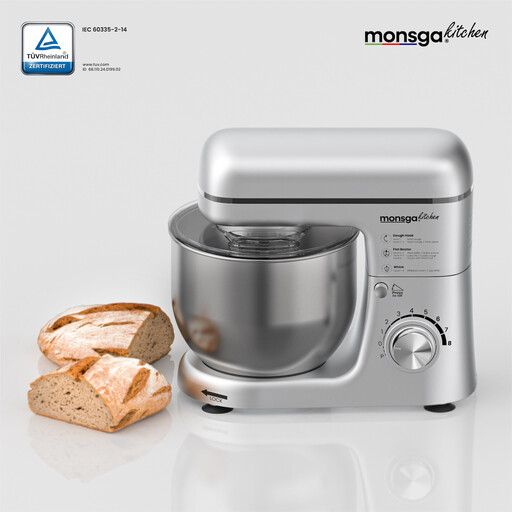
Why it stands out: The monsga SM100 combines a powerful motor with a thoughtful design. The 1000-watt copper motor and 360° planetary mixing action ensure thorough and even mixing of ingredients. Despite its power, the operating noise remains below 75 dB according to the manufacturer, allowing for a pleasant working experience.
Advantages:
Who it's for: This model is a great choice for home bakers who regularly make bread, pizza, or larger batches of cake and are looking for a machine with high performance and a moderate noise level.

Why it stands out: The Aucma stand mixer is distinguished by its fine-tuned speed control and reliable motor. With 10 speed settings plus a pulse function, it offers exceptionally precise control for a wide variety of recipes. The 400-watt copper AC motor is designed for everyday baking and cooking needs.
Advantages:
Who it's for: This model is particularly suitable for cooking beginners and home bakers who want a versatile and easy-to-use machine for a wide range of recipes, from light batters to sauces.

Why it stands out: This Aucma model sets itself apart with its particularly quiet 450-watt direct current (DC) motor and large 6-litre bowl. According to the manufacturer, the noise level is only 68–72 dB, making it one of the quieter options available. The large capacity is ideal for preparing big batches.
Advantages:
Who it's for: Ideal for users who frequently prepare large quantities and place a high value on quiet operation. The combination of a large bowl and a low-noise motor makes it a comfortable assistant in any family kitchen.
Didn't find the right model for you in our selection? Every kitchen and every cooking style has different requirements. To find the machine that perfectly fits your needs, it's worth taking a look at other alternatives.
Discover our entire range of Stand Mixers and find the perfect model for your kitchen.
The required wattage depends heavily on its intended use. For light tasks like mixing batter or whipping cream, models with 300 to 500 watts are often sufficient. If you plan to regularly knead heavy yeast or bread doughs, a model with at least 800 watts and a robust gearbox is recommended to avoid overloading the motor.
Planetary mixing action is a system where the mixing tool (e.g., the dough hook) rotates on its own axis while simultaneously circling the inner edge of the bowl. This dual motion ensures that all ingredients—even those at the bottom and sides of the bowl—are captured and mixed evenly. The result is more homogeneous doughs and batters.
Theoretically, yes, but not every machine is equally suited for the task. Kneading firm bread dough requires a dough machine with a powerful motor, a stable housing, and a specially shaped dough hook. Pay attention to the maximum dough capacity specified by the manufacturer and choose a model designed for that load to ensure the appliance's long-term durability.