
Lieferung heute & morgen

Qualitätsgarantie

Willkommens-Angebote freischalten: KOSTENLOSE Lieferung | Bis zu 80 % RABATT | Kostenlose 30-Tage-JoyPlus-Testphase
App herunterladen
Purchasing a new stand mixer can be a significant investment. Whether for weekly bread baking, elaborate cakes, or processing large batches for the family, the right appliance should make your work easier and perform reliably for years to come. But the market is flooded with tempting offers and technical specs that confuse more than they clarify. Many buyers only realise after a few months that their new device can't handle their demands.
To save you from a bad purchase, we'll highlight the most common pitfalls and show you which objective criteria truly matter when making your choice.
Marketing promises often focus on superficial features. However, a machine's true weaknesses only reveal themselves during real-world use, especially with demanding tasks like kneading heavy dough.
To make an informed decision, you should focus on the core technical features that define a durable and high-performance stand mixer with a bowl.
Instead of focusing solely on wattage, you should pay attention to the motor's design and the mixing mechanism. Planetary mixing action is now standard in high-quality machines. This means the mixing tool not only rotates on its own axis but also moves along the edge of the bowl. This ensures all ingredients are evenly incorporated from the bottom to the sides. A quiet stand mixer is often equipped with a direct current motor (DC motor), which also delivers constant torque even at low speeds—ideal for slowly kneading dough.
The capacity of the mixing bowl should match your household size and cooking habits.
A stainless steel bowl is hygienic, dishwasher-safe, robust, and does not absorb odours or stains.
A good stand mixer for baking should come equipped with at least three basic tools:
Before buying, check which optional accessories are available. Ports for meat grinders, blenders, pasta attachments, or vegetable slicers turn the machine into a multifunctional kitchen helper.
Here are some models that represent a considered choice for different user profiles, based on objective features.

Why this model is a good fit: This model provides a solid foundation for anyone who wants to bake regularly without immediately investing a professional-level budget. It combines a powerful motor with a family-friendly bowl size and the most important basic functions.
The 1000-watt motor provides sufficient power for most types of dough, and the silicone suction feet ensure a stable base, thus avoiding the "walking" machine pitfall.
5.0-litre usable capacity: Ample for family-sized portions. Planetary mixing action: Ensures ingredients are mixed evenly.
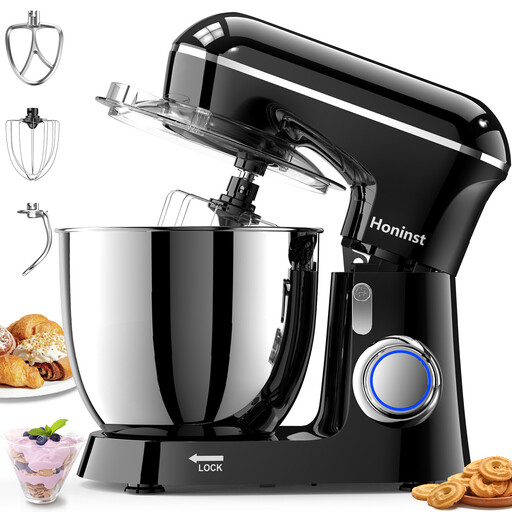
Why this model is a good fit: Anyone who regularly processes large quantities needs capacity and a robust drive above all. This model, with its large bowl and copper motor, is designed to handle larger batches.
Instead of just focusing on wattage, this model uses a pure copper motor, known for its durability and efficient power transmission. The overheat protection prevents motor damage under heavy load.
6.2-litre bowl (6.5QT): Ideal for large dough quantities or family portions. 10 speed settings: Allows for precise control for different recipes.

Why this model is a good fit: For cooks who want to do more than just bake. This set integrates a meat grinder and a blender, becoming a central processing unit in the kitchen, which saves space and money on individual appliances.
This model avoids the expensive upgrade trap by including key accessories like a meat grinder and blender in the set. This provides full functionality from the start without hidden costs.
7-in-1 functionality: Combines kneading, mixing, whipping, blending, and meat grinding in one device. Safety shut-off: The motor stops when the head is lifted.
While a powerful stand mixer is the centrepiece for heavy-duty tasks, the importance of a high-quality whisk for quick, delicate jobs should not be overlooked. From emulsifying a vinaigrette to whipping a small amount of cream, the right manual tool is often indispensable.
We have compiled a complete, up-to-date list of products that fully meet these strict selection criteria and EU safety regulations.
1. How many watts should a good stand mixer have? Wattage alone is not the deciding factor. A figure between 800 and 1200 watts is a good benchmark for most household applications. However, more important are the quality of the motor (e.g., a durable copper motor), a robust metal gearbox, and an efficient mixing system that actually transfers the power into the bowl.
2. What is planetary mixing action and why is it important? Planetary mixing action ensures an exceptionally thorough mixing of ingredients. The mixing tool (e.g., the dough hook) rotates on its own axis while simultaneously moving in a circular path along the edge of the bowl. This allows it to reach all areas of the bowl, leaving no pockets of flour or sugar at the bottom or sides.
3. Can I knead heavy doughs like bread dough in any stand mixer? Not every machine is suitable for heavy doughs. A good dough mixer needs a high-torque motor that doesn't overheat during slow kneading, a stable base thanks to a high dead weight and suction feet, and a solid metal dough hook. Models with plastic gears or poor stability can quickly reach their limits or be damaged by this kind of load.