
Lieferung heute & morgen

Qualitätsgarantie

Willkommens-Angebote freischalten: KOSTENLOSE Lieferung | Bis zu 80 % RABATT | Kostenlose 30-Tage-JoyPlus-Testphase
App herunterladen
Investing in a new stand mixer can make preparing bread, cakes, and other dishes significantly easier. But the market is crowded and filled with marketing promises that often obscure more than they clarify. Many home bakers invest in an appliance that proves to be inadequate or impractical after a short time. This guide will help you navigate the common pitfalls and make an informed decision based on objective criteria.
Before we dive into the important technical details, you should be aware of the most common marketing traps that lead to disappointment.
To find the right appliance for your needs, focus on the following technical parameters that define a reliable stand mixer for baking.
The heart of any mixer is its mixing system. A planetary mixing action is the gold standard here. This means the mixing tool rotates on its own axis while simultaneously moving along the edge of the bowl. This ensures that all ingredients in the stand mixer's bowl are evenly incorporated and mixed. Pay attention to the material of the included tools:
As mentioned, wattage alone is not a definitive measure of quality. A motor with high torque at low speeds is crucial for a dough mixer to effortlessly handle even heavy yeast or bread doughs. A metal gearbox is more resistant to wear and tear than a plastic one and ensures more efficient and quieter power transmission.
The size of the mixing bowl should suit your household. For occasional baking or small households, a capacity of 4 to 5 litres is sufficient. If you regularly prepare large quantities of dough for bread or pizza, a bowl with 6 litres or more is recommended. Practical additional features can simplify your workflow even further:
Here are some models tailored to different needs that meet the quality criteria mentioned above.
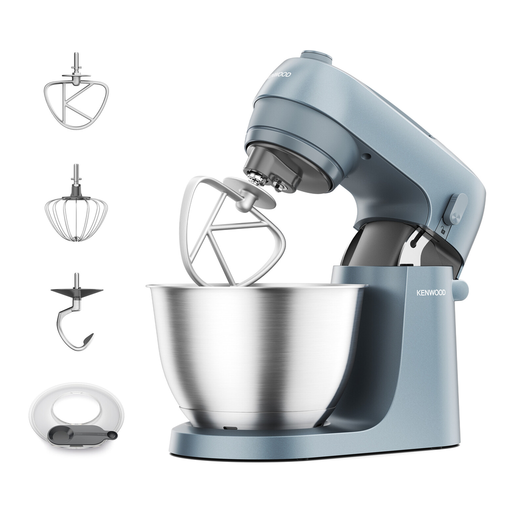
Why it's a great fit: Ideal for home bakers with limited counter space who don't want to compromise on quality. The compact design and robust metal housing provide a solid foundation for regular baking projects.
The robust all-metal housing prevents the typical instability of cheaper plastic models (Pitfall 3). The focus is on the core functions of mixing and kneading, without superfluous accessories (Pitfall 2).
Compact Height: At just 30 cm tall, it fits under most wall cabinets. Sturdy Housing: The metal body ensures a secure footing even when processing dough.

Why it's a great fit: For anyone who bakes regularly and in large quantities. The combination of a powerful motor, large bowl, and precise weighing function streamlines the entire baking process.
The 1200-watt ChefMotor proves that high wattage, when combined with high-quality engineering (Pitfall 1), truly delivers superior performance. The integrated scale is a useful feature that improves workflow, rather than just being a gimmick (Pitfall 2).
Integrated EasyWeigh Scale: Ingredients can be weighed directly in the bowl. Large Capacity: The 7-litre mixing bowl is suitable for processing large batches.
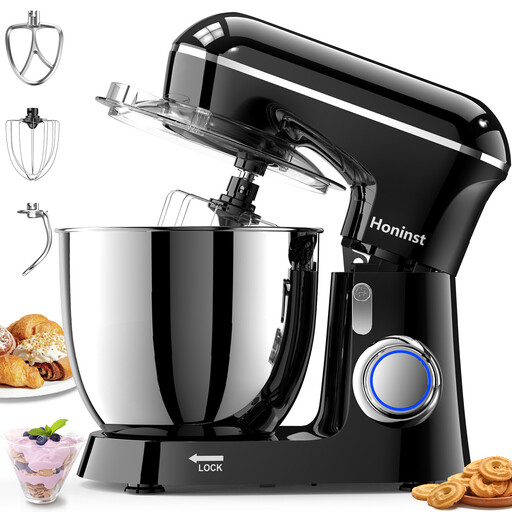
Why it's a great fit: For users who need a large capacity and versatile options for everyday family use without a premium budget. It offers a solid basic setup for a variety of recipes.
Despite its attractive price, the manufacturer states it uses a copper motor, which suggests greater durability than basic motors (Pitfall 1). The anti-slip suction feet also address the problem of instability (Pitfall 3).
Extra-Large Volume: The 6.5 QT (approx. 6.2 litre) stainless steel bowl is designed for large family-sized portions. 10 Speed Settings: Offers fine-tuned control for different preparations.
We've compiled a complete, up-to-date list of products that fully meet these strict selection criteria and German safety regulations.
1. How much wattage does a good stand mixer really need? Wattage is not the sole indicator of quality. For most household applications, including processing heavy bread doughs, a machine with a high-quality motor of 800 watts or more is generally sufficient. However, the quality of the gearbox and the motor's torque are more critical. A good DC (direct current) motor can often deliver more power with fewer watts than a simple AC (alternating current) motor.
2. What is planetary mixing action and why is it important? A planetary mixing action is a mechanism where the mixing tool (e.g., the dough hook) rotates on its own axis while simultaneously travelling around the edge of the bowl. This dual motion ensures that all ingredients are scraped from the sides and bottom of the bowl and are evenly processed into a homogeneous mixture. It is the standard for effective mixing and kneading results.
3. Can I clean my stand mixer's accessories in the dishwasher? This depends on the material. Always read the manufacturer's instructions. As a rule, stainless steel mixing bowls and whisks are dishwasher-safe. For dough hooks and flat beaters made of coated aluminium, hand washing is often recommended, as harsh detergents can attack and damage the coating.