
Lieferung heute & morgen

Qualitätsgarantie

Willkommens-Angebote freischalten: KOSTENLOSE Lieferung | Bis zu 80 % RABATT | Kostenlose 30-Tage-JoyPlus-Testphase
App herunterladen
A stand mixer should reliably handle smoothies, shakes, soups or ice. In practice, however, some purchasing decisions quickly lead to disappointment: a compact smoothie maker isn't enough for family portions, a large jug is impractical in a small kitchen, and a high wattage alone doesn't guarantee suitable blending performance.
So before you buy, it's worth taking a closer look at the design, jug, blades, controls and cleaning. Our selection shows different solutions for UK households – from the personal blender to the versatile multi-function mixer.
Motor power is often prominently advertised. However, a high wattage figure doesn't solely describe how evenly a blender processes ingredients. The blade shape, number of blades, jug geometry and permitted operating time are also crucial.
For soft fruits and protein shakes, a compact blender may suffice. If you regularly want to crush frozen fruit, nuts or ice, you should also look for a designated ice crush function, a pulse button and clear usage instructions.
The jug size doesn't always correspond to the maximum recommended liquid volume. With the Ninja Professional Blender, for example, the jug holds 2.1 litres, but the stated maximum liquid volume is 1.9 litres. The 'MAX' marking should always be observed to avoid overflow and strain on the motor.
A blender with many individual parts can cause more hassle in daily use than expected. Removable blades, dishwasher-safe jugs and tightly sealing lids make cleaning easier. The motor unit, however, should not be immersed in water with the featured appliances and should be cleaned with a damp cloth.
For simple smoothies, a blender with 300 to 600 watts is often sufficient. Depending on the design, an appliance with 900 to 1,300 watts offers additional reserves for frozen ingredients or ice. Nevertheless, the wattage is only a comparative value.
The operating time is also important. According to product specifications, several models must not run for longer than 60 seconds at a time. For multiple portions, breaks are advisable so the motor can cool down. A high-performance blender is therefore not automatically suitable for long continuous runs.
A blender with a glass jug is flavour-neutral and temperature-resistant within the respective manufacturer's specifications. However, glass is heavier and can break if knocked. Plastic or Tritan jugs are lighter and practical for on-the-go use.
Orient yourself by household size:
With plastic jugs, the BPA-free label can be a relevant selection criterion. It describes the material used, but is not a quality judgement on the entire appliance.
Four stainless steel blades are common on many household blenders. Six blades or special blade arrangements can change contact with ingredients, but don't replace correct filling. A pulse function helps deliver short, powerful bursts and gives you better control over consistency.
Also check whether accessories actually suit your daily life. A hand blender with whisk and chopper attachment is ideal for soups straight in the pot, purées and small quantities. A stand appliance, on the other hand, is usually more practical for larger portions and cold drinks.
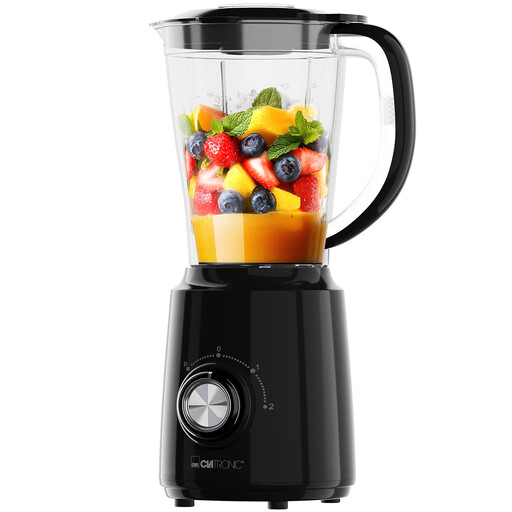
Why this product suits the profile: This stand mixer combines 500 watts, a 1.5-litre jug, four speed settings and a pulse/turbo function for everyday drinks and simple kitchen tasks.
The scale on the BPA-free jug supports controlled filling. Removable stainless steel blades make cleaning easier to access.
1.5-litre jug, ice crush function, safety cut-out and rubberised feet.
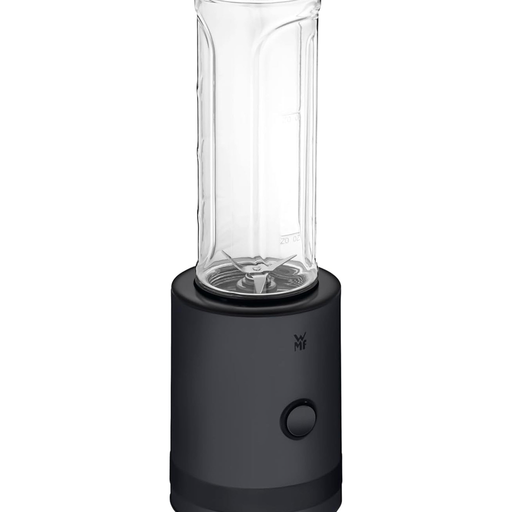
Why this product suits the profile: This compact appliance is designed for single portions and comes with two 0.6-litre Tritan drinking jugs.
The clearly limited 0.6-litre size prevents a mini blender from being planned for family quantities. The drinking jugs also serve as on-the-go containers.
300 watts, 23,000 revolutions per minute according to product specification, four stainless steel blades and dishwasher-safe jugs.
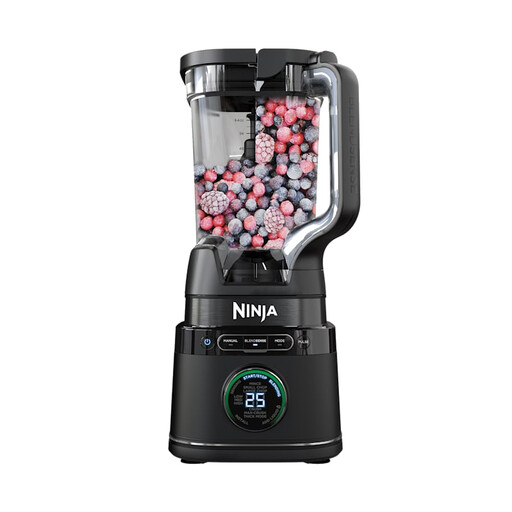
Why this product suits the profile: The large jug is ideal for multiple portions, meal prep and cold blended drinks with frozen ingredients.
The separate indication of jug capacity and maximum liquid volume makes the fill limit clear. The instructions limit continuous operation to 60 seconds.
1000 watts, six stainless steel blades, three speeds plus pulse, and dishwasher-safe removable parts.
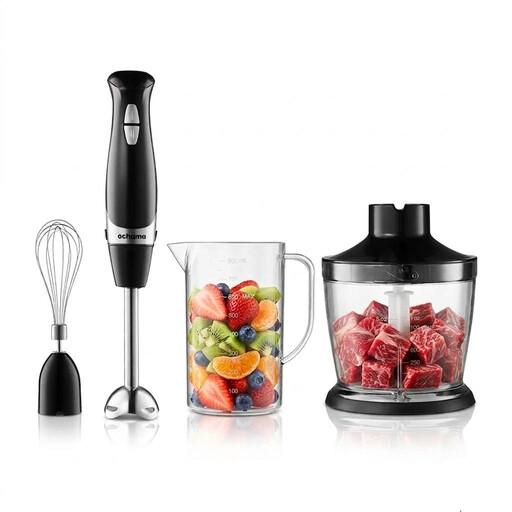
Why this product suits the profile: As a **hand blender**, this appliance can be used directly in a pot or beaker and doesn't need a large base on your worktop.
The removable attachments make cleaning easier. The contents of the box make it clear which functions – whisk, chopper and beaker – are actually included.
600 watts, two speed settings, 500 ml chopper and 800 ml mixing beaker.
We've put together a complete, regularly updated list of products that fully meet these strict selection criteria and the safety regulations in force in the EU.
Electricity consumption depends mainly on motor power, running time and frequency of use. Short blending cycles and appropriate ingredient quantities reduce operating time. A small smoothie maker can involve less effort for a single portion than a large blender, while a large appliance avoids multiple runs for several portions.
That depends on the specific model. Many appliances are intended for cold or room-temperature ingredients. With hot liquids, pressure can build up inside the jug. So check the temperature limit in the instructions before use. For hot soups, a suitable hand blender is often more practical, provided the manufacturer allows its use in a pot.
It's not possible to give a reliable general lifespan. It depends on frequency of use, ingredients, cleaning and adherence to operating times. Overfilling, dry continuous operation and blocked blades can strain the motor and seals. Regular cleaning and breaks between blending cycles support proper use.
For one person, 0.6 to about 0.9 litres is usually sufficient. Two to several portions can be prepared with 1.2 to 1.5 litres. Families and those with a meal prep routine can choose a larger jug, but should consider the maximum liquid marking and the available space in your kitchen.