
Lieferung heute & morgen

Qualitätsgarantie

Willkommens-Angebote freischalten: KOSTENLOSE Lieferung | Bis zu 80 % RABATT | Kostenlose 30-Tage-JoyPlus-Testphase
App herunterladen
A stand mixer can take much of the hard work out of kneading, mixing and whisking. But a low price or a high wattage rating doesn’t automatically make it the right choice. What matters is the bowl’s usable capacity, the build, the accessories included and the space available in your kitchen.
A high motor rating can sound impressive at first. But on its own, it tells you little about how effectively an electric stand mixer handles stiff dough. Some manufacturers quote the maximum power or power available for short periods, while others state the rated power. These figures aren’t directly comparable.
So, also look for:
For a dough mixer, a powerful motor with good power transfer is more important than the biggest number on the rating plate.
A stand mixer with a bowl that holds 6 litres can’t necessarily handle 6 litres of dough. Capacity usually refers to the available space inside the bowl, not the recommended amount for yeasted dough, cake batter or egg whites.
So check the details for:
A 5-litre stand mixer is often suitable for everyday quantities in smaller households. A 6-litre stand mixer offers more capacity for families, but also takes up more worktop space.
A wide range of attachments can look versatile at first glance. But for most baking recipes, three basic tools matter most: a dough hook, whisk and mixing or flat beater. A meat mincer, blender attachment or pasta accessories are only worthwhile if you’ll use those functions regularly.
Before buying, check whether the accessories are included or need to be purchased separately. You should also consider cleaning, spare parts availability and compatibility with your model.
Bread and pizza dough need a steady run at low to medium speed. Whipping cream or egg whites calls for higher speeds and finer control. Variable speed control can be useful for delicate mixtures, although several fixed settings are enough for many households.
A planetary mixing action moves the attachment around its own axis and around the edge of the bowl. This helps it incorporate ingredients more evenly in many recipes. However, the term alone doesn’t tell you how well the motor and gearbox perform, or how much dough the appliance can actually handle.
Stainless steel is hard-wearing, doesn’t retain odours easily and is simple to clean in many cases. Glass and plastic bowls can also be practical, but differ in weight, impact resistance and heat resistance.
A tilt-head design makes it easier to change the bowl and attachments. A stable base is also important when mixing stiff dough. Non-slip feet or suction cups can help prevent the appliance from moving across the worktop. Check its height, too: you should be able to use and store your stand mixer under or alongside your wall cabinets.
A stand mixer with scales lets you weigh ingredients directly into the bowl. This can cut down on steps, but it’s still worth checking the scales’ accuracy and maximum load. A timer can help with repeat tasks, while heating functions are only useful if you want to warm ingredients directly in the appliance.
The CE marking is a manufacturer’s declaration that the product meets relevant EU requirements. It isn’t an independent quality mark. So read the safety information and instruction manual, and check the details of the responsible person in the EU.

Why it suits this household: The 5-litre bowl, ten speed settings and three essential attachments cover everyday baking tasks in smaller households.
The product details specify the bowl size, speed settings, and overheating and overload protection. This makes it easier to assess its features before you buy.
5-litre stainless steel bowl; dough hook, whisk and mixing beater included.

Why it suits this household: The DuoBowl system with 7- and 5-litre bowls, along with the built-in EasyWeigh scales, is ideal for households that regularly prepare different quantities.
Having two bowls means you don’t have to prepare small quantities in a very large bowl. The rated power of 1,200 watts is clearly stated.
EasyWeigh scales; K-beater, whisk, dough hook and Flexi beater included.

Why it suits this household: If you want to do more than make bread, cakes and pizza, this appliance also lets you mince meat and blend drinks.
The extra functions are clearly specified: a meat mincer and blender complement the core features. Be sure to follow the stated operating limits and use only approved attachments.
6-quart bowl; 1,300-watt motor rating, plus meat mincer and blender attachments.
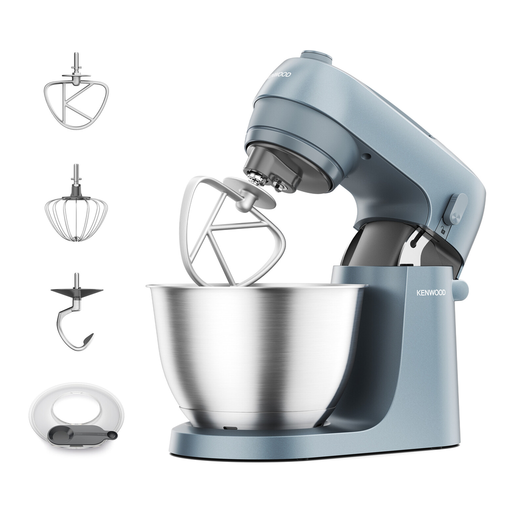
Why it suits this household: At 30 centimetres tall, with a 4-litre bowl, this model is designed for kitchens with limited worktop and storage space.
Its compact dimensions and clearly stated capacity make it easier to judge how much space it needs and what quantities it can handle.
800-watt motor; K-beater, whisk and dough hook, plus six speed settings.
We’ve put together a complete, regularly updated list of products that meet these strict selection criteria and the safety requirements in force in the EU.
For a stand mixer for bread and cakes, a dough hook, whisk and mixing beater are essential. You should also check the maximum dough capacity and recommended running time. If you bake bread often, a stable base at low speed is particularly important.
A 4- to 5-litre bowl may be enough for individuals and smaller households. Families and anyone making larger batches of dough might prefer a 6-litre stand mixer or a model with a DuoBowl system. The key factor is the permitted dough capacity, not just the bowl’s volume.
Consumption depends on the motor’s power, running time, speed setting and how often you use the appliance. A short operating time usually uses less energy than running it for a long time at high speed. To estimate consumption, multiply the power input in kilowatts by the operating time in hours and your electricity tariff.