
Lieferung heute & morgen

Qualitätsgarantie

Willkommens-Angebote freischalten: KOSTENLOSE Lieferung | Bis zu 80 % RABATT | Kostenlose 30-Tage-JoyPlus-Testphase
App herunterladen
A stand mixer can take much of the effort out of baking bread, mixing cake batter and whipping cream. However, models vary considerably in motor power, bowl size, attachments and stability. A high wattage or a large number of speed settings alone won’t tell you whether a machine is right for your recipes.
If you’re looking to buy a dough mixer, a stand mixer for baking or an electric mixer, there are three common mistakes to avoid:
A 6-litre stand mixer is generally suitable for larger family portions, several cake layers or larger quantities of dough. However, the recommended fill level is what matters. According to the product details, the Monsga SM100 has a maximum capacity of 6.0 litres and a recommended capacity of 5.0 litres.
For the bowl, food-grade stainless steel, such as SUS304 or 304 stainless steel, is a useful material to look for. Stainless steel doesn’t usually retain flavours and is easy to clean. A handle can also make pouring and removing the bowl easier.
Light cake mixtures and whipped cream call for different settings from a bread and pizza dough mixer. So, look for:
A stand mixer with 6 speed settings and an additional pulse function gives you a straightforward range of options. More speeds can be useful if you often switch between gently folding ingredients in, mixing at a medium speed and whipping at a high speed.
A stand mixer with a dough hook is designed for yeast dough, bread dough and pizza dough. A whisk is typically used for cream, egg whites and light mixtures. A flat beater is suitable for cake batter, creams and softer mixtures, among other things.
Also check:
A tilting motor head makes it easier to change the bowl and attachments. Suction cups or non-slip feet can help keep the machine in place while it’s running, but you’ll still need a level, sturdy work surface.

Why it suits this profile: The combination of a 6-litre stainless steel bowl, six speed settings and three standard attachments covers everyday baking tasks around the home.
The product details list a dough hook, whisk, beater, splash guard, and overload and overheating protection. That means you won’t need to budget separately for essential attachments.
6-litre bowl made from SUS304 stainless steel, six speed settings plus a pulse function, and a tilting motor head.
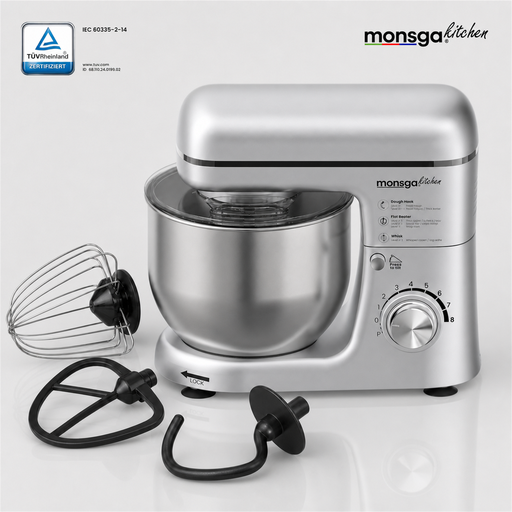
Why it suits this profile: If you regularly prepare different types of dough, creams and whipped mixtures, you’ll have eight speed settings and a wider range of adjustments to choose from.
The product details distinguish between 1000 W peak power and 600 W rated power. This makes it easier to assess the motor rating realistically.
8 speed settings, a 6-litre bowl made from 304 stainless steel, and a coated dough hook, according to the product description.
Why it suits this profile: For households that regularly make bread, pizza, cakes and creams, the bowl size and range of attachments are practical for a variety of tasks.
The recommended fill level of 5.0 litres is listed separately from the bowl’s maximum capacity. The instructions also recommend using low to medium speeds for kneading.
Dough hook, whisk, flat beater and splash guard; overload protection and automatic shut-off when the head is lifted are also listed.
We’ve put together a complete, regularly updated list of products that meet these strict selection criteria and the safety regulations in force in the EU.
For families and regular baking, 5 to 6 litres offers plenty of versatility. However, the usable capacity depends on the type of dough, the ingredients and the manufacturer’s guidance. In particular, don’t fill the bowl to the rim when making yeast dough.
Look for a suitable dough hook, low speed settings, overload protection and a stable base. Don’t consider motor power in isolation: rated power, the recommended dough quantity and the operating instructions all matter too.
Energy consumption depends on the actual power draw and how long the machine runs. A machine with a higher wattage won’t necessarily use more electricity for every task, as the recipe, speed and running time also make a difference. For short mixing and whipping tasks, the operating time is usually limited.