
Lieferung heute & morgen

Qualitätsgarantie

Willkommens-Angebote freischalten: KOSTENLOSE Lieferung | Bis zu 80 % RABATT | Kostenlose 30-Tage-JoyPlus-Testphase
App herunterladen
A stand mixer is designed to make smoothies, process frozen ingredients and, depending on the model, purée soups, sauces or baby food. In practice, however, a high wattage doesn't automatically guarantee great results. What really counts is the interplay between motor power, blade design, container and control system.
When buying a kitchen mixer, you should also pay attention to safety features, cleaning requirements and the actual space it will take up. The following tips will help you cut through the marketing claims and choose a model that suits your household.
A figure like 1,000 or 1,300 watts describes the electrical power consumption, not necessarily the quality of the blending result. Equally important are:
A compact smoothie maker with 300 watts can be sufficient for soft fruit. For larger quantities or frequent ice crushing, the container size, blade design and a suitable pulse function are at least as relevant.
With a 2.1-litre container, the maximum liquid capacity may be lower. The Ninja model in our selection has a container capacity of 2.1 litres but a maximum liquid capacity of 1.9 litres. The "MAX" mark should never be exceeded.
For a single-person household, a personal blender with 600 to 925 millilitres is often sufficient. Families, on the other hand, benefit from 1.2 to 2.1 litres, provided there is enough storage space.
"Easy to clean" doesn't mean the same thing for every appliance. Before you buy, check:
Sharp blades should always be handled with care and never cleaned with bare fingers. The motor base should never be placed under running water.
For occasional smoothies made from soft ingredients, a small smoothie mixer can be enough. For frozen fruit, nuts or ice, models with higher power consumption and a pulse function are more suitable. However, a single wattage figure is not a complete performance indicator.
Also pay attention to the recommended maximum running time. Several appliances in our selection should not be operated for longer than 60 seconds at a time. For multiple batches, cooling breaks are advisable.
Four stainless steel blades are common in many kitchen mixers. A multi-layered six-blade attachment can distribute ingredients differently within the container. However, the most important factor when choosing is your intended use:
A stand mixer is not automatically suitable for hot or boiling liquids. The Ninja Professional Blender and the nutribullet Pro both carry explicit warnings against hot liquids.
A mixer with a glass container, such as the Ariete Vintage 583, is sturdy and more temperature-resistant than many plastic variants, but also heavier. Tritan or polycarbonate containers can be lighter and are well suited for daily use, provided they are used according to the manufacturer's instructions.
For two to four portions, 1.2 to 1.5 litres is often practical. Single portions can be prepared directly in 600 to 925 millilitre on-the-go cups. The key is not to overfill the containers and to add ingredients in a sensible order: liquid first, hard ingredients last.
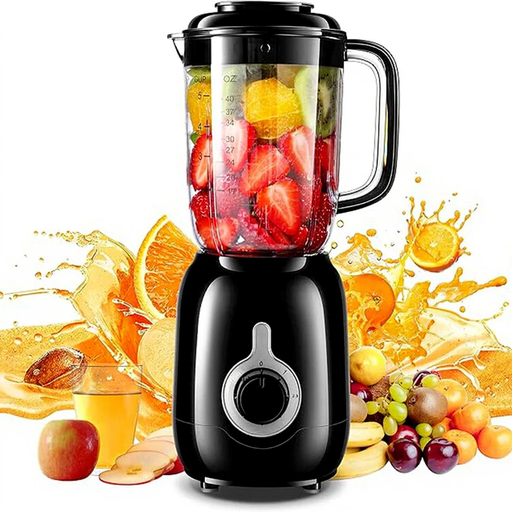
Why this product fits the profile: This 1.2-litre stand mixer is designed for everyday smoothies, shakes and smaller family quantities. The set also includes a grinding cup and a chopping cup, each with a 100-gram capacity.
The pulse function supports short working intervals for ice crushing. A safety lock prevents normal operation when the container is not correctly fitted.
500 watts, four stainless steel blades, two speed settings according to the product description, plus additional grinding and chopping cups.
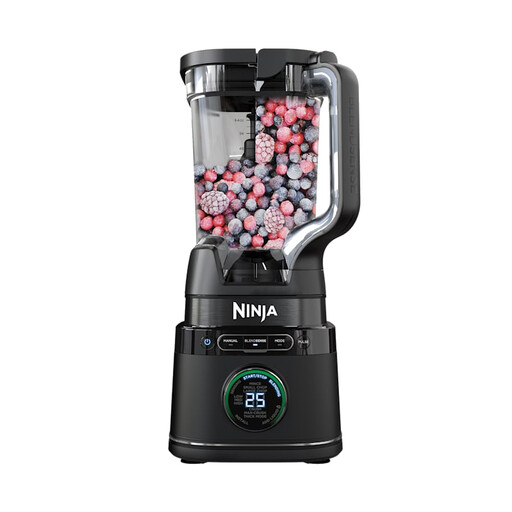
Why this product fits the profile: The large container is designed for family portions and preparing multiple drinks at once. Three speeds plus pulse allow for different consistencies.
The maximum liquid capacity of 1.9 litres is clearly stated. The removable parts are dishwasher-safe according to the product description.
1000-watt motor, 2.1-litre container, six-piece stainless steel blade and dishwasher-safe removable components.
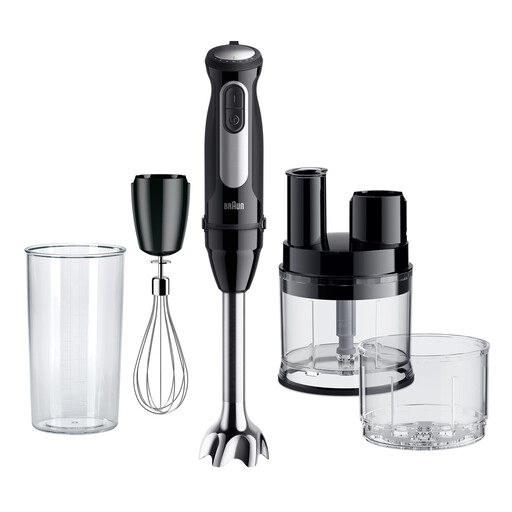
Why this product fits the profile: This hand blender is ideal for users who want to purée, chop, slice, whisk and crush ice. The attachments extend its use beyond classic smoothies.
The variable setting with 25 speeds plus turbo replaces a vague single-button operation. The EasyClick-Plus system makes changing accessories simple.
1000 watts, 25 speed settings, turbo mode plus accessories for chopping, slicing, grating, whisking and ice crushing.
We've put together a complete, regularly updated list of products that fully meet these strict selection criteria and the safety regulations in force in the EU.
A stand mixer only uses electricity while it is running. Therefore, the ongoing costs are mainly determined by usage time, power and frequency. A 1,000-watt appliance running for a total of ten minutes uses approximately 0.167 kilowatt-hours. The actual cost depends on your electricity tariff.
To ensure a long service life, you should:
With a mixer with a chopper or a smoothie maker with on-the-go cups, it is also important to only use approved accessories. A portable blender like the nutribullet Flip runs on a battery and charges via USB-C, but is more limited in terms of fill volume and ice portions, being designed primarily for mobile use.
For soft fruit and occasional shakes, 300 to 500 watts can be sufficient. If you regularly process ice, frozen fruit or nuts, 900 to 1,300 watts plus a pulse or ice-crush function are advisable. However, the wattage alone says nothing about the actual blending quality.
Only if the instruction manual explicitly allows it. Several of the appliances listed here carry warnings against hot or boiling liquids. Steam can build up pressure inside the container and dislodge the lid. Allow the soup to cool down first, or use a hand blender that is approved for this purpose.
It's impossible to give a fixed lifespan. It depends on frequency of use, ingredients, cleaning and adherence to the running time. Overloading, running it dry and continuous blending without breaks can put extra strain on the motor and blades. Product warranty and the availability of spare parts should therefore also be factored into your buying decision.