
Lieferung heute & morgen

Qualitätsgarantie

Willkommens-Angebote freischalten: KOSTENLOSE Lieferung | Bis zu 80 % RABATT | Kostenlose 30-Tage-JoyPlus-Testphase
App herunterladen
A stand mixer with a bowl should knead yeast dough, whip cream and mix cake batter evenly. In practice, however, the differences are not defined solely by wattage or bowl size. For home bakers, families and private households, the actual dough capacity, suitable attachments, stability and cleaning requirements are particularly important.
Manufacturers often state the maximum or so-called peak power. This figure does not necessarily describe the continuous power during normal operation. When comparing models, check whether a rated power is specified and what maximum dough quantity is permitted according to the product data or operating instructions.
A stand mixer for kneading needs a suitable transmission, a stable base and an appropriate kneading duration, especially when handling firm bread or pizza dough. A powerful motor alone does not prevent the appliance from switching off under excessive load or moving across the worktop.
A 6-litre bowl does not automatically hold 6 litres of dough. Ingredients may rise during kneading or splash out while mixing. For example, the Monsga SM100 is listed with a total capacity of 6.0 litres and a recommended usage limit of up to 5.0 litres. The permitted quantity may be lower still for firm dough.
If you regularly prepare bread or pizza, pay attention to the maximum dough capacity. For cakes and creams, it is also important that the mixing attachment can reliably reach smaller quantities.
A stand mixer for baking should offer at least three attachments:
A splash guard helps reduce mess, but it does not replace selecting the correct speed. Additional functions such as a mincer or blender are only worthwhile if you will genuinely use them in everyday life and they have been approved by the manufacturer.
Compare rated power, maximum power and recommended dough quantity separately. Compact models with moderate power are often sufficient for occasional cakes. If you bake bread frequently, a robust housing, overheating protection and low speed settings for kneading are important.
Six to eleven settings provide a useful range of adjustment. A pulse function can be handy for short, controlled bursts. However, having more speed settings alone does not automatically produce better results.
A stainless-steel bowl is hard-wearing, resistant to odours and practical for many households. A handle makes pouring and moving the bowl easier. Families preparing larger quantities may benefit from the extra capacity offered by 5.5 to 7 litres. In smaller kitchens, height is also a consideration: according to the product details, the Kenwood Go is 30 cm high, making it easier to store beneath wall-mounted cupboards.
Pay attention to the footprint, weight and how easily the bowl can be fitted. A tilting motor head makes changing attachments easier.
Noise-level figures should always be considered in relation to the measurement method. The Honinst Stand Mixer is advertised at less than 60 dB, while the Monsga SM100 is specified at up to 75 dB. The actual perceived noise depends on the speed, dough consistency and surface.
Useful features include:
The motor housing must not be immersed in water. Before cleaning, changing an attachment or raising the head, switch off the appliance and disconnect it from the mains.

Why this product suits this profile: This electric stand mixer features a 6-litre stainless-steel bowl, six speed settings and the three essential attachments for cakes, bread and pizza.
The product details specify 450 W motor power, a 6-litre bowl capacity and a noise range of 68 to 72 dB. This makes it easier to put the power and noise figures into context before buying.
A dough hook, whisk and flat beater are included. Suction cups, a splash guard, and overload and overheating protection support everyday household use.

Why this product suits this profile: This model is aimed at households that bake frequently and value separate bowl sizes as well as weighing ingredients directly in the bowl.
The specifications distinguish between a 7-litre and a 5-litre bowl. The integrated EasyWeigh scales reduce the need for additional measuring containers, but do not replace checking the permitted quantities.
The product details list 1200 W motor power, variable speed control and accessories including a dough hook, whisk, flexi beater and splash guard.
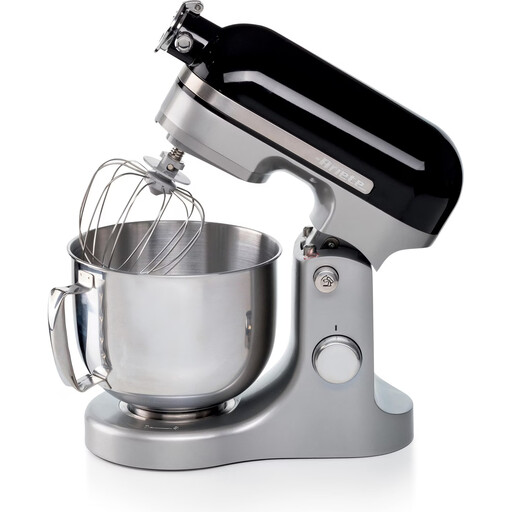
Why this product suits this profile: With 11 speed settings and a 5.5-litre bowl, it is designed for regular preparation of bread, pizza, cakes and creams.
The manufacturer’s specifications state a maximum dough capacity of 1.40 kg. This makes it easier to distinguish the bowl size from the actual quantity of dough the machine is designed to handle.
The product data lists 1600 W, a 3D planetary mixing system, five accessories and dishwasher-safe parts.
A stand mixer for kneading should be operated at low to medium speed when handling firm dough. Follow the quantities and time limits in the instructions, particularly with compact appliances. Higher power can increase electricity consumption per hour of operation; since kneading and mixing usually take only a few minutes, actual consumption mainly depends on how long you use the appliance and your tariff.
Before buying, it is also worth checking the availability of spare parts, warranty terms, accessory prices and cleaning requirements. Dishwasher-safe attachments save time, while a heavy housing permanently takes up worktop space. If you only bake occasionally, you may not need additional modules such as a mincer or stand blender.
We have put together a complete, regularly updated list of products that fully meet these strict selection criteria and the safety regulations applicable in the EU.
For regular cakes, pizza or bread, 5 to 6 litres is often practical. The permitted dough quantity remains the crucial factor. A large bowl is not automatically approved for large quantities of firm dough.
Its lifespan depends on the motor, transmission, materials, workload and maintenance. Not exceeding the maximum dough quantity, taking breaks during longer kneading sessions and using the attachments correctly all help reduce the risk of overloading the appliance.
For heavy doughs and larger quantities, a stand mixer offers greater convenience thanks to its bowl, dough hook and stable base. A hand mixer takes up less storage space and may be sufficient for small quantities. The right choice therefore depends on the recipe quantity, how often you use it and the amount of available worktop space.