Family bakers making one batch
You’re looking for a suitable bowl and controlled mixing for one cheesecake, without paying for extra capacity you won’t need.


When choosing a stand mixer for cheesecake filling, focus on the quantity your recipe actually makes and whether the mixer comes with a suitable mixing attachment. In a cheesecake recipe, KitchenAid Deutschland recommends using the flat beater on speed 2 and scraping down the sides of the bowl repeatedly. That speed setting cannot be directly applied to other machines. A larger bowl or two separate bowls are most useful when making several cakes or working through consecutive stages, rather than as proof that a particular amount of filling will fit.
You’re looking for a suitable bowl and controlled mixing for one cheesecake, without paying for extra capacity you won’t need.
You’re preparing several batches or working through consecutive recipe steps, and weighing up one large bowl against two separate ones.
You’d like to keep using the mixer after the gathering, so the choice of attachments, ease of cleaning and warranty terms all matter.
First, work out how much filling your recipe makes and whether you’ll prepare one batch or several. Then compare the mixing attachment, bowl size and effort involved in any further steps.
| What matters | What to check before buying | Who should consider it? |
|---|---|---|
| Mixing the filling with control | Check whether a flat beater is included and whether you can select a low speed. In its cheesecake recipe, KitchenAid Deutschland recommends using the flat beater on speed 2; that setting applies to the machine described in the recipe. | If I want to mix the cream cheese filling evenly according to the recipe, I look for a suitable beater and a speed I can control easily. Around 33% of consumers put controlled mixing first. |
| Quantity for a family gathering | Compare your recipe quantity and number of batches with the bowl capacity and the manufacturer’s guidance for that particular preparation. A limit for cake batter is not a limit for filling. | If I’m making several cakes, the bowl needs to suit the quantities and the number of steps involved. Around 33% of consumers prioritise batch size. |
| Cleaning between steps | Check whether each specific attachment is dishwasher-safe. A second bowl can make it easier to keep preparation stages separate, provided it’s included in the package. | If I don’t want to wash every attachment by hand while baking, I check the care instructions for the specific parts included. Around 20% of consumers pay particular attention to cleaning and switching between steps. |
| Use after the gathering | Compare only accessories you expect to use in future, and read the warranty terms for the specific model. A voluntary guarantee is separate from your statutory rights. | If I plan to use the mixer regularly, suitable accessories and clear service terms matter to me. Around 14% of consumers focus on long-term use. |
Manufacturer figures for bowl capacity and maximum dough quantities don’t automatically tell you how much cheesecake filling the machine can handle.
Compare your recipe quantity with the instructions for the specific model. If the suitable quantity isn’t clear, plan to make several batches rather than assume an unverified maximum.
Bowl sizes and mixing attachments can vary between specific versions and packages. You can’t determine a stand mixer’s features from its range name alone.
Check the full model code and the parts listed in the offer, especially if you need a second bowl or a flexi beater.
Verbraucherzentrale distinguishes between statutory rights against the seller and a voluntary guarantee, which has its own terms and conditions.
Keep your proof of purchase and the guarantee terms. If something is faulty, first check your statutory rights with the seller.
Bosch lists a 3.9-l bowl for the MUM58720 and a 5.5-l bowl with integrated scales for the Serie 6 MUMS6ZS13D.
According to KitchenAid Deutschland, the specific 5KSM175PSEFL package includes a 4.7-l bowl and a 3-l bowl, as well as flat and flexi beaters.
According to Kenwood, the Chef XL KVL4100S comes with a 6.7-l bowl and a K-beater.
For the KM7-1-4BPT, AEG lists a 6-l bowl and a 4-l bowl, as well as flat beaters with a silicone spatula.
According to Severin, the KM 3898 combines a 5.5-l bowl with integrated scales, a timer and a flat beater.
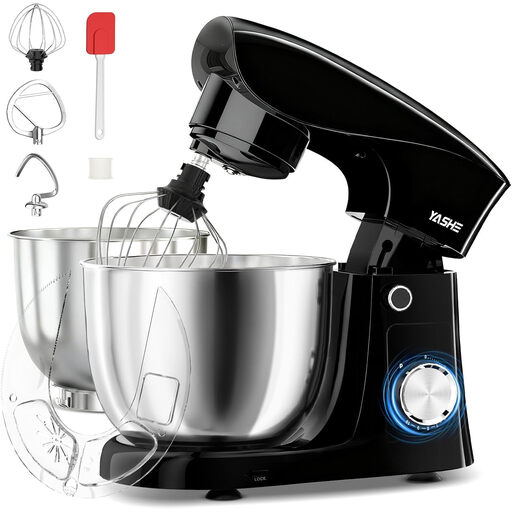
The following Joybuy selections are stand mixers with a mixing bowl, suited to individual recipe batches and consecutive preparation steps.
 No image available
Two separate bowls can be useful when working through consecutive recipe steps.
4.5-l and 5-l stainless steel bowls; 10+ speed settings; tilting motor head; 1500 W.
 No image available
The stated bowl size gives you a specific starting point for checking it against your recipe quantity.
5-l stainless steel bowl; 10 speed settings; 600 W; mixing beater, dough hook and whisk.
 No image available
Compare the stated bowl size with the quantity in your recipe batch.
4.5-l stainless steel bowl; 1300 W; beige finish.
 No image available
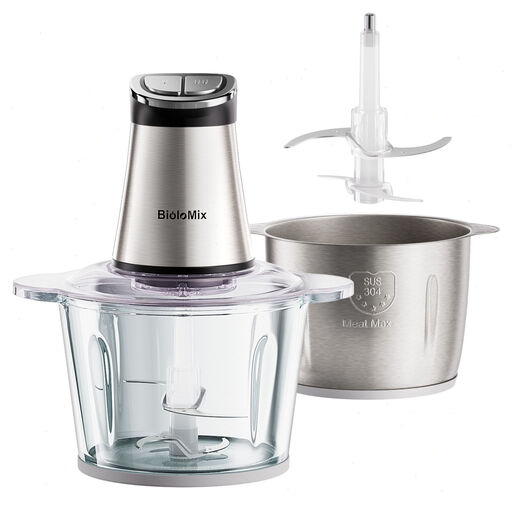
The stated bowl size gives you a guide when comparing the mixer with your recipe quantity.
3-l bowl; two speed settings; 300 W; LED timer display.
 No image available
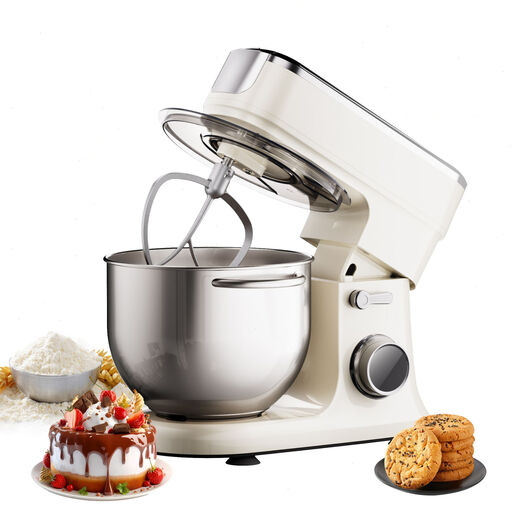
With a large bowl, check that the beater can reach the quantity in your specific recipe batch.
7-l bowl; adjustable speed settings; 1200 W DC motor; digital OLED touch display.
In its cheesecake recipe, KitchenAid Deutschland recommends using the flat beater on speed 2 and scraping down the sides of the bowl repeatedly. That speed setting applies to the machine described in the recipe. For another mixer, follow its instructions and your recipe.
No, it depends on the specific version. KitchenAid Deutschland says the standard 5K452WW whisk isn’t dishwasher-safe because it has an aluminium hub, while other stainless steel versions are dishwasher-safe. Check the exact attachment number.
Your statutory rights apply against the seller; a guarantee is an extra, voluntary benefit subject to its own terms and conditions. Verbraucherzentrale recommends keeping the two separate and remembering your statutory rights against the seller if a product is faulty.
Electrical appliances must comply with the relevant EU requirements. Subject to its exclusions, Directive 2014/35/EU applies to electrical equipment rated at 50 to 1,000 V AC or 75 to 1,500 V DC; EUR-Lex lists these scope limits. Parts intended to come into contact with food must meet the relevant requirements of Regulation (EC) No 1935/2004, as set out by the European Commission. These requirements don’t replace checking the information for the specific model.