
Lieferung heute & morgen

Qualitätsgarantie

Willkommens-Angebote freischalten: KOSTENLOSE Lieferung | Bis zu 80 % RABATT | Kostenlose 30-Tage-JoyPlus-Testphase
App herunterladen
Kneading heavy bread dough by hand can be strenuous, and evenly mixing ingredients for a delicate cake requires patience and precision. A reliable stand mixer can take over these tasks, making it an indispensable tool in the kitchen. However, the selection is vast, and the technical specifications can be confusing.
This guide is here to help. We will introduce you to various models and explain the key features to look for, enabling you to make an informed decision—without the marketing hype. Our goal is to help you find the stand mixer for baking that best fits your needs and budget.
Before you choose a model, there are a few technical aspects to consider. These three points will help you objectively evaluate a machine's performance and functionality.
Wattage alone isn't always indicative of a mixer's performance. An efficiently designed motor with a lower wattage can sometimes deliver more torque for heavy doughs than a less efficient, high-wattage motor. More important is a planetary mixing action. This is where the mixing attachment spins on its own axis while also moving in a circular path around the bowl. This ensures all ingredients are thoroughly incorporated, from the bottom to the sides of the bowl.
The size of the stand mixer's bowl determines the quantities you can process at once. For an average household or home baker, a bowl capacity of 4 to 5 litres is usually sufficient. This allows you to whip small amounts of cream as well as prepare dough for a whole loaf of bread or a family-sized cake. Stainless steel bowls are a practical choice as they are robust, durable, odour- and taste-neutral, and often dishwasher-safe.
Most stand mixers come with a standard set of attachments: a dough hook for heavy doughs, a flat beater for cake batter and creams, and a whisk for egg whites and cream. Ensure the attachments are sturdy and easy to clean. Another often-overlooked factor is the noise level. A quiet stand mixer with an operating noise level below 75 decibels (dB) makes for a much more pleasant experience, especially during longer prep times.
Here is a selection of models that stand out for their specific features and applications.
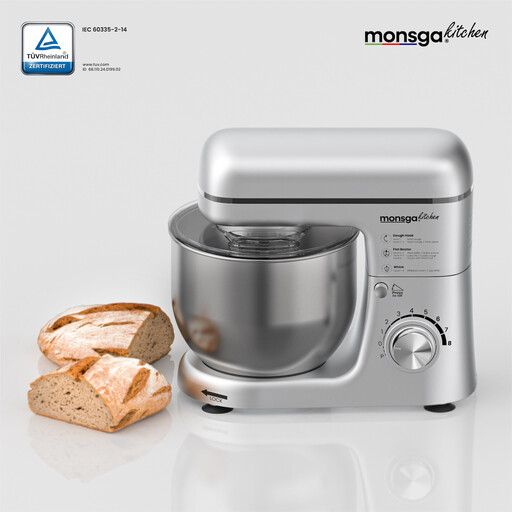
Why it stands out: The monsga SM100 combines a powerful 1000-watt motor with a generous 5.0-litre stainless steel bowl. A key feature is its Teflon-coated dough hook, which offers excellent non-stick properties and is heat-resistant. With an operating noise level below 75 dB, it's one of the quieter models in its performance class.
Pros:
Who it's for: Home bakers and families looking for a versatile, high-capacity mixer for regular baking projects, from heavy bread dough to light and airy creams.

Why it stands out: This model features a durable 400-watt pure copper AC motor and precise control with 10 speed settings plus a pulse function. Its metal gear and belt-drive construction is designed for stable, low-vibration operation.
Pros:
Who it's for: Budget-conscious beginners and home users looking for a reliable and easy-to-use dough mixer for everyday baking and cooking tasks.
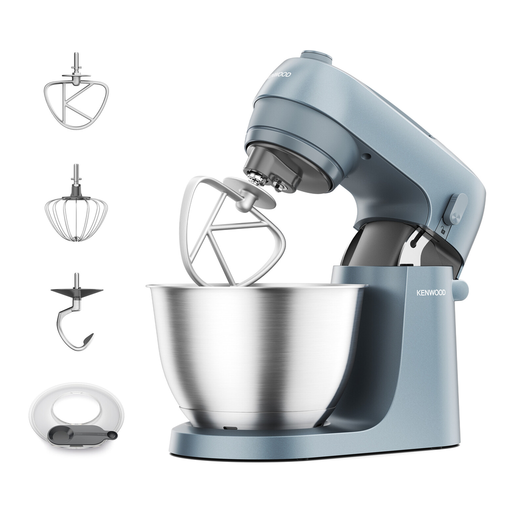
Why it stands out: The Kenwood Go is distinguished by its extremely compact design. At just 30 cm tall, it fits perfectly in kitchens with limited space. Despite its small footprint, it features a robust all-metal body and an 800-watt motor.
Pros:
Who it's for: Users with limited space, design-conscious bakers, and anyone who prefers a compact yet powerful and durable kitchen machine from an established brand.
The models featured here provide a good overview of the available features across different price points. However, the market offers an even wider variety of appliances with different specifications and designs.
If you want to compare more models or search for specific features, you're sure to find the right appliance in our broader selection.
? Explore our full range of mixers and find the perfect model for your kitchen.
Wattage is just one indicator of performance. A well-designed stand mixer with an efficient motor and a solid gearbox can achieve excellent results with as little as 400 to 800 watts, especially when kneading heavy doughs. More important than pure wattage is the motor's ability to maintain consistent power even at low speeds.
With a planetary mixing action, the attachment (e.g., the dough hook) spins on its own axis while simultaneously moving in a circular path around the bowl. This dual motion ensures that all ingredients—even those at the sides and bottom of the bowl—are captured and thoroughly mixed. This system is a hallmark of an effective stand mixer for baking.
Although it's often known as a dough mixer or mixer for baked goods, a stand mixer is a versatile appliance. Depending on the model and available attachments, it can also be used to shred vegetables, make pasta, grind meat, or blend smoothies. This makes it a multifunctional tool for a wide variety of kitchen tasks.