
Lieferung heute & morgen

Qualitätsgarantie

Willkommens-Angebote freischalten: KOSTENLOSE Lieferung | Bis zu 80 % RABATT | Kostenlose 30-Tage-JoyPlus-Testphase
App herunterladen
Purchasing a new stand mixer can make preparing bread, cakes, and other dishes significantly easier. However, the market is filled with tempting offers that don't always deliver on their promises. As a Joybuy Product Recommendation Officer, I see daily which features truly matter and which are just marketing gimmicks. Many buyers invest in appliances that are either too loud, too weak for heavy doughs, or become unusable after a short time.
Before you make a decision, you should be aware of the three most common pitfalls that lead to disappointment:
To avoid a bad purchase, focus on the technical fundamentals that define a reliable and durable stand mixer for baking.
A machine's performance doesn't depend on wattage alone. The crucial factor is the combination of motor type and gearbox design.
The size of the mixing bowl and the quality of the basic attachments should match your cooking and baking habits.
Here are some models that represent a considered choice for different user profiles based on their objective features.

Why it's a good fit: Ideal for home bakers looking for a reliable basic setup for occasional baking. The 5-litre bowl offers enough capacity for standard recipes without taking up too much kitchen space.
This model focuses on essential functions. Instead of advertising unnecessary accessories, it offers the three core attachments and solid performance for everyday tasks. The overheat protection is a practical safety feature.
Offers a solid basic package with 10 speed settings and a pulse function at an accessible price. The tilt-head design makes it easy to handle.
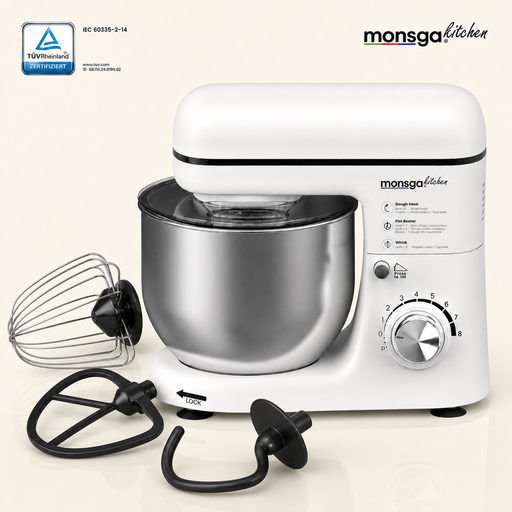
Why it's a good fit: For those who bake regularly and in larger quantities. The 6L mixer with bowl and the 1000-watt motor provide enough power reserves for heavy bread doughs and family-sized portions.
The high wattage is complemented here by useful quality features. The Teflon-coated dough hook and flat beater are a practical advantage that simplifies cleaning and replaces the "accessory illusion" with real added value.
Powerful performance for demanding tasks and a large bowl capacity. The non-stick coating on the tools makes it easier to work with sticky doughs and simplifies the subsequent cleanup.

Why it's a good fit: Perfect for users who value a quiet kitchen environment. The DC (direct current) motor operates more efficiently and quietly than conventional AC motors, making it ideal for open-plan kitchens.
This model impressively debunks the "wattage trap." With a nominal rating of 450 watts, it has less power on paper, but the high-quality DC motor delivers high torque and, according to the manufacturer, operates significantly quieter at 68-72 dB.
An exceptionally quiet stand mixer thanks to its DC motor. The combination of a 6L bowl and quiet operation makes it a comfortable assistant for frequent use.
We have compiled a complete, up-to-date list of products that meet these strict selection criteria and comply with current safety regulations.
Wattage alone is not a definitive indicator of performance. For light tasks like whipping cream or mixing simple batters, models with 300 to 500 watts are sufficient. For regular kneading of heavy bread or yeast doughs, the combination of motor type and gearbox is more important. An appliance with a high-quality DC motor or a powerful AC motor (800 watts or more) with a robust metal gearbox is the better choice here.
A planetary mixing action is a system where the attachment (e.g., the dough hook) rotates on its own axis while also travelling in a circular path around the edge of the bowl. This dual motion ensures that all ingredients are incorporated from the bottom to the sides for a homogeneous mix. For anyone who bakes regularly, this feature is an indispensable standard that significantly improves the quality of the results.
This depends on the material of the accessories. Always read the manufacturer's instructions. Mixing bowls and whisks made of pure stainless steel are generally dishwasher-safe. For coated tools (e.g., dough hooks with a non-stick coating) or parts made of aluminium, hand washing is often recommended to avoid damaging the coating or the material.