
Lieferung heute & morgen

Qualitätsgarantie

Willkommens-Angebote freischalten: KOSTENLOSE Lieferung | Bis zu 80 % RABATT | Kostenlose 30-Tage-JoyPlus-Testphase
App herunterladen
A multifunctional stand mixer promises to revolutionise your cooking and baking: kneading, stirring, mixing, and even processing meat—all with a single appliance. However, the market is flooded with models whose advertised features often fail to deliver in practice. Many home cooks invest in a device that loses power after a short time or whose accessories remain unused in the cupboard. This guide reveals the pitfalls to avoid and the technical features that truly matter when making your choice.
Before you make a decision, it's crucial to question common marketing claims. Certain features are often overemphasised, while critical quality aspects are left in the background.
To avoid a bad purchase, you should focus your attention on the following technical parameters. These determine the actual functionality and lifespan of your stand mixer.
Instead of just looking at the wattage, the type of motor and the quality of the gearbox are decisive. A motor with continuous power delivery is better suited for long-term operation than one that only reaches a high peak power for a short time. A robust metal planetary mixing action ensures that power is distributed evenly throughout the bowl, effortlessly kneading even heavy doughs. This combination is the heart of every good multifunctional stand mixer.
The capacity of the mixing bowl should suit your household. For a family or ambitious home bakers, a dough mixer with a 6.5L capacity or larger is a sensible choice for processing bigger batches of dough or ingredients at once. A bowl made of stainless steel is the preferred option. It is hygienic, non-reactive, durable, and usually dishwasher-safe, which makes cleaning much easier.
A stand mixer with a meat grinder is only as good as its attachments. Make sure that the included mixer with accessories is suitable for your needs.
Based on these objective criteria, we have identified models that represent a suitable solution for specific user profiles.
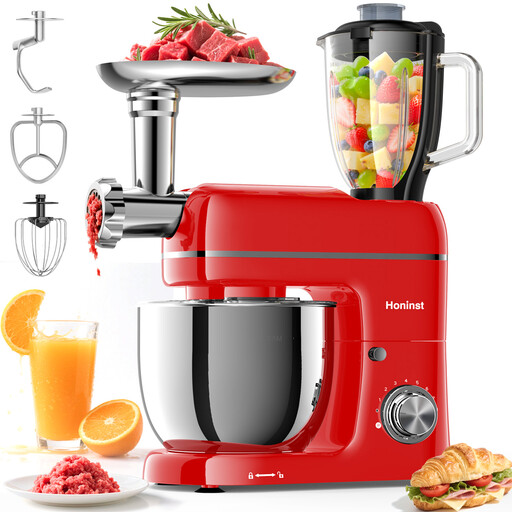
Why It's a Match: Ideal for home cooks seeking maximum versatility. This appliance combines the functions of a stand mixer, meat grinder, and blender, covering a wide range of kitchen tasks—from baking and making smoothies to preparing sausages.
Addresses the pitfall of impractical accessories by bundling the most important functions (kneading, blending, meat grinding) into a single, coordinated system. This reduces the need for separate appliances and ensures compatibility.
Offers a comprehensive solution as a stand mixer with meat grinder and blender. The large 6.5 QT (approx. 6.2-liter) stainless steel bowl is well-suited for preparing meals for the whole family.
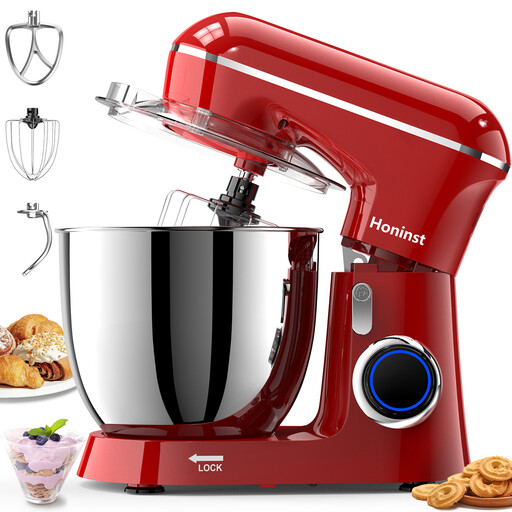
Why It's a Match: A great choice for users whose primary focus is baking. Those who need a powerful baking appliance for doughs and batters but can do without a meat grinder and blender will find a focused solution here.
Avoids the pitfall of paying for unused features. By concentrating on the core functions of mixing and kneading, the focus is on performance and stability for these specific tasks.
Strong focus on kneading and mixing performance with a 10-speed motor and planetary mixing system. The Honinst Stand Mixer, with its 6.5 QT bowl, offers sufficient capacity for most household baking projects.
If the models featured here don't perfectly match your needs, you can find a wider selection of appliances in our main category. There, you can compare different models and their accessories.
1. How many watts should a good stand mixer with a meat grinder have? Raw wattage alone isn't the deciding factor. More important is the combination of a durable motor and a robust metal gearbox. For home use, models with a continuous power of 800 to 1300 watts are generally sufficient to reliably handle heavy tasks like kneading bread dough or grinding meat.
2. Are the accessories of a multifunctional stand mixer dishwasher-safe? This depends on the specific model and the materials used. Stainless steel mixing bowls and some mixing tools are often dishwasher-safe. However, parts of the meat grinder, especially those made of cast aluminum, should be hand-washed to prevent discoloration and material damage from harsh detergents. Always refer to the manufacturer's specific care instructions.
3. How loud is a stand mixer during operation? The noise level varies depending on the motor quality, construction, and selected speed setting. High-quality models with a solid housing and a well-insulated motor block tend to be quieter. Some manufacturers specify the noise level in decibels (dB). A value below 75 dB at maximum speed can be considered relatively quiet for such a powerful appliance.