Bakers making two trays one after the other
If you’re baking two trays one after the other, you can time mixing and filling to suit the oven schedule, so the finished muffin batter isn’t left waiting unnecessarily.


Choose a stand mixer to suit the weight of your recipe, with a suitable mixing attachment and speed settings you can control easily. For muffin batter, gentle mixing matters more than the highest possible wattage. The German Federal Centre for Nutrition recommends mixing the ingredients quickly shortly before baking. If you’re baking two trays one after the other, plan your preparation so the second batch doesn’t have to sit as finished batter for too long.
If you’re baking two trays one after the other, you can time mixing and filling to suit the oven schedule, so the finished muffin batter isn’t left waiting unnecessarily.
If you’re preparing a larger quantity, compare the recipe weight with the dough capacity specified for the particular model.
If worktop space is limited, weigh up whether a compact machine offers the right balance of extra bowl capacity, attachments and cleaning effort.
When baking two trays of muffins one after the other, the key considerations are mixing control, the right recipe quantity, the space required and whether you’ll use the machine for more than muffins.
Best for: When worktop space is limited and the recipe quantity is within the dough capacity specified for the particular model.
Keep in mind: Bowl volume alone doesn’t tell you how much dough the machine can handle.
Best for: When you’re actually making a larger quantity in one batch and have enough worktop space.
Keep in mind: Extra capacity won’t solve the timing between two trays; don’t leave the finished batter mixed and standing for too long.
Best for: If you only bake muffins occasionally and can prepare the dry and wet ingredients separately.
Keep in mind: You’ll need to mix the ingredients yourself. The German Federal Centre for Nutrition recommends combining them quickly shortly before baking.
| Buying priority | What to look for | Who is it important to? |
|---|---|---|
| Mixing control and timing | Check that the mixing attachment is suitable and the speed can be controlled; time mixing and filling to suit the oven schedule. | When I’m baking two trays one after the other, I want to mix the ingredients briefly at the right time before baking. Around 36% of consumers prioritise mixing control and tray timing. |
| Recipe quantity | Compare the recipe weight with the manufacturer’s guidance for the relevant type of dough and the particular model. | When I’m making the batter for both trays in one batch, I want to know the permitted quantity for my model. Around 29% of consumers prioritise capacity that suits their recipe quantity. |
| Space and cleaning | Check the appliance’s dimensions, the attachments included and the cleaning instructions for the particular model. | When worktop space is limited, I don’t want to accommodate a larger machine than necessary, and I want the attachments to be easy to clean. Around 21% of consumers prioritise space and ease of use. |
| Additional uses and after-sales support | Consider only features and attachments you’ll also want to use for other recipes; check the warranty terms separately from your statutory rights. | When I want to use the machine regularly for other tasks too, or receive good support after buying it, I look for useful extra features and clear terms. Around 14% of consumers put these considerations first. |
Manufacturers specify different maximum quantities for different types of dough. A large bowl therefore doesn’t automatically mean the machine can handle the same quantity of muffin batter or cake mix.
Compare the recipe weight with the capacity specified for the relevant type of dough and exact model.
The German Federal Centre for Nutrition recommends combining the dry and wet ingredients quickly shortly before baking. If you make a large batch too early, the second portion may have to wait unnecessarily.
Plan the oven schedule and filling before combining the ingredients; a larger bowl doesn’t replace good timing.
If the heading and description mention different types of appliance or features, it may not be clear what the product actually includes.
Check the model number, items included and technical specifications against each other rather than relying on the product title alone.
The MUM Serie 2 includes compact models such as the MUMS2AW01, with a 3,8-l bowl and patisserie attachments. It could be a good fit if you’re short on worktop space and need a clearly specified capacity for cake mix.
According to Kenwood Germany, the kMix KMX750AWH has a 5-l bowl, variable speed and a K-beater. It’s worth considering if you’d also like to use a larger bowl for other tasks.
The Artisan 5KSM125 is supplied with a flat beater, whisk and dough hook. KitchenAid Germany lists a 4,7-l bowl for the variant shown.
According to Severin, the KM 3898 combines a 5,5-l bowl with integrated scales, a timer and a flat beater. These features are useful if you’ll actually use them in your baking routine.
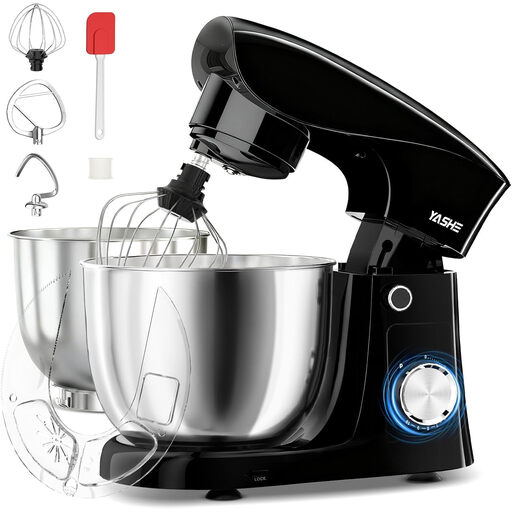
This selection includes stand mixers with mixing functions and a range of bowl sizes for muffin batter and cake mix. Compare the listed features and the dough capacity specified for the particular model with your recipe.
 No image available
If you’d like to choose between two batch sizes, compare your recipe quantity with the stated bowl capacities.
Check the permitted dough quantity for your particular recipe and model.
 No image available
If you’re looking for a mixing attachment and several speed settings, check that the items included meet your recipe’s requirements.
The number of speed settings alone doesn’t tell you how briefly to mix muffin batter.
 No image available
If you’re looking for a bowl with a stated capacity and mixing attachments, check that it suits the quantity and type of dough in your recipe.
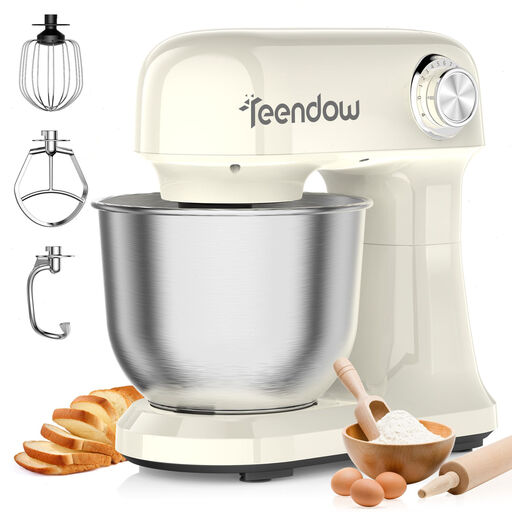 No image available
If you’re looking for a machine with several speed settings, consider the dough capacity specified for your recipe as well as the bowl size.
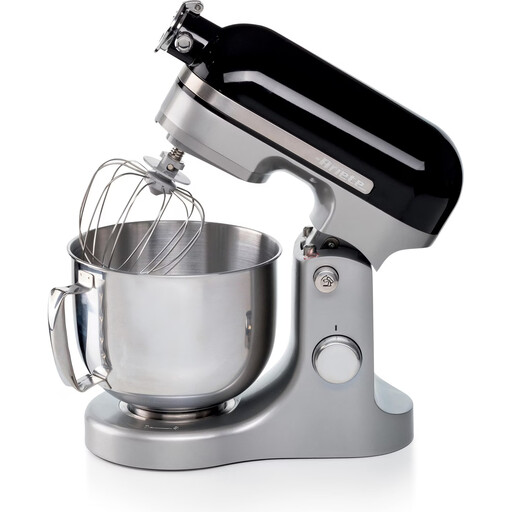 No image available
If a flat beater is suitable for your preparation, compare the stated dough capacity with the recipe weight and type of dough.
Check which type of dough the capacity specified for the particular model refers to.
No. Bowl size alone isn’t a reason to do so. Prepare the dry and wet ingredients separately and, if your recipe allows, combine them shortly before baking. If the second tray is going into the oven later, bear that in mind when dividing the batter.
That depends on your oven and the recipe, not on the stand mixer. Bosch specifically describes baking on multiple levels for ovens with 3D hot air; this doesn’t mean every oven is suitable. Check your oven’s instructions, heating function, shelf positions and how well both trays are cooked.
Check whether a whisk or flat beater is suitable by referring to your model’s instructions and your recipe, rather than choosing based only on the name of the dough hook. Whether the bowl and attachments are dishwasher-safe depends on the model and individual parts; Severin describes the KM 3898 attachments as dishwasher-safe.
Your statutory rights against the seller for faulty goods are separate from a voluntary manufacturer’s or retailer’s warranty. Under section 438 of the German Civil Code (BGB), the standard limitation period for claims relating to defects in goods is two years from delivery. Many online consumer contracts also generally come with a 14-day right to cancel; the conditions and exceptions are set out in law, as explained by the Verbraucherzentrale.
No. An electrical appliance covered by relevant EU legislation must carry the required CE marking; this means the manufacturer declares that it complies with the applicable requirements. It isn’t an independent quality mark and doesn’t replace checking the details of the specific offer.