Hosts making a large batch of dough
If you want to keep the number of batches to a minimum, compare your recipe’s total weight with the limits for the exact model and dough type.


First, work out the flour quantity and total recipe weight for each kneading cycle, then compare both with the specifications and kneading instructions for the exact model. If you can split the amount needed for the party, a smaller all-round stand mixer could be an option; if you regularly make large batches, it’s also worth comparing larger machines or a spiral mixer. Manufacturers’ figures for different types of dough are not a direct measure of pizza dough performance.
If you want to keep the number of batches to a minimum, compare your recipe’s total weight with the limits for the exact model and dough type.
For you, suitability for the consistency you’re aiming for and the kneading instructions matter more than an overall ranking of a versatile stand mixer.
If you can split the amount needed for the party, you could consider a more compact all-round mixer that you can also use for other kitchen tasks later on.
A good fit if: You can split the amount needed for the party and would also like to use the appliance for mixing or whisking afterwards. Kenwood Germany lists a maximum of 800 g of flour and 1.6 kg of bread dough for the Smart-Touch KHC40.080BK; Bosch Home Appliances Germany lists up to 1.9 kg of yeast dough for the MUM58710.
The trade-off: Making several batches takes time. Figures for flour, bread dough and yeast dough use different measures, so they don’t automatically confirm the same capacity for pizza dough.
A good fit if: You’re looking for a versatile machine that can handle larger batches. Kenwood Germany lists a maximum of 2.42 kg of bread dough for the Chef XL KVL4100S; Bosch Home Appliances Germany lists a 5.5-litre bowl and a maximum of 1.5 kg of flour for the MUMS6ZS13D.
The trade-off: Larger appliances need more worktop space. Bowl capacity and manufacturers’ limits, which may be defined differently, are no substitute for checking against your recipe.
A good fit if: Your individual batch of pizza dough falls within the model’s stated limits. Ooni Europe lists a minimum quantity of 1 kg, a maximum of 4 kg and 55–80% hydration for the Halo Pro.
The trade-off: The minimum quantity may not be practical for small everyday portions. Elsewhere, Ooni’s product page also mentions “5 kg of dough”; check the confirmed maximum before planning larger batches.
| Consideration | What to check before buying | Who should consider it? |
|---|---|---|
| Maximum batch size | Note the flour weight and total dough weight separately for each batch, then compare them with the figures for the exact model and dough type. | If I want to make as few batches as possible for the party, the maximum capacity needs to suit my recipe. Around 31% of consumers would also put batch size first. |
| Suitability for pizza dough | Check the dough hook, intended dough type, kneading instructions and, where specified, the hydration range for the exact model. | If my dough has a particular consistency, I want to know whether the instructions say the model is suitable for it. Around 31% of consumers would prioritise suitability for their specific dough. |
| Making several batches | Check the appliance dimensions, how to clean removable parts, and the operating time and overload guidance in the manual. | If I’m planning several batches one after another, a practical workflow and available worktop space matter to me. Around 23% of consumers would prioritise how easy it is to handle multiple batches. |
| Use after the party | Check the dough hook, the extra functions you actually want and whether accessories are compatible with the exact model. | If I want to use the machine for other baking tasks later, I don’t want to pay for functions I won’t use. Around 15% of consumers would first weigh up versatility and the accessories included. |
Manufacturers specify different limits depending on the model and type of dough. Bowl capacity alone therefore doesn’t tell you how much pizza dough the machine can handle in one batch.
For your recipe, note the flour weight and total dough weight separately, then check the relevant figure and kneading instructions for the exact model.
Making extra batches can add time to your party preparations.
In its general stand mixer test of 30 October 2026, IMTEST ranked the Kenwood Smart-Touch KHC40.080BK first. The magazine also reported that heavy bread dough needed some extra work. The overall ranking isn’t a dedicated pizza dough test.
Use an overall ranking for context only, and check reports on dough performance, batch limits and kneading instructions for the exact model separately.
Ooni lists a minimum quantity of 1 kg for the Halo Pro and a maximum of 4 kg in its comparison table, while elsewhere on the same product page it states “5 kg of dough”.
Check the minimum quantity, hydration and confirmed maximum in the manual before deciding how much dough to make for your party.
A high minimum quantity can make small everyday batches impractical.
The models mentioned have different bowl and capacity specifications; compare each figure with the relevant measure for your recipe.
The Smart-Touch KHC40.080BK and Chef XL KVL4100S have different stated limits for dough and flour.
According to the manufacturer, the KM 3898 comes with dough, mixing and whisking attachments.
Ankarsrum describes the Assistent Original as suitable for larger quantities of dough.
The Halo Pro is described as a dough-focused spiral mixer, with specifications for minimum quantity and hydration.
This selection includes stand mixers and food mixers for pizza dough and other baking tasks. For the specific product listing, check that the appliance has the required CE marking if it falls under the relevant EU rules, and review the documentation for materials that come into contact with food. The European Union explains the requirements for CE marking, while the Federal Office of Consumer Protection and Food Safety provides information on food contact materials.
 No image available
For a party-sized batch that can be split into a suitable quantity, and when you also want to mix or whisk ingredients.
5.5-litre bowl; 11 speeds.
 No image available
The dough hook and explicitly stated suitability for pizza and bread dough make it a good match for recipes where the batch size is within the limits for the exact model.
5-litre stainless steel bowl; 10 speeds; 600 W; dough hook, mixing beater, whisk and splash guard as stated in the product name.
 No image available
For a party batch that suits your recipe and the usable capacity of the exact model; it’s also listed as suitable for other mixing tasks.
4.5-litre stainless steel bowl; 1,300 W; 6 speeds; dough hook, whisk and mixing tool as stated in the product details.
 No image available
For dough and other baking tasks, provided the planned batch is within the usable capacity of the exact model.
5.5-litre bowl; 11 speeds; five pre-set programmes as stated in the product details.
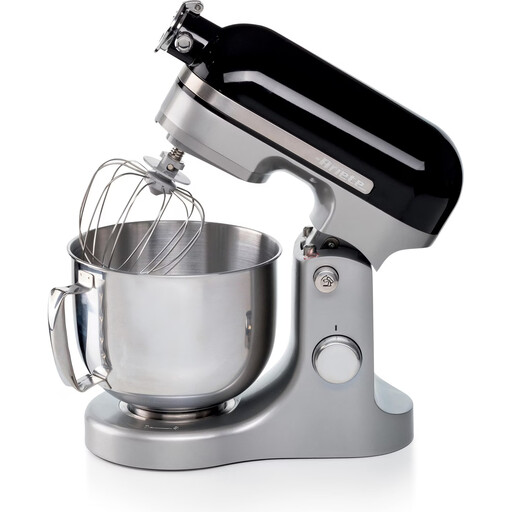 No image available
For a batch within the stated dough capacity; larger quantities need to be planned differently.
5.5-litre stainless steel bowl; 11 speeds; stated dough capacity of 1.4 kg; dough hook, flat beater, whisk and splash guard as listed in the product details.
No. Compare the flour quantity and total weight for each batch with the specifications for the exact model and type of dough. For the MUM58710, Bosch Home Appliances Germany lists a capacity of up to 1.9 kg of yeast dough separately from its 3.9-litre bowl capacity.
Follow the operating time and overload guidance in your model’s manual. For the KM 3899, Severin describes an automatic shut-off after a maximum of 15 minutes’ operation or in the event of an overload, followed by around 20 minutes of cooling time if needed; this doesn’t apply to other machines as a general rule. Switch off the appliance, unplug it and wait until it has stopped moving before cleaning.
Electrical appliances covered by relevant harmonised EU rules must carry CE marking. The European Union describes it as the manufacturer’s declaration of conformity, not an independent quality mark. Parts that come into contact with dough must also meet the requirements for food contact materials. Check the labelling and product documentation for the specific listing.
Your statutory rights are generally against the seller; a voluntary manufacturer’s guarantee is separate. The Verbraucherzentrale lists repair or replacement as the first options for bringing the product into conformity.