
Lieferung heute & morgen

Qualitätsgarantie

Willkommens-Angebote freischalten: KOSTENLOSE Lieferung | Bis zu 80 % RABATT | Kostenlose 30-Tage-JoyPlus-Testphase
App herunterladen
A stand mixer with a bowl can take much of the hard work out of baking bread, making biscuits and whipping cream. But power ratings, capacity and attachments aren’t always presented consistently. If you focus only on a high wattage or a large bowl, you could end up with a mixer that’s too small, too noisy or difficult to clean for your household.
This buying guide explains which specifications really matter and what to check before you buy.
A figure such as 1000 watts might seem straightforward at first. However, for many appliances, this refers to the maximum or so-called peak power. The actual rated power may be lower. For example, the Monsga SM100 is listed with 1000 watts peak power and 600 watts rated power.
When choosing a mixer, it’s therefore important to check:
A high wattage alone doesn’t tell you how well a stand mixer will handle every type of baking dough.
A stand mixer with a 6-litre bowl offers more space than a 4- or 5-litre model. However, the maximum usable capacity depends on the ingredients. Liquid mixtures, cake batter and firm bread dough place different demands on the motor and attachments.
The Monsga SM100 is listed with a maximum bowl capacity of 6.0 litres and a recommended capacity of 5.0 litres. This difference matters: it helps stop ingredients being pushed over the rim while kneading. Check the recommended working quantity in the instruction manual rather than comparing bowl capacities alone.
A stand mixer is versatile only if its attachments suit the way you plan to use it:
A traditional blender, on the other hand, is often designed for chopping or blending liquids. It won’t replace a stand mixer with a dough hook if you regularly make heavy doughs.
A compact mixer may be enough for occasional cakes and biscuits. If your family often bakes bread or pizza, also look for torque at low speed, overload protection and a sturdy build.
A stand mixer with 8 speed settings allows you to adjust more precisely, from gently folding ingredients to whipping at speed. However, more settings don’t automatically mean better results. What matters is being able to use low and medium speeds with control. For kneading, a low to medium setting is generally recommended, according to the instruction manual.
A bowl made from 304 stainless steel is rust-resistant and designed for contact with food. A handle, secure locking mechanism and tilting motor head are useful features. They make it easier to fit and remove the bowl and attachments.
A smaller bowl is often enough for two or three people. Families and anyone preparing larger batches of dough may want to consider a stand mixer with a 6-litre bowl. You’ll need enough worktop space for it, so check the dimensions, weight and cable length against the space you have in mind before buying.
A stated noise level can help when comparing mixers, but it depends on the measuring distance, type of dough and speed setting. The Monsga SM100 is described as producing less than 75 dB, while the Ariete model is listed at 70 dB. Treat these as manufacturer figures, not a guarantee of how noisy a mixer will seem in every kitchen.
Suction feet or non-slip elements can improve stability. For everyday use, dishwasher-safe attachments and a splash guard are also helpful. Don’t immerse the motor housing in water; clean it with a damp cloth instead.

Why this product suits this profile: Its 5-litre stainless steel bowl and ten speed settings make it suitable for everyday cakes, biscuits and smaller batches of bread dough.
The product details list the motor power, bowl capacity, speed settings and attachments separately. This makes it easier to assess what’s included than relying on a single wattage figure.
5-litre bowl, 10 speed settings plus pulse function, dough hook, whisk, mixing beater and splash guard.
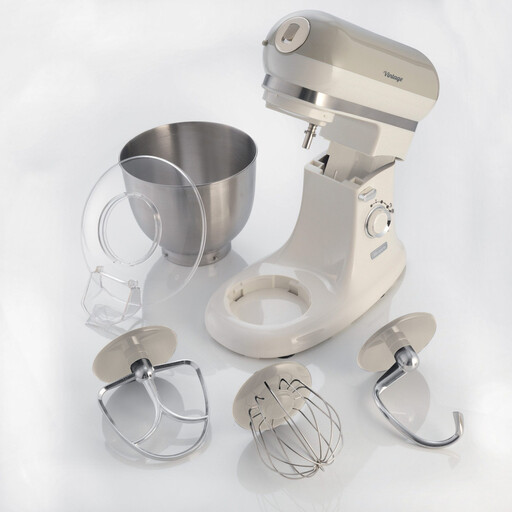
Why this product suits this profile: A good option for anyone who values clear power specifications as well as a larger bowl and a defined set of attachments.
The specifications list 1200 watts, 5.5 litres, seven speed settings and a pulse function separately. This makes it easier to judge whether the mixer suits the quantity in your recipe.
5.5-litre stainless steel bowl, planetary mixing action, dough hook, whisk and mixing attachment; attachments are listed as dishwasher-safe in the product description.
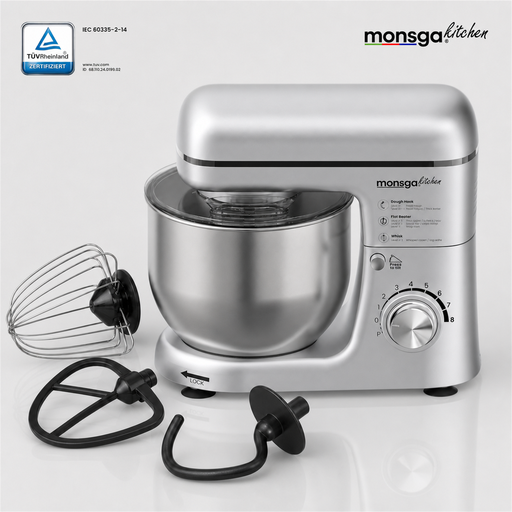
Why this product suits this profile: For households that regularly prepare larger quantities and want a stand mixer with 1000 watts peak power, a large bowl and several attachments.
The specifications distinguish between 1000 watts peak power and 600 watts rated power. They also state a recommended capacity of 5.0 litres for the 6.0-litre bowl.
6-litre stainless steel bowl with handle, eight speed settings, dough hook with Teflon coating according to the product details, whisk, mixing beater and splash guard.
We’ve put together a complete, regularly updated list of products that meet these strict selection criteria and fully comply with the safety regulations in force in the EU.
It depends on the recipes you make. Lower power is often enough for light cake batters and cream. If you regularly make bread or pizza dough, rated power, torque, a dough hook and overload protection matter more than a maximum figure on its own. A 1000-watt stand mixer may be suitable if peak and rated power are clearly stated.
A 5- to 6-litre bowl offers plenty of room for many family recipes. The recommended filling capacity is what matters, though. Don’t fill the bowl to the rim when making firm dough: this puts more strain on the motor and ingredients may spill out.
There’s no reliable one-size-fits-all answer. Lifespan depends on how often you use the mixer, the quantity of dough, how you clean it and whether you follow the recommended operating times. Sticking to the maximum filling capacity, using low speeds for kneading and cleaning the motor housing with a dry cloth can help reduce everyday wear and tear.