
Lieferung heute & morgen

Qualitätsgarantie

Willkommens-Angebote freischalten: KOSTENLOSE Lieferung | Bis zu 80 % RABATT | Kostenlose 30-Tage-JoyPlus-Testphase
App herunterladen
A stand mixer with a bowl should knead dough, whip cream and mix batters evenly. In practice, however, the differences often only become apparent after several uses. A high wattage rating alone says little about the appliance’s actual suitability, and a large bowl does not automatically mean it is designed for large quantities of dough.
Before buying, home bakers, families and private households should therefore check three common pitfalls:
For occasional mixing, a compact electric hand mixer is often sufficient. If you regularly prepare bread, pizza or firm shortcrust pastry, you should also pay attention to the construction, permitted dough quantity and operating instructions.
A higher wattage may indicate greater power reserves, but it is not proof of quality on its own. More meaningful factors include:
A dough mixer should not be operated continuously at its highest setting when working with heavy doughs. The operating time specified by the manufacturer should be observed, particularly with budget models.
A 5.5-litre or 6-litre stand mixer provides ample room for many family recipes. What matters, however, is how much flour, liquid or finished dough the appliance can actually process. For example, the Ariete 1589 Moderna is specified as having a 5.5-litre bowl capacity and a maximum dough quantity of 1.40 kg. These figures should not be treated as equivalent.
Use the following guide when choosing:
The shape of the bowl also matters. A splash guard reduces flour and liquid splashes. A bowl handle makes transferring ingredients easier, while a tilting machine head simplifies changing accessories.
A stand mixer with a dough hook, whisk and beater covers the most important baking tasks. The dough hook is designed for yeast, bread and pizza dough. The whisk is suitable for cream, egg whites and light creams. A flat beater or K-beater processes cake batter, buttercream and softer mixtures.
Multiple speed settings allow you to adapt the appliance more precisely to the recipe. Ideally, a stand mixer with several speed settings should start slowly, preventing flour from splashing out of the bowl. A pulse function can be used for short, controlled bursts.
When it comes to cleaning, the following points are relevant:
If you only prepare small quantities and make dough occasionally, a hand mixer can be a suitable alternative. According to the product details, the SEVERIN HM 3820 model has 300 watts, five speed settings plus turbo, as well as two beaters and two dough hooks. A separate bowl is required, and the appliance must be used according to the instructions when working with firm dough.
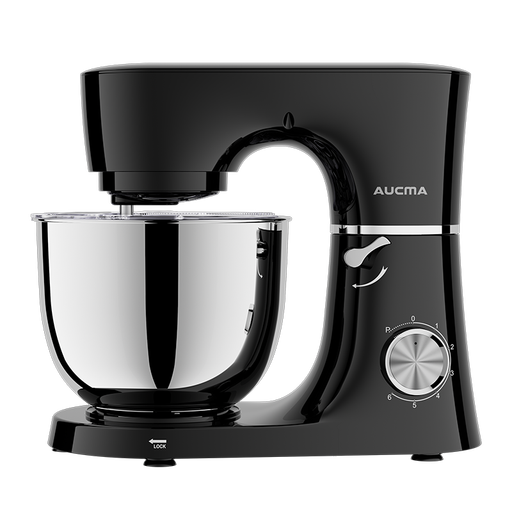
Why this product suits this profile: The 6-litre stainless steel bowl, six settings and three standard attachments cover typical baking and cooking tasks in a household.
The product details state the bowl size, accessories and safety features alongside the motor power. This makes it easier to assess how it can be used than by looking at the wattage alone.
450-watt motor, 6-litre stainless steel bowl, pulse function, dough hook, whisk and beater.
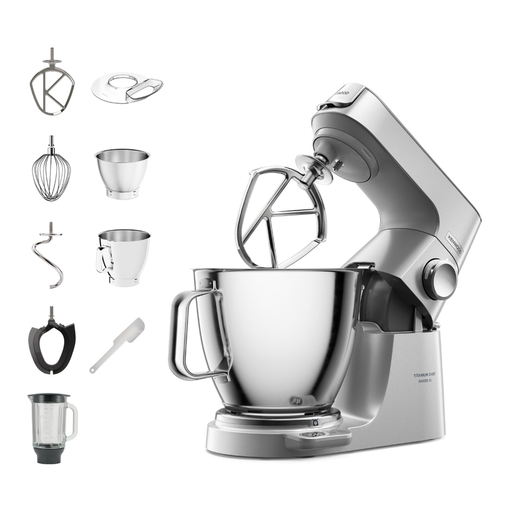
Why this product suits this profile: For regular baking, this model offers additional features such as integrated scales and two bowls with capacities of 7 and 5 litres.
The two bowl sizes reduce the need to process small and large quantities in the same bowl. The integrated scales are listed as a specific feature.
1200 watts, variable speed control, EasyWeigh scales, K-beater, whisk, dough hook and Flexi beater.
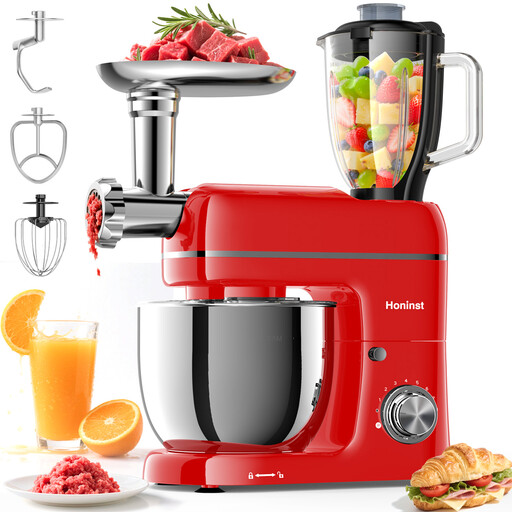
Why this product suits this profile: This appliance combines mixing and kneading with additional attachments for blending and chopping, making it suitable for households with a wide range of kitchen tasks.
The additional functions are linked to specific accessories. Before buying, check whether you genuinely need the meat grinder and blender jug in your household and whether you will clean them regularly.
6-quart bowl, 1300 watts maximum power, eight settings plus pulse function, meat grinder and blender attachments.
Electricity consumption mainly depends on power, running time and frequency of use. An appliance with a higher rated power does not automatically use more electricity for every recipe if it runs for less time. For everyday use, efficient processes, suitable quantities and following the recommended running times are therefore key.
You should also look out for:
For regular baking in a family household, 5.5 to 6 litres is often practical. The permitted dough quantity for the specific model remains the deciding factor. For small portions, a 4-litre bowl may take up less space.
A stand mixer works hands-free and usually offers a larger bowl and greater stability when handling dough. A hand mixer is more compact, easier to store and suitable for smaller quantities. The right choice depends on the quantity of dough, how often you bake and the space available.
It is not possible to give a reliable general lifespan. This depends on the motor, gearbox, care, dough quantity and operating time. Staying within the maximum capacity, using the accessories correctly and cleaning the motor housing with a dry cloth helps reduce typical strain.
We have put together a complete, regularly updated list of products that fully meet these strict selection criteria and the safety regulations applicable in the EU.