
Lieferung heute & morgen

Qualitätsgarantie

Willkommens-Angebote freischalten: KOSTENLOSE Lieferung | Bis zu 80 % RABATT | Kostenlose 30-Tage-JoyPlus-Testphase
App herunterladen
A stand mixer with a bowl can save you time when baking and cooking, provided the bowl size, attachments and motor power suit your needs. Many shoppers, however, focus first on wattage or a long list of accessories. That can lead to the wrong purchase: a machine may be advertised as versatile, yet wobble on the worktop, heat up quickly when kneading bread dough or take up more cupboard space than expected.
This buying guide from the Joybuy Product Recommendation Officer explains which specifications really matter and which model might suit different needs.
A high wattage rating alone tells you little about how well a dough mixer handles firm bread dough. The gearbox, power transmission, speed control, mixing system and the manufacturer’s stated maximum dough capacity all matter too. With compact machines, you should also avoid kneading continuously without breaks.
Check the instruction manual, the permitted filling capacity and the guidance on overheating protection. A motor with a moderate rated power may be suitable for everyday household quantities, while a high peak power rating does not automatically mean the machine is suitable for large batches of bread dough.
A 6-litre stand mixer offers more room than a 4- or 5-litre model. But that does not mean you can fill the bowl to the brim. Liquids, flour and dough all need room to move. On the other hand, a very large bowl can be impractical for small quantities if the whisk cannot reach the ingredients properly.
Look at the recommended working capacity, not just the stated bowl capacity. A 5 to 6.5-litre bowl can be a good choice for families and frequent baking. If you usually make smaller cakes, a more compact mixer may suit you better.
A stand mixer for baking often comes with three basic attachments: a dough hook, a whisk and a flat beater or mixing beater. This combination covers many everyday tasks. However, a blender attachment, meat mincer or vegetable slicer is not necessarily included.
Read the accessories list before buying and check whether replacement parts are available. It’s also worth checking whether the bowl and attachments are dishwasher-safe, and whether the motor housing should only be cleaned with a damp cloth. These details have more impact on everyday use than decorative extras.
Stainless steel is widely used for mixing bowls because it is durable and easy to clean. The models featured here include bowls made from 304 stainless steel. Capacities range from 4 litres to 6.5 quarts; quarts are not exactly equivalent to litres, so compare the manufacturers’ specific capacity claims.
A capacity of 5 to 6 litres is often suitable for family-sized portions, pizza and bread dough, or several cake components. You should still check the maximum dough capacity in the instruction manual.
Multiple speed settings let you start slowly when mixing flour and liquids, then increase the speed for whipping cream or egg whites. A pulse function can deliver short bursts of power. It is no substitute for precise speed control, but it can be handy for certain recipe steps.
The speed control on an electric stand mixer should be easy to reach. A tilt-head design also makes it easier to fit the bowl and change attachments.
Non-slip feet or suction cups help reduce movement on a smooth worktop. A stable body is more important than striking looks, especially when kneading. Decibel figures are only comparable when measured in the same conditions: a model rated by its manufacturer at under 60 dB cannot be directly compared with one rated at 72 or 75 dB.
Also check the recommended operating time and cooling breaks. Overload and overheating protection are useful safety features, but they do not mean you can knead continuously or exceed the permitted capacity.

Why this product suits this profile: The 5-litre stainless steel bowl, ten speed settings and three basic attachments cover everyday baking and cooking tasks around the home.
The product details specify a rated power of 400 watts, overheating protection and a recommended operating limit for kneading. This makes it easier to assess the machine realistically rather than relying on peak power figures alone.
304 stainless steel bowl, ten speeds plus pulse function, dough hook, whisk and mixing beater.
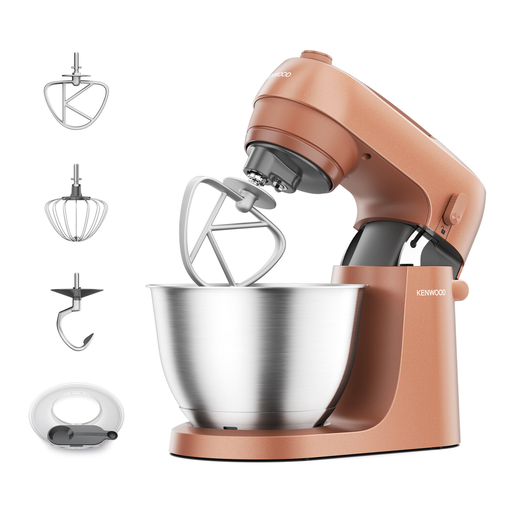
Why this product suits this profile: The metal body, 4-litre stainless steel bowl and compact height of 30 cm will appeal to buyers who consider both materials and worktop space.
The product description gives specific maximum quantities for cake and bread dough, making it easier to compare the capacity with the size of your usual recipes.
800-watt motor, six speeds plus pulse function, K-beater, balloon whisk and dough hook.
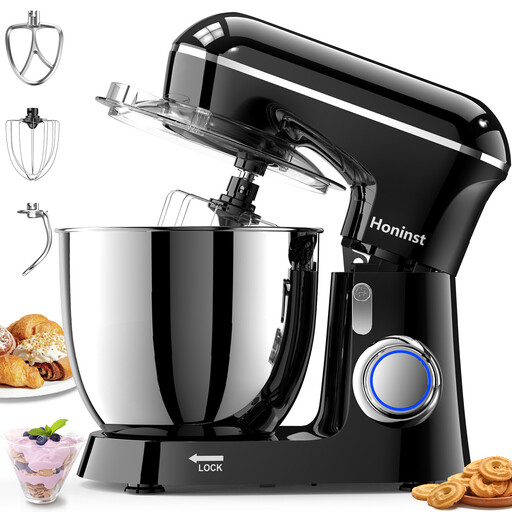
Why this product suits this profile: According to the product details, the larger bowl is suitable for bigger household quantities and a range of baking tasks, from bread to desserts.
As well as ten speed settings, the product details list a splash guard, non-slip suction cups and overheating protection. Even with the larger bowl, you should only fill it within the limits set out in the instruction manual.
6.5-quart stainless steel bowl, dough hook, whisk and mixing beater; product details state a noise level below 60 dB.

Why this product suits this profile: The 6-litre capacity is well suited to family-sized portions, while its straightforward range of features handles bread, pizza, cakes and pasta.
The specifications list 450 watts, six speeds plus a pulse function, and a noise range of 68 to 72 dB measured from one metre away. This gives you a more specific basis for comparison.
6-litre stainless steel bowl, three standard attachments, splash guard, plus overload and overheating protection.
We’ve put together a complete, regularly updated list of products that meet these strict selection criteria and the safety regulations in force in the EU.
A 4- to 5-litre bowl is often enough for a small household. Families who regularly bake bread, pizza or several cakes may want to consider a 6-litre bowl or larger. The manufacturer’s stated maximum ingredient and dough capacities are still the most important factors.
Its lifespan depends on how often you use it, how you clean it, how heavily you load it and whether you follow the recommended operating intervals. Don’t overfill the bowl, use the right attachments and let the motor cool down after longer kneading sessions. Keep the motor housing out of water.
Energy use depends on the rated power and how long the machine runs. A 400-watt appliance used for a shorter time may use less energy in everyday use than a more powerful model that runs for longer. To estimate running costs, use: power in watts × operating time in hours = approximate energy use in watt-hours.