
Lieferung heute & morgen

Qualitätsgarantie

Willkommens-Angebote freischalten: KOSTENLOSE Lieferung | Bis zu 80 % RABATT | Kostenlose 30-Tage-JoyPlus-Testphase
App herunterladen
A stand mixer with a bowl can be much more practical than a handheld appliance for kneading, mixing and whisking. However, not every mixer will automatically deliver great results. The key factors are the combination of motor power, bowl capacity, attachments, stability and ease of use.
A high wattage may sound impressive at first, but it doesn’t give you the full picture of how an appliance will perform in everyday use. You should also consider the drive system, the power available at low speeds and the permitted running time. A motor may be under more strain when kneading firm bread dough than when briefly whipping cream.
So check the details on overheating and overload protection, recommended quantities and the rest periods required between several cycles.
A 6-litre stand mixer offers more space than a 5-litre model. However, that doesn’t mean you can fill the bowl to the brim with dough. Liquids, flour and yeast dough all need room for the mixing attachment to move. Always check the instruction manual for the actual maximum quantity.
A very large bowl may also be impractical for smaller households if the mixing attachment can’t reliably reach small quantities.
A stand mixer with a dough hook, whisk and beater can handle typical baking tasks. But it’s also important to check whether the attachments are quick to change and whether there’s a splash guard. Attachments that are difficult to clean often end up being used less.
Check the care instructions carefully for coated attachments. Stainless steel parts and dishwasher-safe components can make cleaning easier, but they don’t replace the manufacturer’s instructions.
A bowl made from food-grade stainless steel, such as SUS304, is durable, doesn’t retain flavours and is generally easy to clean. As well as the stated capacity, check the shape of the bowl and whether it has a handle.
A stand mixer with several speed settings should let you gently fold ingredients in as well as whisk at high speed. A pulse function can be useful for short bursts of power, but it shouldn’t be confused with continuous operation.
A low to medium setting is usually recommended for yeast dough. Egg whites and cream are typically whisked at a higher speed. An electric stand mixer with a clearly marked speed dial lets you adjust the speed more precisely than a model with just two fixed settings.
Suction cups or non-slip feet can help stop the mixer from moving around on the worktop. Even so, it should always be placed on a level, dry and stable surface. The decibel rating is useful for comparing models, but the noise you hear also depends on the worktop, the room and the consistency of the dough.
Also measure the space available before you buy. A tilt-head design makes it easier to change attachments, but you’ll need extra headroom to open it.
The models below vary in capacity, stated motor power, speed settings and attachments. The details are based on the respective product descriptions.

Why it suits this profile: The 5-litre stainless steel bowl, ten speed settings and three standard attachments cover typical baking and cooking tasks at home.
The product description specifies overload and overheating protection, as well as four suction cups. This makes key buying criteria clear.
Stated 400-watt motor power, 5-litre bowl, dough hook, whisk, beater and pulse function.

Why it suits this profile: The 6-litre capacity gives you extra room for bread, pizza and cake dough when you regularly cook for several people.
Check the stated bowl capacity against the recommended quantities in the manual. The product description also gives a noise level of 68–72 dB at a distance of one metre.
6-litre bowl, stated 450-watt motor power, six speeds plus a pulse function, and a splash guard.
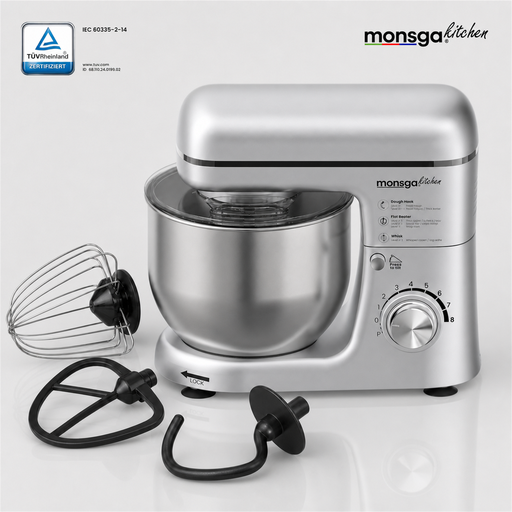
Why it suits this profile: This model is aimed at frequent users looking for an electric stand mixer with several speed settings, a large bowl and coated attachments.
The description distinguishes between 1000 watts of peak power and 600 watts of rated power. This helps you assess the motor rating accurately.
6-litre bowl, eight speed settings, 360-degree planetary mixing action and a Teflon-coated dough hook, according to the product description.

Why it suits this profile: This multifunctional stand mixer combines mixing, kneading and whisking with a mincer and blender attachment.
Before buying, consider whether you’ll actually use all the additional functions. The manual also specifies a maximum running time of six minutes.
Stated maximum power of 1300 watts, 6-quart bowl, eight speed settings plus a pulse function, and mincer and blender attachments.
We’ve put together a complete, regularly updated list of products that meet these strict selection criteria and fully comply with the safety regulations in force in the EU.
A blender or hand blender, on the other hand, is better suited to smoothies, soups, sauces and puréed ingredients. For bread and pizza dough, a baking stand mixer with a dough hook is generally the more suitable type of appliance.
Wattage alone isn’t a reliable way to choose a mixer. Also check the rated and peak power, gearing, recommended dough quantity, and operating and rest times. A smaller model may be enough for occasional baking; if you often make yeast dough, a sturdy design and low speed are more important.
Its lifespan depends on how it’s used, the quantity of dough, cleaning and whether you follow the manufacturer’s instructions. Overloading, long continuous runs and using the wrong attachments can put extra strain on the motor and drive system. Regular cleaning and allowing the motor to cool between cycles help ensure it’s used as intended.
It depends on the quantities in your recipes and the space you have available. A 6-litre bowl is handy for family-sized portions, but takes up more room. If you mostly prepare small quantities, check whether the mixing attachment can reliably reach them.