
Lieferung heute & morgen

Qualitätsgarantie

Willkommens-Angebote freischalten: KOSTENLOSE Lieferung | Bis zu 80 % RABATT | Kostenlose 30-Tage-JoyPlus-Testphase
App herunterladen
A stand mixer with bowl can take over a lot of the hard work when baking bread, stirring cake batter and whipping cream. However, high wattage, large litre capacities and lots of accessories don't automatically lead to the right buying decision. What really matters is whether the motor, bowl, accessories and controls suit your own recipes and the space you have available.
Manufacturers sometimes quote the maximum or so-called peak power. This figure doesn't always describe the continuous usable motor power. When comparing a kneading machine, you should therefore also look at the stated nominal power, the maximum dough quantity and the intended application.
For yeast dough, a dough hook is essential. A stand blender with a blade attachment, on the other hand, is primarily intended for liquids, smoothies or puréed ingredients and does not replace a dough kneading machine.
A bowl with a 6-litre capacity cannot be completely filled with dough. Dough expands and needs room to move. With the Monsga SM100, for example, the total volume is 6.0 litres with a recommended usage of up to 5.0 litres. The maximum dough quantity can also be significantly lower than the bowl volume.
A set with a dough hook, whisk and flat beater covers many standard recipes. Nevertheless, buyers should check whether the parts are dishwasher-safe, what material they are made from and whether a splash guard is included. A stand mixer with a stainless steel bowl is also usually easy to clean and odour-resistant, but should not be treated with abrasive cleaners or steel wool.
For a stand mixer for baking, several speed levels are useful: low levels for mixing and kneading, medium levels for cake batter, and higher levels for egg whites or cream. A stand mixer with multiple speed levels allows finer adjustment than an appliance with just two settings.
Pay attention to the following details:
For single people or small households, 4 litres can be sufficient. Families and users who regularly bake bread, pizza or several cakes often prefer 5 to 7 litres. The external dimensions should not be overlooked either. A machine not only needs to sit on the worktop, but also fit under wall units when the head is tilted up.
Noise figures such as 70, 72 or 75 dB are only meaningful when measured under comparable conditions. They provide a technical reference value, but no guarantee of a particular perception in the kitchen. Non-slip feet, suction pads and a sturdy housing help to reduce movement during kneading.
For everyday use, a tilting motor head, a splash guard and dishwasher-safe accessories make handling easier. The motor housing, cable and mains plug must never be immersed in water.

Why this product fits the profile: This appliance offers a 6-litre stainless steel bowl, six levels plus pulse function, and a dough hook, whisk and flat beater for typical household baking recipes.
The product details clearly state motor power, capacity, a noise range of 68 to 72 dB and the accessories included.
6-litre bowl, pulse function, overheating protection and four suction pads.
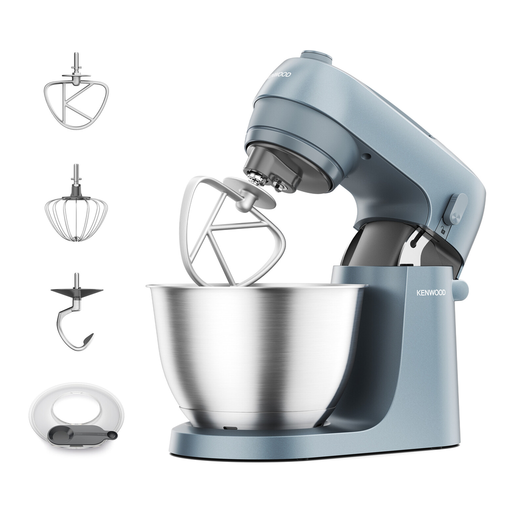
Why this product fits the profile: With a height of 30 cm, a 4-litre stainless steel bowl and controls at the front, this model is designed for smaller worktops.
The compact height is stated concretely, replacing vague claims about space saving.
800-watt motor, six levels plus pulse function, and K-beater, balloon whisk and dough hook.

Why this product fits the profile: The integrated EasyWeigh scales and the DuoBowl system with 7-litre and 5-litre bowls are aimed at users who frequently prepare different quantities.
The features are described using specific components: scales, two bowls and variable speed control.
1200 watts nominal power, 7-litre bowl, Flexi-beater and several baking attachments.

Why this product fits the profile: In addition to stirring and kneading, the set includes a meat grinder and a blender attachment for users who want to consolidate several kitchen appliances.
The additional functions and the 6-litre bowl are listed concretely; the maximum running time of six minutes should be noted.
1300 watts maximum power, eight levels plus pulse function and multiple attachments.
We have put together a complete, regularly updated list of products that fully meet these strict selection criteria and the safety regulations in force in the EU.
For smaller quantities, 4 litres is often sufficient. For families, bread and pizza dough, 5 to 7 litres is practical. What matters most is the permitted dough quantity, as the nominal bowl volume should not be fully used.
A stand mixer for bread and cakes should have at least a dough hook, a whisk and a flat beater. For yeast dough, a stated dough capacity is also important. For cakes, cream and egg whites, several speed levels are needed.
The consumption depends on the nominal power and the running time. An appliance with 1200 watts uses up to 0.6 kWh during half an hour of operation if it continuously draws this power. During normal stirring, the actual consumption is often lower. Wattage and running time should therefore be considered together.