
Lieferung heute & morgen

Qualitätsgarantie

Willkommens-Angebote freischalten: KOSTENLOSE Lieferung | Bis zu 80 % RABATT | Kostenlose 30-Tage-JoyPlus-Testphase
App herunterladen
A stand mixer with bowl can save you time when baking and cooking, provided the bowl size, attachments and motor power match your actual needs. If you regularly make bread, pizza, cakes, creams or pastries, you shouldn't just focus on wattage or a modern casing. What really matters is the combination of usable capacity, the right mixing attachment and a sturdy construction.
A specification like "6 litres" describes the volume of the bowl. That doesn't automatically mean you can process six litres of dough or liquid. With yeast dough, the permitted amount is usually much lower. The manufacturer Monsga, for example, states a recommended usable capacity of 5 litres for a 6-litre bowl. With the Ariete model featuring a 5.5-litre bowl, a maximum dough quantity of 1.4 kg is specified.
For families, a 6-litre stand mixer is practical, provided your work surface is large enough. Also check the maximum dough quantity stated in the instruction manual.
Motor power is just one parameter. The gearbox, overheating protection, drive system and how long the appliance can run under load are also relevant. An electric stand mixer with high peak power can still struggle with heavy dough if the recommended dough quantity is exceeded.
So look out for information on overload protection, cooling breaks and the intended domestic use. A stand mixer for baking isn't automatically designed for continuous operation like in a bakery.
A dough hook is intended for firm yeast doughs, bread and pizza dough. The mixing paddle or flat beater is suitable for cake batter, creams, sauces and softer mixtures. A balloon whisk is used for whipping eggs, cream or light mixtures.
A stand blender with a blade attachment serves a different purpose. It's designed for smoothies, soups or purées and doesn't replace a dough kneading machine with a bowl.
A stainless steel bowl is durable, food-safe and generally doesn't absorb odours. A handle makes it easier to remove, while a splash guard can reduce flour dust and liquid splashes. With a tilting head design, the bowl and attachments are often easier to fit.
Look out for:
A stand mixer with multiple speed settings allows finer adjustment to your recipe. Low speeds are suitable for initial mixing and kneading, medium settings for cake batter, and higher speeds for whipped cream or egg whites. A pulse function can provide a short burst of extra speed.
However, more settings don't automatically mean better results. What's important is that the speed can be adjusted smoothly and that the manufacturer provides clear usage instructions.
Removable attachments and dishwasher-safe accessories can make cleaning easier. The motor housing must never be immersed in water. Before changing the dough hook, balloon whisk or mixing paddle, the appliance must be switched off and unplugged from the mains.
Also look out for:

Why this product fits the profile: The 5-litre stainless steel bowl and ten speed settings cover typical baking and cooking tasks in the home.
The product details state the bowl volume, ten speeds, pulse function and maximum operating limits in the safety instructions.
5-litre bowl, ten speed settings, dough hook, balloon whisk, mixing paddle and splash guard.
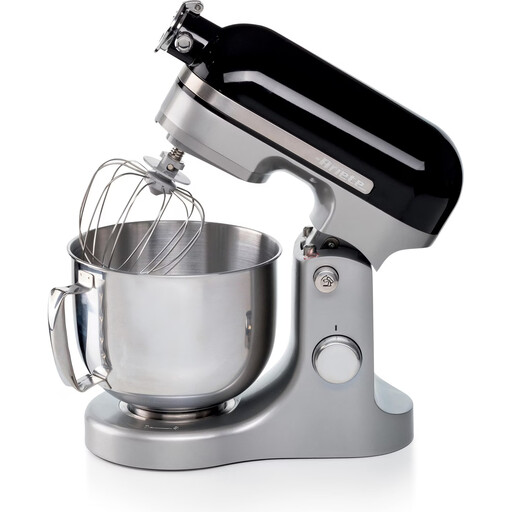
Why this product fits the profile: This model combines a 5.5-litre stainless steel bowl with eleven speed settings and extensive accessories.
The stated dough capacity of 1.40 kg helps avoid confusing bowl size with the permissible dough quantity.
1600 W power rating, eleven speeds, 3D planetary mixing system, five accessories and dishwasher-safe parts.

Why this product fits the profile: The large bowl and three standard attachments suit a wide range of household recipes from bread to cakes.
The product description mentions ten speeds, overheating protection, suction cups and a splash guard rather than just highlighting motor power.
6.5-quart stainless steel bowl, ten speed settings, three attachments and, according to the manufacturer, less than 60 dB.
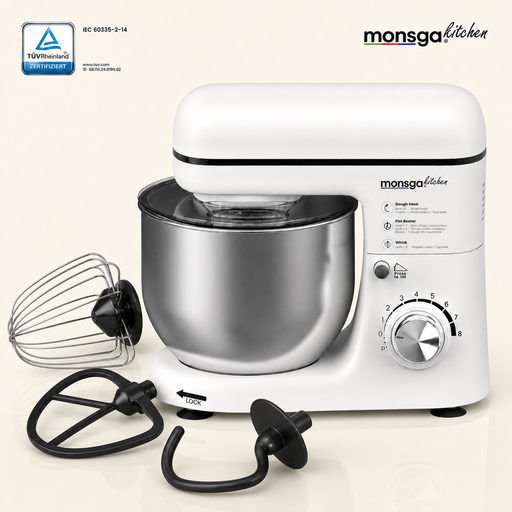
Why this product fits the profile: For regular kneading, mixing and whisking, this model offers eight speeds plus coated tools.
The recommended usable bowl capacity of 5 litres is explicitly distinguished from the maximum fill volume.
6-litre stainless steel bowl, eight speeds, coated dough hook and mixing paddle, plus dishwasher-safe accessories.
We've put together a complete, regularly updated list of products that fully meet these strict selection criteria and the safety regulations in force in the EU.
For firm doughs, a stand mixer with a dough hook and good stability is advisable. Check the maximum dough quantity stated by the manufacturer and use a low to medium speed setting when kneading. A larger bowl alone doesn't tell you anything about the permitted flour or dough quantity.
The lifespan depends on usage, cleaning, load and adherence to the recommended operating times. Overfilling, long continuous running times and incorrect attachments can put more strain on the motor and gearbox. Allow the appliance to cool down after intensive kneading sessions and store accessories in a dry place.
The ongoing electricity costs depend on the actual power consumption and the operating time. The calculation is: Power in kilowatts × operating time in hours × electricity price per kilowatt-hour. A machine with 1,000 watts running for 10 minutes theoretically consumes about 0.167 kWh. For the actual consumption, it's the real-world usage that matters, not just the maximum wattage rating.