Small lunchbox batches
If you usually bake a small batch, check that the mixer and its attachments suit the quantity in your recipe. Bowl capacity alone won’t tell you whether a machine can handle small batches well.


For lunchbox yeast dough, choose a stand mixer that suits the amount of dough you actually make and the yeast dough limit specified for that particular model – don’t rely on bowl capacity alone. For small batches, also consider whether the mixer handles smaller quantities well and how much space it takes up. If you bake in batches for the freezer, the capacity for your type of dough and the right kneading tool are key.
If you usually bake a small batch, check that the mixer and its attachments suit the quantity in your recipe. Bowl capacity alone won’t tell you whether a machine can handle small batches well.
If you prepare several portions at once, compare the weight of your recipe with the yeast dough limit stated for that specific model. Check whether the figure refers to flour or the total dough weight.
If you want to use the same machine for mixing or whisking, check which attachments are included and whether the machine and its accessories will fit in your available storage space.
| Buying concern | What to check before buying | Who should pay particular attention |
|---|---|---|
| Suitable batch size | Check the yeast dough limit for the specific model and make sure it suits the weight of your recipe. | If I usually bake just one lunchbox portion, I want a machine that suits the amount in my recipe. Small batches are a priority for around 29% of shoppers. |
| Capacity for batch baking | Compare the total weight of your dough with the model specifications; where stated, distinguish between firm and soft yeast dough. | For several lunchboxes’ worth of dough, I need a limit that suits my recipe and type of dough. Around 29% of shoppers prioritise capacity for larger batches. |
| Kneading tool and method | Check which tool is recommended for your dough, along with the speed and kneading time specified in the instructions. | If my dough contains plenty of butter and sugar, I want to match the tool and kneading method to the recipe. For around 28% of shoppers, finding the right way to knead enriched yeast dough is the main concern. |
| Space and other uses | Compare the machine’s dimensions and included accessories with your worktop space and the mixing and whisking tasks you have planned. | If worktop space is limited, I want to know whether the machine and its accessories will suit my other baking tasks. Around 14% of shoppers prioritise space and versatility. |
Specifications can refer to different types of dough. For example, Bosch Hausgeräte distinguishes between cake batter and yeast dough for the MUM58710, while Kenwood also gives separate limits for firm and soft yeast dough.
Compare the recipe weight, type of dough and specification for the exact model on a like-for-like basis.
A high capacity doesn’t prove that a machine will handle small quantities well. Ankarsrum recommends different tools for smaller and larger batches, and the machine’s footprint may also be a factor.
Check the instructions for guidance on small quantities and attachments, and measure the space where you plan to put the machine.
Attachments and extra bowls can vary between specific versions. What’s included with another model from the same brand isn’t a reliable guide to what comes in the box.
Before buying, check the full model number and the list of parts included with that particular version.
The MUM58710 may suit manageable household batches, provided its stated yeast dough capacity matches your recipe.
The Chef and Chef XL are worth considering if you compare your recipe quantity with the specifications for the exact model and type of dough.
The Assistent Original uses a rotating bowl and a different kneading method from a conventional planetary mixer.
The Artisan 5KSM175 may be a good fit if you want to mix and whisk as well as make yeast dough, and would like to use both bowls.
These stand mixers and dough mixers are product options for making yeast dough. For buttery lunchbox dough, check the specifications and instructions for the model you’re considering.
 No image available
The product name describes it as a dough mixer; check the instructions to make sure the intended recipe quantity and type of dough suit this model.
Listed features include a 5.5 L capacity, 11 speeds and a 4.5-inch LED touchscreen.
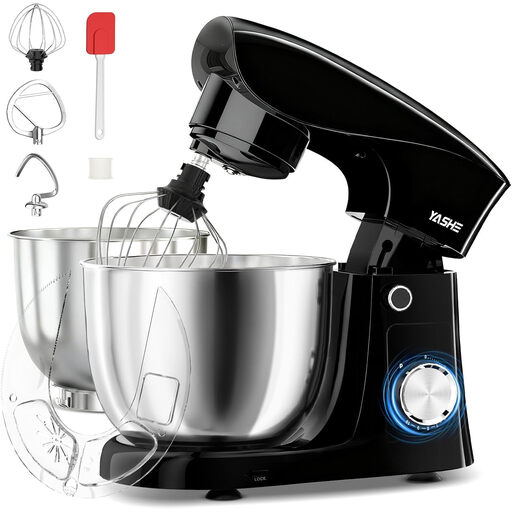 No image available
If you’re looking for a machine with a dough hook, check whether the instructions for this model cover your enriched dough and the quantity you plan to make.
The product name lists 1500 W, 10+ speeds, a tilt-head design, a dough hook and two stainless steel bowls, with capacities of 4.5 L and 5 L.
 No image available
If you want to mix and whisk as well as knead, compare the listed attachments with the tasks you have in mind.
The product name lists a 5 L stainless steel bowl, 600 W, 10 speeds, a dough hook, mixing beater, whisk and splash guard.
 No image available
The product name describes it as a dough mixer; before choosing, check the specifications for the exact model to make sure it suits yeast dough and the quantity in your recipe.
Listed features include a 4.5 L stainless steel bowl, 1300 W and a 6+P speed setting.
 No image available
If you’re considering a dough mixer with pre-set programmes, check whether its instructions describe the right method for your yeast dough.
The product name lists 5.5 L, 11 speeds, five pre-set programmes and an LED touchscreen.
No. Compare the total weight of your batch with the limit stated for yeast dough or for the specific model. Kenwood also distinguishes between firm and soft yeast dough; these limits aren’t interchangeable.
It depends on how the machine is designed. For smaller quantities and doughs with plenty of butter, Ankarsrum recommends the roller rather than the dough hook. Don’t assume this advice applies to machines with a different design.
Follow the instructions for your exact model. KitchenAid’s general FAQ recommends speed 2 for yeast dough, while a braided yeast loaf recipe from the same brand uses speed 1 and kneads for seven minutes. These aren’t rules that apply across all manufacturers.
In Germany, online purchases generally come with a right to cancel, usually within 14 days of receiving the goods. Verbraucherzentrale recommends checking the information for your specific contract and notifying the retailer that you wish to cancel.
In Germany, new mains-powered stand mixers within the relevant voltage range of 50 to 1,000 V AC must meet conformity requirements, including CE marking. According to the European Union, the CE mark indicates that the manufacturer declares the product complies with applicable rules; it doesn’t assess how well the machine kneads.