
Lieferung heute & morgen

Qualitätsgarantie

Willkommens-Angebote freischalten: KOSTENLOSE Lieferung | Bis zu 80 % RABATT | Kostenlose 30-Tage-JoyPlus-Testphase
App herunterladen
A stand mixer with a bowl can take over much of the manual work involved in baking bread, mixing and whisking. However, simply looking at wattage and bowl size will not automatically help you find the right appliance. What matters is whether the motor, accessories, capacity and controls suit the recipes you make.
Manufacturers sometimes state motor power as a peak value. The Monsga SM100, for example, is listed with 1000 Watt Peak Power, as well as a rated power of 600 Watt. When assessing an electric dough mixer, it is therefore important to check how much power is available continuously and what quantities may be processed according to the instruction manual.
An appliance with a high wattage is also not automatically designed for particularly heavy doughs. The drive system, gearing and recommended dough quantity also play a role.
A stand mixer with a 6-litre bowl offers plenty of space for ingredients. However, the usable volume may be lower than the advertised total capacity. The Monsga SM100 has a maximum bowl volume of 6 litres, but use of up to around 5 litres is recommended. For yeast dough, the manufacturer's quantity specifications also apply.
Too little mixture can cause ingredients to remain around the edge of the bowl with some mixing systems. Too much dough can put strain on the motor and gearbox.
The description quiet stand mixer is difficult to compare without knowing the measurement conditions. The Monsga SM100 is described as having a noise level of under 75 dB, while the AUCMA ASM1559 is rated at 68 to 72 dB within one metre. These figures provide a useful indication, but they depend on the speed, dough consistency, surface and distance.
A stable base can also affect noise levels. Suction cups or non-slip feet can reduce movement across the worktop.
For regular use, a stainless steel bowl is practical because it is low-odour, robust and easy to wipe clean. In addition to the total volume, check the following:
A larger bowl also requires sufficient storage space. Dimensions of around 40 centimetres in height or more may be important if you plan to place the appliance beneath wall units.
A stand mixer with a dough hook is suitable for yeast, pizza and bread dough. The flat beater or mixing paddle is designed for cake mixtures, creams and potato dishes. A whisk is typically used for whipping egg whites or cream.
If you only bake cakes occasionally, you may not need a large dough mixer. For regular bread and pizza dough, however, a sturdy dough hook, low-speed settings and a stable housing are particularly important.
Several speed settings allow you to adapt the mixer more precisely to the recipe. Slow start-up helps to reduce flour dust and splashes. Other practical features include:
Before changing accessories, switch off the appliance and disconnect it from the mains. Do not immerse the motor housing in water.

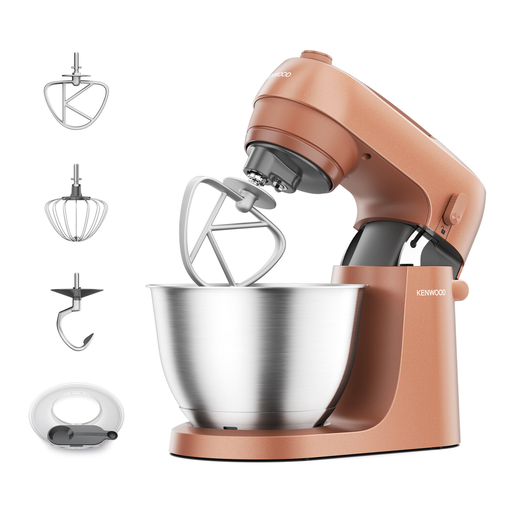
Why this product suits the profile: The 6-litre stainless steel bowl and six speed settings cover typical home baking tasks without requiring an extensive range of additional accessories.
The specifications state the 450-watt copper motor, bowl size, speed settings and accessories in detail. This makes it easier to assess the appliance than relying on performance claims alone.
6-litre stainless steel bowl, six settings plus pulse function, dough hook, whisk and flat beater, as well as a tilting motor head.
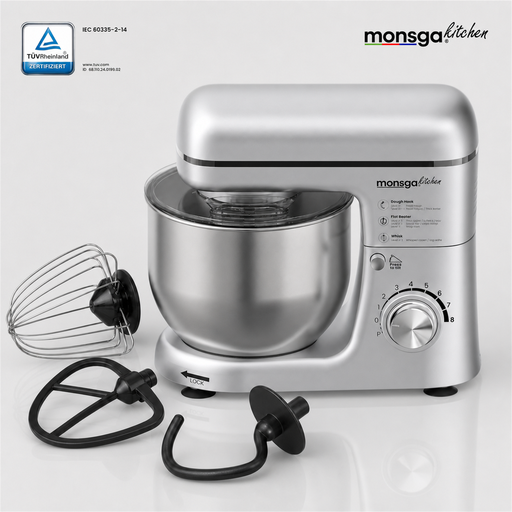
Why this product suits the profile: If you are looking for a more compact stand mixer for baking, with a branded model and metal housing, you get a 4-litre bowl in a comparatively space-saving design.
The stated 4-litre capacity is supplemented by specific maximum quantities, including 1.5 kg of bread dough and 1.8 kg of cake mixture.
800-watt motor, six settings with pulse function, planetary mixing system, 30 cm height, plus K-beater, whisk and dough hook.
Why this product suits the profile: For households that regularly make bread, cake and pizza dough, this model offers a large bowl, eight speed settings and several standard attachments.
The product specifications distinguish between 1000 watts of peak power and 600 watts of rated power. The recommended bowl capacity is around 5 litres rather than the full capacity.
304 stainless steel bowl with handle, eight speed settings, tilting motor head, dough hook, flat beater, whisk and overload protection.
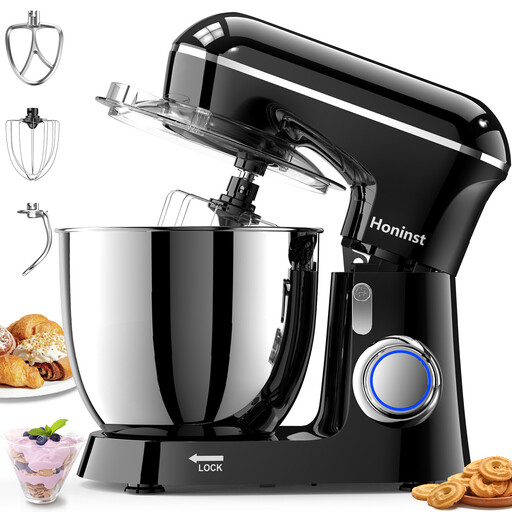
Why this product suits the profile: This model is aimed at users who regularly prepare different doughs and mixtures in larger quantities and need ten speed settings.
The instructions expressly specify typical household quantities and the permitted maximum quantities. This helps prevent a large bowl from being mistaken for unlimited load capacity.
6.5-quart stainless steel bowl, ten speeds, three attachments, tilting head, splash guard and overheating protection according to the product description.
We have put together a complete, regularly updated list of products that fully meet these strict selection criteria and the safety regulations applicable in the EU.
A stand mixer with a bowl is designed for kneading, mixing and whisking. It generally works hands-free and is suitable for larger quantities. A blender with a blade attachment, on the other hand, is primarily used to process liquids, fruit, vegetables, ice or nuts. It cannot replace a dough mixer for bread dough.
A hand mixer is more compact and can be used with different bowls. It may be sufficient for small quantities of cake mixture or cream. With firm bread dough, however, the strain depends more heavily on how it is used and on the manufacturer's specifications.
For regular cake, bread and pizza preparation, 4 to 6 litres is often sufficient. The recommended dough quantities are what matter, not just the nominal volume. With smaller recipes, a very large bowl can also be less practical if the mixing tools cannot reach the bottom properly.
Consumption depends on the actual motor power and how long the appliance runs. An appliance with a rated power of 600 watts running for ten minutes would theoretically use around 0.1 kWh. Actual consumption may vary depending on the dough, speed and appliance. Short operating times and suitable quantities help to reduce unnecessary strain.
It is not possible to reliably determine a fixed service life from the wattage. It depends, among other things, on how frequently the appliance is used, the dough quantity, cleaning and breaks during longer operating periods. Keeping within the maximum load, using accessories correctly and disconnecting the appliance from the mains before cleaning all help create the right conditions for reliable use at home.