
Lieferung heute & morgen

Qualitätsgarantie

Willkommens-Angebote freischalten: KOSTENLOSE Lieferung | Bis zu 80 % RABATT | Kostenlose 30-Tage-JoyPlus-Testphase
App herunterladen
A steak knife should cut through meat cleanly without unnecessarily tearing the surface. At the same time, many households use the same knife for pizza, quiche, bread and bread rolls. Descriptions such as ‘extra sharp’, ‘rust-resistant’ or ‘professional’ may sound convincing at first. However, specific details about the blade, handle, dimensions and care are much more informative.
A serrated steak knife can be practical when cutting through crusts and fibrous foods. The teeth grip the surface and reduce the effort required. However, this does not mean that every serrated steak knife cuts in the same way. The shape and consistency of the teeth, as well as the quality of the blade construction, are also important.
A coarse or uneven serration can leave untidy cuts on delicate foods. For steaks, pizza and firm crusts, a fine to medium serrated edge is usually more versatile than very coarse teeth.
The term stainless-steel steak knife initially describes only the blade material. The construction, blade thickness and care instructions are also relevant to everyday usability. A non-forged knife may be perfectly adequate for use at the dining table, while a model made from a single piece or forged is more likely to be designed for stability and a particular feel in the hand.
Stainless steel still needs care. Food residue, salt and acids should not be left on the blade for long. Thorough drying after washing is advisable, even if the model is stated to be dishwasher-safe.
A coloured plastic handle can be practical when several knives need to be easy to distinguish at the table. However, a secure shape, sufficient room for your fingers and balanced weight are more important. A handle that is too smooth may feel less secure with wet hands. If you use the knife frequently, an ergonomically shaped handle with a clean transition to the blade is recommended.
For table and steak knives, a blade length of 11 to 13 cm is easy to handle in everyday use. An 11 cm blade is suitable for steaks, pizza, sausages and many smaller cutting tasks. Longer models can provide more cutting surface for larger portions or firmer foods, but they also require more space at the table.
A serrated steak knife is particularly suitable for grilled surfaces and crisp pizza bases. With a smooth edge, the cutting edge can usually be sharpened more precisely. With a serrated edge, however, the tooth geometry is crucial; a conventional sharpening steel is not always suitable.
Polypropylene, or PP for short, is a common plastic material for lightweight table knives. It is resistant to moisture and easy to clean. One example is the Victorinox Swiss Classic models with PP handles, an overall length of around 22 cm and a weight of approximately 28 g.
With a steak knife set, all the handles should ideally have a consistent shape. For the hospitality and catering sectors, stackable storage, quick cleaning and a sufficient number of knives are also important.
A dishwasher-safe steak knife saves time, but it should not automatically be left in the dishwasher permanently. Heat, alkaline detergents and contact with other cutlery can put greater strain on the cutting edge and handle surface. We recommend:
For cutting performance, a wooden, plastic or fibre-based chopping board is generally more suitable.
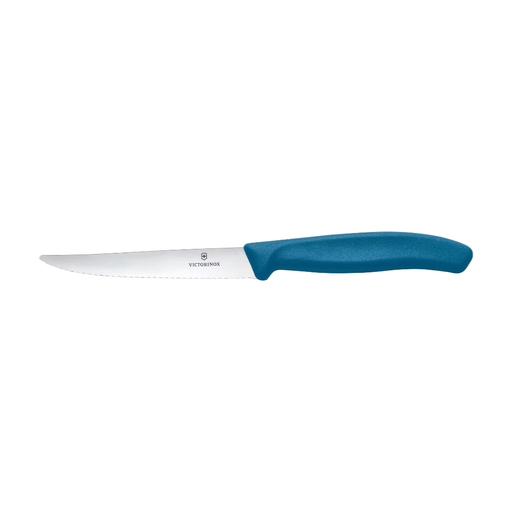
Why this product suits this profile: This individual knife covers typical uses at the dining table and is suitable for steak, pizza and firm crusts. With an 11 cm blade and a weight of approximately 28 g, it remains light and easy to handle.
The product details specify the blade length, PP handle, serrated edge and dishwasher suitability, rather than relying solely on vague claims about sharpness.
11 cm serrated blade, ergonomic polypropylene handle, 28 g weight and dishwasher cleaning possible.
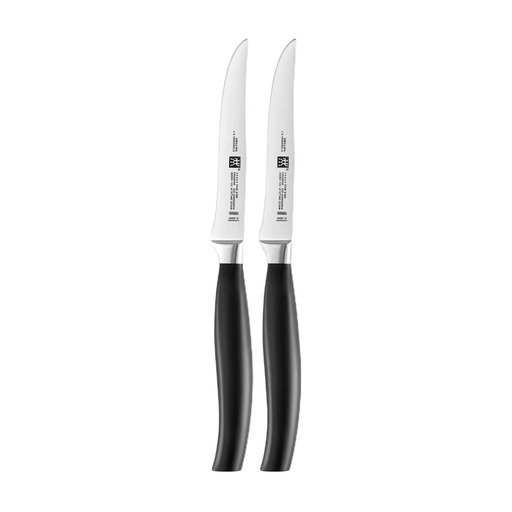
Why this product suits this profile: This two-piece set is designed for a two-person household or an intimate dinner for two. According to the product details, the blades are made from SIGMAFORGE special steel.
The product description highlights hardened special steel, an ergonomically balanced plastic handle and a finger guard. This makes the relevant safety and material information clear.
Two knives, SIGMAFORGE special steel, hardened blade, ergonomic plastic handle and integrated finger guard.
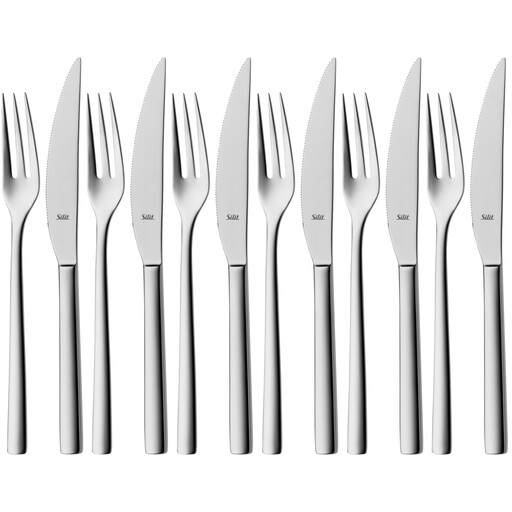
Why this product suits this profile: Twelve knives are suitable for larger households, barbecues, as well as hospitality and catering businesses. The series is designed for steak, pizza and quiche.
The details specify 18/10 Crominox stainless steel, a forged construction, a serrated edge and dishwasher suitability. This makes it easier to assess the materials and construction before buying.
12-piece steak knife set, 18/10 stainless steel, forged blade, serrated edge and dishwasher cleaning possible.
We have put together a complete, regularly updated list of products that fully meet these strict selection criteria and the safety regulations applicable in the EU.
Even a well-chosen serrated kitchen knife will remain functional for longer when used correctly:
If you use knives frequently at home or in a commercial setting, it is also worth comparing individual knives with sets. Individual Victorinox steak knives can be combined flexibly by colour and quantity. A Victorinox steak knife in a set of 6 may be more suitable for families or events. A ZWILLING steak knife in a two-piece set, on the other hand, is aimed at smaller dining occasions.
Yes, provided the blade is sufficiently long and sturdy. The teeth can cut through crisp bases without requiring much pressure. For very thick pizzas or large trays, a longer pizza knife or pizza cutter is often more practical.
It is not possible to give a reliable fixed lifespan. This depends on how often the knife is used, the chopping board, cleaning and how the blade is handled. Wooden or plastic boards, rinsing the knife immediately and storing it safely help reduce unnecessary wear. Damaged or bent blades should not be used further.
If the manufacturer expressly states that the knife is dishwasher-safe, it can generally be cleaned in the dishwasher. Nevertheless, for the gentlest possible care, hand washing with mild washing-up liquid followed by drying is recommended. This can help protect the surface of coloured plastic handles and the cutting edge, particularly on serrated blades.