
Lieferung heute & morgen

Qualitätsgarantie

Willkommens-Angebote freischalten: KOSTENLOSE Lieferung | Bis zu 80 % RABATT | Kostenlose 30-Tage-JoyPlus-Testphase
App herunterladen
A steak knife should cut through meat without unnecessarily tearing the crust or pushing the piece around the plate. Even so, some product claims can be misleading when you are shopping. A particularly shiny blade, for example, says little about its actual cutting performance. Likewise, the term “rust-resistant” is no substitute for checking the material, care instructions and workmanship.
This guide from the Joybuy Product Recommendation Officer explains what households, barbecue enthusiasts, home cooks, hosts and catering businesses should look for when buying.
With steak knives, the edge design is crucial. A serrated edge grips the surface of roast or grilled meat and can also cut through crisp pizza bases. The teeth often remain functional for longer in everyday use than a very fine straight edge, although they cannot be re-sharpened with every standard knife sharpener.
A straight blade can offer precise control, but requires regular sharpening. If you are buying a steak knife set, you should therefore check whether the edge is suitable for the intended use and whether care or sharpening instructions are provided.
Many rust-resistant steak knives are labelled as dishwasher-safe. This makes cleaning easier, but it does not mean that the blade and handle will remain unchanged in the dishwasher indefinitely. Heat, detergents and contact with other cutlery can put strain on the edge and surface.
For knives with wooden handles or delicate handle joints, hand washing is generally the more careful option. Regardless of the material, it is advisable to dry knives immediately after washing and not store them loose in a cutlery drawer.
A classic steak knife is designed for cutting meat on the plate. A longer carving knife or slicing knife, on the other hand, is used when preparing raw meat, roasts or poultry. A 20-cm carving knife offers greater blade length and control when handling large pieces, but is often less convenient at a laid table.
For steak and pizza knives, a blade length of 11 to 12 cm is often sufficient. This size is easy to handle at the table and is suitable for steaks, schnitzels, pizza and other firm foods. For roasts or large cuts of meat, around 20 to 22 cm is more practical.
A serrated or toothed edge is particularly useful when the surface is crisp. This includes grilled meat with a crust, pizza, quiche and similar baked foods. The teeth should be cleanly finished and should not end in sharp edges where they meet the handle.
Stainless steel is widely used for steak knives. The term “rust-resistant” indicates increased corrosion resistance, but does not mean complete immunity. Acidic foods, moisture and harsh cleaning products can still affect the surface.
When choosing, specific details such as a stainless-steel blade, specially hardened steel or a corrosion-resistant finish are more useful than general advertising claims. One example of a carving knife with clearly specified steel processing is the ZWILLING Professional S Meat Knife with a 20-cm blade and FRIODUR ice hardening. According to the product description, it is not intended for the dishwasher and should be cleaned by hand.
An ergonomic, non-slip handle supports safe handling. Plastic and polypropylene handles are easy to clean and practical for everyday use. Wooden handles offer a different feel, but generally require more care.
The right set size depends on your household:
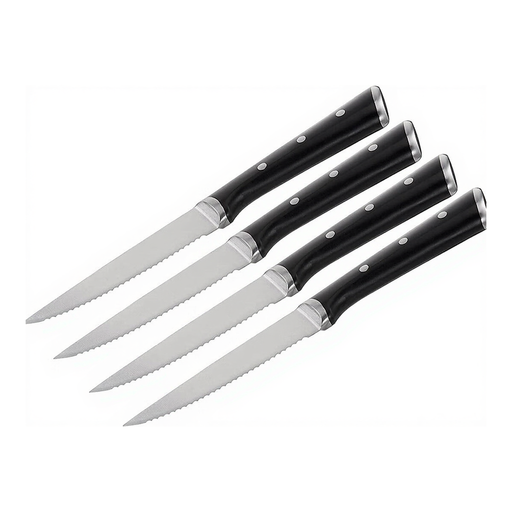
Why this product suits this profile: The 4-piece set provides a practical selection for everyday dining and smaller barbecues.
The product details clearly specify stainless steel, 11-cm blades, ABS handles, a serrated edge and dishwasher suitability.
Four knives, rust-resistant stainless steel and a specified finger guard make choosing for everyday use easier.
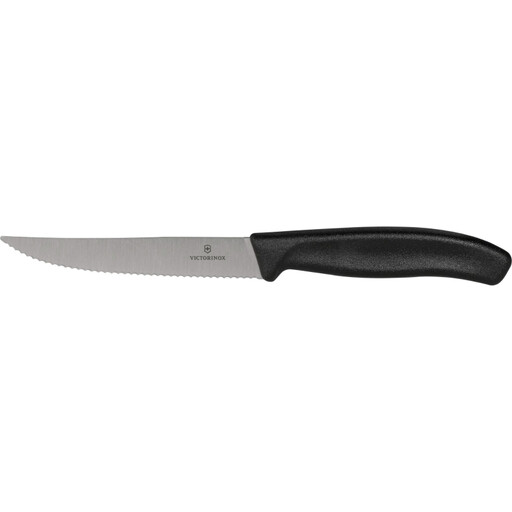
Why this product suits this profile: The 12-cm stainless-steel blade with a serrated edge and the ergonomic plastic handle are designed for regular use at the table.
The blade length, material, Swiss origin and dishwasher suitability are clearly stated in the product details.
Serrated stainless-steel blade, lightweight handle and suitability for both households and catering.
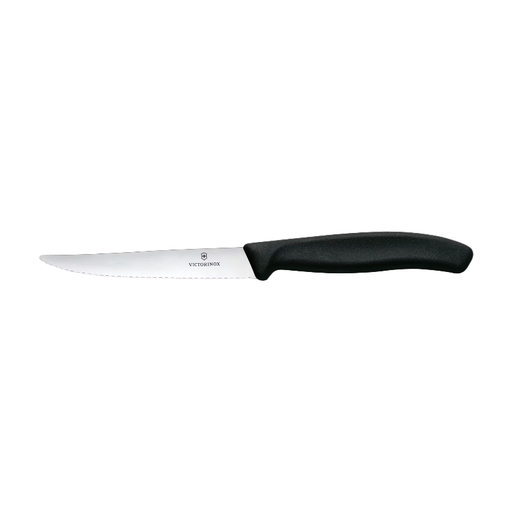
Why this product suits this profile: The 6-piece steak and pizza knife set covers barbecues, family meals and crisp pizza bases.
The toothed edge is explicitly described as suitable for steak and pizza; the six matching knives make it easier to create a coordinated table setting.
11-cm stainless-steel blades, polypropylene handles, dishwasher suitability and six knives per set.
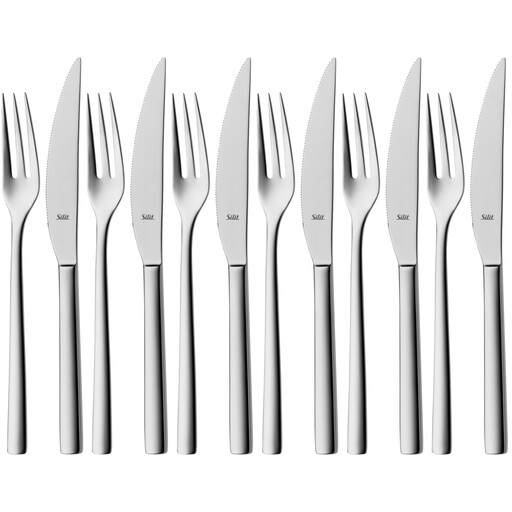
Why this product suits this profile: Twelve knives make it easier to equip many places at family celebrations, barbecues or in a restaurant.
The product details specify 18/10 stainless steel, one-piece forged knives, a serrated edge and dishwasher suitability.
Large set size, rust-resistant Crominox steel and specified suitability for steak, pizza and quiche.
We have compiled a complete, regularly updated list of products that fully meet these strict selection criteria and the safety regulations applicable in the EU.
It depends on how you intend to use them. A serrated edge is suitable for crisp crusts and pizza and often needs less sharpening in everyday use. With appropriate care, a straight blade can cut very precisely, but it must be maintained regularly with a suitable sharpening tool.
It is not possible to give a reliable fixed lifespan. It depends on the material, edge design, frequency of use, cutting surface and cleaning method. Soft cutting surfaces, hand washing and dry storage can help protect the blade. With serrated knives, replacement is often more practical than sharpening, as not every knife sharpener is suitable for serrated edges.
For two to four people, a 4-piece set is usually sufficient. If you regularly entertain guests, a 6-piece set offers greater flexibility. A 12-piece steak knife set is particularly worthwhile when you have many places at the table or use the knives frequently in a catering environment.