
Lieferung heute & morgen

Qualitätsgarantie

Willkommens-Angebote freischalten: KOSTENLOSE Lieferung | Bis zu 80 % RABATT | Kostenlose 30-Tage-JoyPlus-Testphase
App herunterladen
A steam cleaner promises hygienic, deep cleaning without any chemicals—an attractive solution for health and eco-conscious households. But the market is flooded with devices whose marketing promises often fall short in practice. Before you make a decision, it's crucial to understand the common pitfalls that can lead to a poor purchase.
Many buyers focus on a single, prominently advertised metric, overlooking crucial design features. The result is often an appliance that brings more frustration than cleanliness. Here are two of the most common problems to watch out for:
Instead of being guided by marketing buzzwords, you should base your selection on objective, practical criteria.
To find a device that meets your needs and delivers long-term, satisfactory performance, you should carefully examine three core parameters. These determine whether a steam cleaner is suitable for your specific applications—from tiles and grout to upholstery.
These two values are inextricably linked and define the cleaning performance.
The practical aspects of use are largely determined by the device's water supply.
A steam cleaner's true capabilities are revealed through its accessories. Instead of focusing on sheer quantity, check their usefulness for your purposes. A good steam cleaner for tiles and grout needs durable brushes (ideally brass for non-sensitive grout and nylon for tiles). For use as a steam upholstery cleaner, a special attachment with a microfibre cloth is essential.
Some devices can be converted from a floor unit into a handheld steam cleaner, offering maximum flexibility. Check if the most important attachments—floor nozzle, jet nozzle, small round brush, and window squeegee—are included and solidly built.
Based on the criteria above, we have identified a few models that represent a considered choice for different user profiles and their specific requirements.

Why This Fits Their Persona: Ideal for users seeking a powerful yet straightforward solution for general household cleaning without a large budget. The combination of rapid readiness and long runtime makes it perfect for everyday use.
With 3.5 bar pressure and 1500W power, this device offers solid, balanced performance instead of an exaggerated marketing spec. The large 1.6-litre tank prevents constant refill breaks.
Very short 15-second heat-up time according to the manufacturer; up to 48 minutes of runtime thanks to the large tank; 6-level steam control for different surfaces.
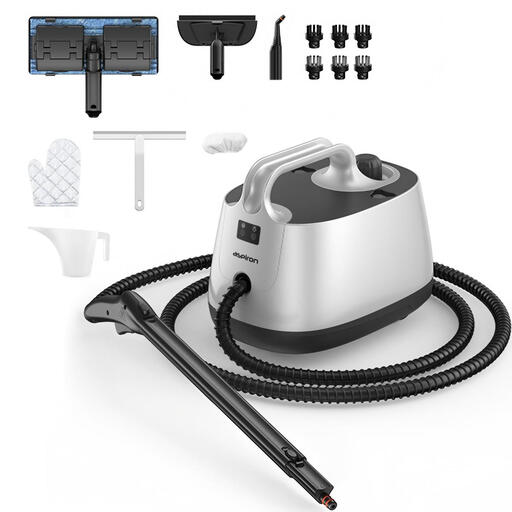
Why This Fits Their Persona: Perfect for homeowners looking for a single, powerful device for a wide range of tasks throughout the house—from floors and windows to upholstery and even the car.
This model avoids the useless accessory trap by providing a 21-piece set for specific applications (floors, windows, grout, upholstery) rather than just focusing on the quantity.
Powerful 4-bar steam pressure for deep cleaning; large 1.5-litre tank for extended use; very comprehensive accessory package for maximum versatility.
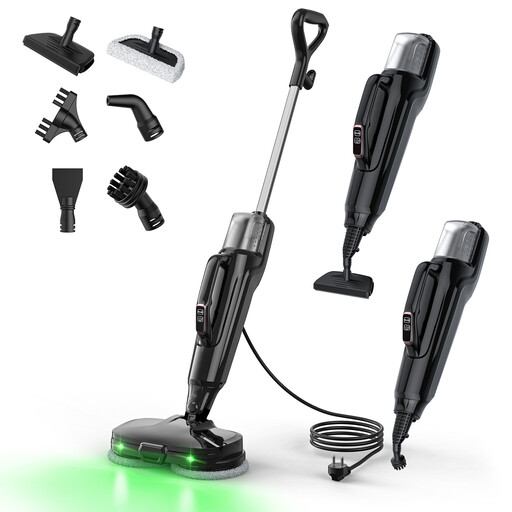
Why This Fits Their Persona: Designed for users whose primary focus is the thorough cleaning and maintenance of hard floors. The combination of steam cleaning and polishing offers a genuine added value over conventional steam mops.
Instead of just being another standard steam mop, this model's dual-motor system offers a specialised function that tackles stubborn dirt while simultaneously polishing the floor.
Dual-motor system for simultaneous steaming and polishing; detachable handheld steam cleaner for flexibility; LED lighting to make dust visible.
We have compiled a complete, up-to-date list of products that fully meet these strict selection criteria and UK safety regulations.
1. Can a steam cleaner damage parquet or laminate flooring? Yes, caution is advised. Steam cleaners are primarily designed for sealed hard floors like tile, stone, or sealed hardwood. On unsealed wood, waxed floors, or poorly bonded laminate, the moisture and heat from the steam can cause swelling or damage. Always check your flooring manufacturer's recommendations and test the device on an inconspicuous area before cleaning the entire surface.
2. How often do you need to descale a steam cleaner? The frequency depends on the water hardness in your area. With hard, calcareous water, you should descale the device every few months or after a certain number of tank fillings (see the user manual). To minimise limescale buildup from the start and extend the life of the appliance, using distilled or demineralised water is a very good practice.
3. Is a steam cleaner truly a chemical-free cleaning method? Yes, the fundamental principle of steam cleaning is based solely on the physical action of hot water vapour. The high temperature dissolves grease and dirt and has a sanitising effect on many common household bacteria and germs. Adding chemical cleaning agents is not necessary or recommended, as they can damage the device and produce harmful fumes.