
Lieferung heute & morgen

Qualitätsgarantie

Willkommens-Angebote freischalten: KOSTENLOSE Lieferung | Bis zu 80 % RABATT | Kostenlose 30-Tage-JoyPlus-Testphase
App herunterladen
A steam cleaner can treat floors, grout, windows, upholstery and other surfaces with hot steam. This is appealing for many households because chemical-free cleaning means you can avoid harsh cleaning agents, depending on the level of soiling. However, devices differ significantly in steam pressure, heating time, tank size, accessories and suitability for delicate materials.
If you only focus on a high wattage or a long list of accessories, you can easily end up with a device that is impractical for everyday use. The following points will help you interpret marketing claims and choose a steam cleaner that suits your home.
A steam cleaner with 1500 W can heat water quickly. However, wattage primarily describes the electrical power consumption. On its own, it tells you nothing about how consistently the steam is delivered, how well the attachments fit, or how easy the device is to handle.
Far more important is the combination of steam pressure, temperature, steam control, hose length and build quality. A high-pressure steam cleaner with a stated pressure of 4 bar can be useful for stubborn dirt, provided the steam reaches the surface in a targeted and controlled manner.
21 attachments may seem versatile at first glance. What really matters is whether the right brushes, floor cloths, window attachments and nozzles are included, and whether they are easy to clean and store afterwards. For a steam cleaner for floors, for example, a sturdy floor head and sufficient reach are more important than several small specialist nozzles.
A steam cleaner for windows also needs a suitable rubber lip or squeegee. For grout, narrow nozzles and robust brushes make sense. So before you buy, check which attachments are actually intended for the surfaces you plan to clean.
Hot steam can damage delicate materials. Caution is needed with untreated wood, certain types of laminate, waxed surfaces, sensitive varnishes, leather and non-colourfast textiles. With a steam cleaner for upholstery or carpets, you should first test an inconspicuous area.
The manufacturer's instructions and the care guidelines for the material in question take priority. Steam also doesn't replace extraction: for heavily soiled carpets or upholstery, an extractor may be more suitable because it removes liquid and dissolved dirt.
Steam pressure is usually given in bar. A higher value can help loosen dirt in grout or on hard surfaces. For textiles, however, controllable steam output is particularly important so that the material doesn't become unnecessarily soaked.
According to the product specifications, the ASPIRON CA019 Steam Cleaner offers 4 bar, up to 145 °C hot steam and a power output of 1500 W. These values describe the technical capabilities of the device. They are not a general promise of effectiveness and should always be considered in relation to the specific attachment and the surface being treated.
A larger tank reduces interruptions but can make the device heavier. According to the product description, the ASPIRON CA019 has a 1.5-litre water tank. This can be practical for several rooms, whereas for short tasks a more compact device is easier to store.
Also pay attention to:
A steam cleaner works with heated water and steam. An extractor sprays water or cleaning solution onto textiles and then vacuums up the dirty liquid. For carpets, sofas, mattresses and car seats, a steam cleaner for carpets can treat surface deposits; for deep-set stains, a device with spray and suction functions is often more suitable.
Your choice should therefore depend on your usage profile: steam is best for hard, heat-resistant surfaces and targeted treatment. Spray extraction is useful on water-safe textiles but requires careful drying.
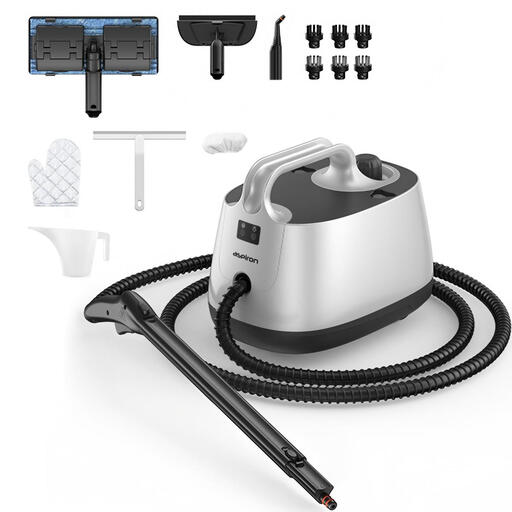
Why this product fits the profile: A versatile steam device for households that want to clean floors, windows, grout and other hard surfaces with one system.
The key technical specifications, the 1.5-litre tank and 21 accessories are clearly stated. This makes it easier to match the choice to your actual needs.
1500 W, 4 bar, up to 145 °C according to product specifications, plus accessories for floors, windows, grout, upholstery and car interiors.
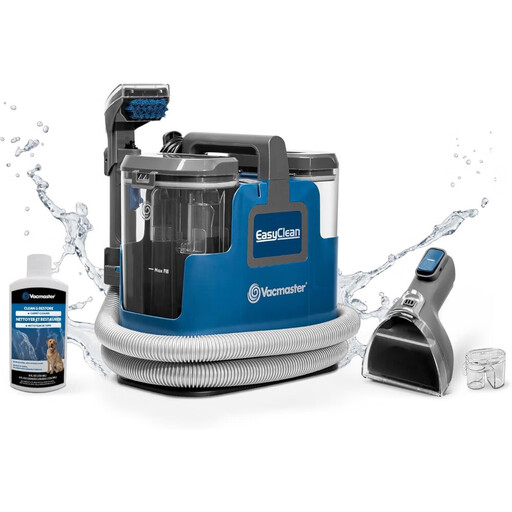
Why this product fits the profile: For users who want to clean upholstery, carpets, stairs and car seats using spray and suction functions.
This device is not a steam cleaner but an extractor. This clear distinction prevents high steam temperature from being confused with thorough liquid extraction.
17 kPa suction power according to product specifications, two separate water tanks and a 1.8-metre hose.

Why this product fits the profile: A handy solution for targeted stains on water-safe sofas, carpets, mattresses and car seats.
The 3-in-1 function of spraying, brushing and extracting addresses textile stains more precisely than a pure steam device. A colourfastness test on a hidden area is still necessary.
600 W motor, 17 kPa suction power according to product specifications and separate tanks for clean and dirty water.
We have compiled a complete, regularly updated list of products that fully meet these strict selection criteria and the safety regulations in force in the EU.
Before use, always follow the instruction manual, material guidelines and safety distances. Never leave the device unattended while plugged in. Unplug the device before maintenance, cleaning or changing attachments. Steam devices should not be used by children and should only be used indoors unless the manufacturer states otherwise.
Running costs mainly include electricity, water, descaling and, where necessary, replacement cloths or brushes. Tap water can vary in hardness depending on your region. You should therefore follow the instructions on descaling and permitted water quality. With an extractor, cleaning solutions are also needed; with a steam cleaner, you can often do without cleaning agents depending on the application.
For car interior care, a combination of a suitable steam cleaner, microfibre cloths and narrow brushes is recommended. Electronic components, displays, speaker grilles and sensitive leather surfaces must not be treated directly with hot steam. You can find more suitable products under Autowaschen Innenraum.
That depends on the type of laminate, its seal and the flooring manufacturer's instructions. Too much heat or moisture can damage the joints and surface. Only use a low, controlled steam output if the floor manufacturer permits it, and test an inconspicuous area first.
The lifespan depends on frequency of use, water quality, descaling, storage and maintenance. After each use, remove any residual water and moisture according to the instruction manual. Accessories, hoses, seals and cloths are typical wear parts and should be checked regularly.
Consumption depends on the electrical power and the actual running time. A device with 1500 W theoretically uses 1.5 kWh during one hour of operation, although heating and operating phases can vary. For an accurate estimate, multiply the power in kilowatts by the usage time and your electricity tariff rate.