People who iron skirts regularly
If you iron several suitable skirts or other items one after another, you can compare tank capacity, refilling and ease of use for longer ironing sessions.


A steam generator iron could be worth it if you regularly iron several skirts or other suitable items in one go, and have room for the base, hose and ironing surface. For ironing a single skirt and with little storage space, a standard steam iron may be more practical. Start by checking the care symbols on each skirt, then consider how much you iron, the space available and the maintenance involved – not just the advertised steam pressure.
If you iron several suitable skirts or other items one after another, you can compare tank capacity, refilling and ease of use for longer ironing sessions.
If you share an ironing area, consider whether you can put away the separate base and hose once you have finished ironing.
If care symbols differ, or a skirt has a lining or trim, the permitted treatment for that particular garment matters more than the material it is made from.
A good fit if: You iron several items that the care labels say can be steam-ironed in one go, and have room for the base, hose and ironing surface.
Consider: The base and hose need extra space when in use and in storage; the generator also needs descaling.
A good fit if: You usually just give one skirt a quick iron and don’t want to store a separate base.
Consider: You may need to stop and refill more often when ironing several items in a row; it depends on the model.
A good fit if: The care label rules out steam or says not to iron the garment.
Consider: A temperature setting on the appliance does not override the garment’s care instructions.
GINETEX distinguishes between ironing temperatures and care symbols that warn steam could cause damage, even at a low temperature. So check the label on the skirt you are about to iron.
| What matters | What to check before buying | Who it matters most to |
|---|---|---|
| How much you iron and how often you need to stop | Check the exact model’s tank capacity and whether it can be refilled. Distinguish continuous steam output in g/min from a short steam boost. | If I iron several skirts in one go, I want to stop less often to refill the tank. Around 30% of consumers put the amount of ironing they do first. |
| Space for use and storage | Compare the appliance’s dimensions with the space available. Consider how the hose and cable are stored, and whether there is a travel lock. | If I share an ironing area, I need to be able to put away the base and hose after use. Around 30% of consumers prioritise space for use and storage. |
| How to treat the skirt | Check the care and steam instructions for each item. Temperature control does not replace the care symbol. | If my skirts have different care symbols, linings or trims, I want to follow the permitted treatment for each one. Around 20% of consumers prioritise treating their skirts appropriately. |
| Descaling and ongoing costs | Read the maintenance instructions for the exact model. Check whether it uses a reusable container or requires replacement parts. | If I use the appliance regularly, I want to know how much upkeep it involves and whether replacement parts may be needed. Around 20% of consumers prioritise easy maintenance and predictable running costs. |
For the Tefal SV9202, Tefal lists continuous steam output of 130 g/min and a steam boost of 520 g/min. These are different manufacturer specifications and do not prove that it will save you a particular amount of time.
For longer ironing sessions, compare continuous steam output separately from the short steam boost.
The care symbol on an individual skirt may restrict ironing or steam. GINETEX also highlights care symbols that warn steam could cause damage, even at a low ironing temperature.
Check the label before ironing and follow its temperature and steam instructions.
Descaling systems vary from model to model. Philips notes that hard water can lead to limescale building up more quickly.
Read the maintenance instructions for the specific appliance and check which descaling method it uses.
Depending on the model, descaling takes extra time and specific replacement parts may also be required.
The Express Protect SV9202 is an example of a steam generator iron with a removable tank, designed for longer ironing sessions.
The CareStyle Compact IS 2143 BL is a model to consider if storage space is limited.
The PerfectCare 6000 PSG6023/20 is an example of a steam generator iron with a removable tank and descaling system.
The Compact Steam Pro DG7623 is marketed as a compact steam generator iron.
According to Polti, the La Vaporella XT100C has several programmes for suitable fabrics, including cotton.
The models below are steam generator irons suited to regular ironing sessions. Compare tank capacity, steam output and the space needed against your day-to-day needs. Before buying, also check the compliance information required for the specific listing, along with the instructions for use and safety information in German.
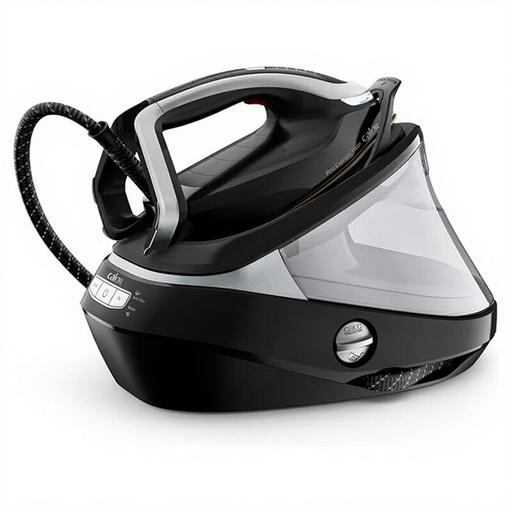 No product image available
Positioned for longer ironing sessions; the product name lists a 1,2-l tank.
3000 W; continuous steam output: 180 g/min; steam boost: 800 g/min.
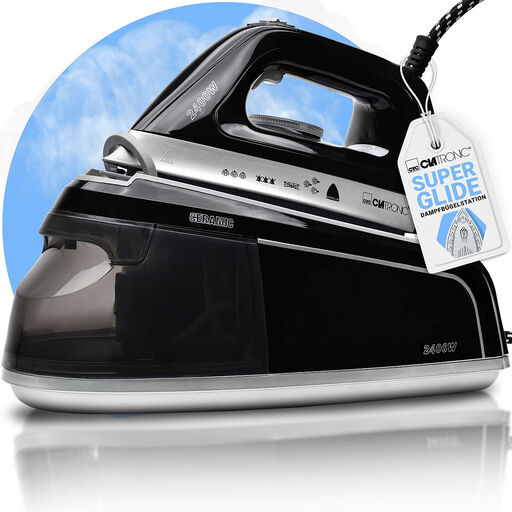 No product image available
Positioned for ironing several items; the product name lists a removable 1,2-l water tank.
3,5 bar; up to 80 minutes’ operating time; 2400 W.
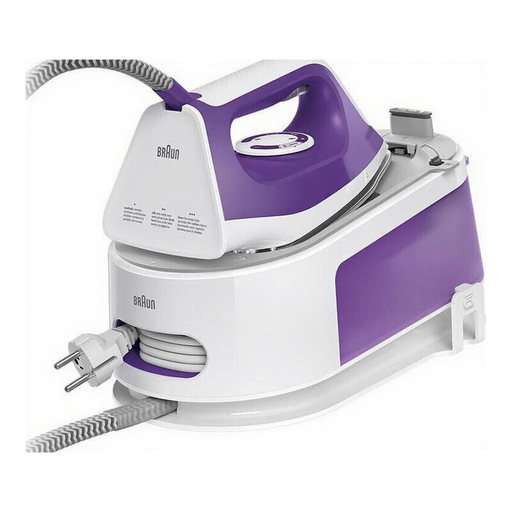 No product image available
Listed as a steam generator iron for ironing several items. Before choosing, compare the space needed for the base with the storage space you share.
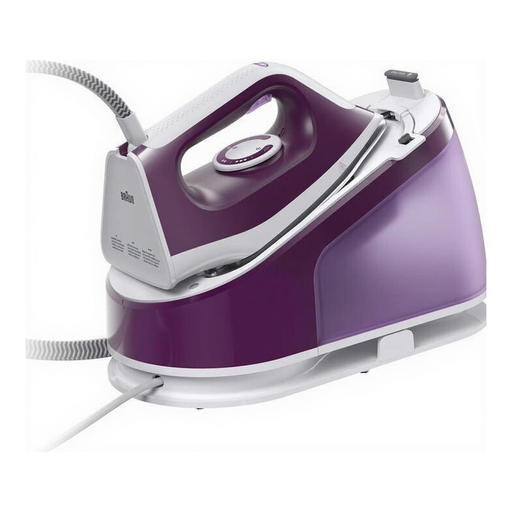 No product image available
Listed as a steam generator iron for ironing several items. Check whether you can put it away after use in your shared ironing area.
The product name identifies this as the Pro model.
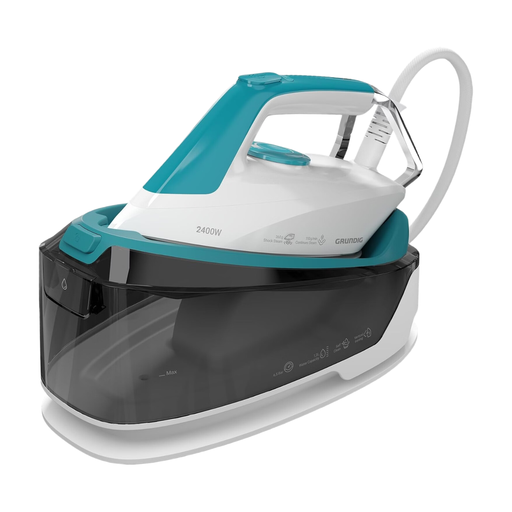 No product image available
Positioned for ironing several items; the product name lists a 1,2-l water tank.
2400 W; 6,5 bar; steam output: 110 g/min; steam boost: 360 g/min.
No. The care symbol on the individual skirt is what matters. GINETEX distinguishes between permitted ironing temperatures, a no-ironing symbol and a low-temperature setting where steam could cause damage. Neither the material name nor an automatic appliance setting replaces this information.
Follow the instructions for your exact model rather than mixing descaling methods from different steam generators. Philips notes that hard water can cause limescale to build up more quickly. For certain Easy De-Calc models, it says to unplug the appliance and let it cool before opening it. These instructions do not automatically apply to every Philips or other brand’s model.
The seller is generally responsible for the statutory guarantee. The Verbraucherzentrale distinguishes this responsibility from an additional manufacturer’s warranty, which is subject to its own terms.
CE-marked appliances placed on the German market must meet the relevant conformity requirements. The Bundesnetzagentur lists the CE marking and the required instructions for use and safety information in German among the checks retailers should make. Check the details for the specific listing.
In Germany, you can take old electrical appliances to local collection points for free, among other options. Retailers’ take-back schemes are subject to their own acceptance conditions, as explained by the Umweltbundesamt.