Precision ironing for uniform sleeves
You want to iron narrow sleeves and seams neatly without creating an unwanted crease down the length of the sleeve.


If you regularly iron several uniform items and have enough space, a steam generator iron with a well-shaped precision tip and an easy-to-fill tank could be a sensible choice. To avoid unwanted creases running down the sleeve, a suitable sleeve board may matter more than an especially powerful steam shot. If you only have a few sleeves to iron or space is limited, a standard steam iron may be more practical; always follow the care label on the uniform item.
You want to iron narrow sleeves and seams neatly without creating an unwanted crease down the length of the sleeve.
You iron several uniform items in a row and want to weigh up tank capacity, refilling and maintenance against the space the appliance takes up.
You use a small or shared utility room and need to find space for the base unit, hose and storage.
A good choice if: you regularly iron several uniform items and have room for the appliance beside the sleeve board.
Things to consider: the base unit and hose need space for use and storage. Compare the tank, precision tip and ease of use on the specific model.
A good choice if: you only iron individual sleeves occasionally or a separate base unit would take up too much room in your ironing area.
Things to consider: the built-in water tank is not a substitute for a steam generator iron's separate tank; a suitable sleeve board may help here too.
A good choice if: the care label says not to iron the item or only permits ironing without steam.
Things to consider: automatic temperature settings and the manufacturer's instructions do not override the care label.
| What matters | What to look for when buying | Who should pay particular attention? |
|---|---|---|
| Precision around sleeves and seams | Check that the sleeve board fits well, and consider the shape and handling of the iron's tip. | If you want to iron narrow areas and avoid an unwanted crease down the sleeve, it is important to be able to position the sleeve and guide the iron properly. Around 33% of consumers prioritise precision around sleeves and seams. |
| Several uniform items in a row | Check the tank capacity, whether it can be removed and how it can be refilled on the exact model variant. | If you iron several suitable uniform items in one session, how often you need to stop and refill matters. Around 27% of consumers prioritise being able to iron more items with fewer interruptions. |
| Space and ease of use | Consider the appliance's dimensions, the weight of the iron, hose length and a stable surface to set it down on. | If your utility room is small or shared, you need to be able to store the appliance, hose and sleeve board safely. Around 20% of consumers prioritise the space available. |
| Suitability for the uniform fabric | Follow the care label, particularly if ironing is prohibited or only permitted without steam. | If you want to care for your uniform items properly, the setting must match the care symbols. Around 13% of consumers prioritise suitability for the specific fabric. |
| Descaling and maintenance | Check the descaling method, the type of water permitted and the care instructions for the exact model variant. | If you want to spend as little time as possible maintaining the appliance after ironing, the descaling method is an important factor. Around 7% of consumers prioritise ease of maintenance. |
Steam performance figures do not tell you whether the sleeve will sit properly on the board or whether the iron's tip can reach narrow areas easily.
First check the sleeve support and how easy the iron is to handle; then compare the steam performance figures for the specific models.
Some fabrics must not be ironed at all, or must not be ironed with steam.
Check the care label on each uniform item before steam ironing it.
The base unit and steam hose also need suitable space for use and storage.
Compare the dimensions of the complete appliance with the space available, including room for the sleeve board.
The Express Protect SV9202E0 is an example of a model with a precision tip, a separately filled tank and a limescale collector.
The PerfectCare 6000 PSG6020/30 is an example of a model with published dimensions, a removable tank and automatic temperature settings.
The CareStyle 1 Pro IS1514VI and CareStyle 7 Pro IS7286BK illustrate different approaches to controls, with a mechanical thermostat and digital programmes respectively.
The La Vaporella XT120C is an example of a steam generator iron with a boiler, programmes and a removable tank.
Joybuy product options for uniform items that can be ironed with a steam generator iron.
 No image available
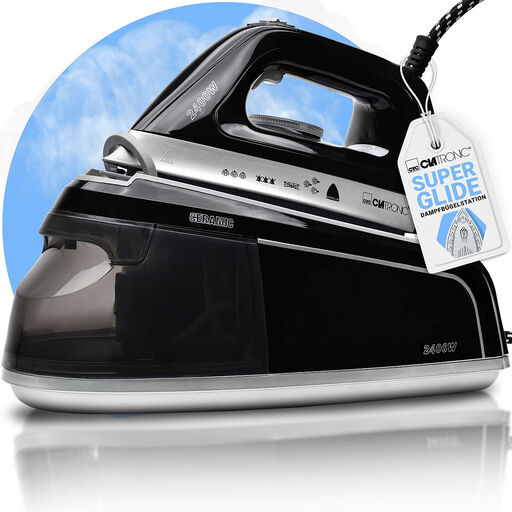
Could be worth considering for ironing several suitable items in a row, if the tank capacity and footprint suit your ironing area.
The product information lists a removable 1,2-l tank and up to 80 minutes of use under average conditions.
Other listed features include steam output of up to 90 g/min, 3,5 bar, 2.400 W, variable temperature control and a Superglide soleplate.
The product information also lists an electronic anti-drip system and a transport lock.
No. If you only iron a few sleeves occasionally, a standard steam iron may be enough. If a crease running down the sleeve is your main concern, first check whether a suitable sleeve board would help; if you iron several items in one session, a steam generator iron's separate tank may come in handy.
No, you must follow the care label. The GINETEX symbol guide includes both ‘Do not iron’ and an ironing setting that does not permit steam; at another low setting, steam can cause irreparable damage.
For the Leifheit sleeve board 71820, the manufacturer requires a level surface and says not to place the iron on the cover. Instead, put it on the designated rest on the appliance or in a suitable iron rest. Also follow the instructions for your specific appliance.
Follow the instructions for water and descaling in the manual for the exact model variant. Philips notes that limescale and dirt can build up more quickly in hard water; a limescale collector does not replace model-specific maintenance.
For new electrical equipment within the scope of 50 to 1.000 V AC, the 1. ProdSV requires the manufacturer to provide an EU declaration of conformity following the conformity assessment procedure, as well as CE marking. The European Commission clarifies that CE marking is not an individual approval issued by a government authority.