
Lieferung heute & morgen

Qualitätsgarantie

Willkommens-Angebote freischalten: KOSTENLOSE Lieferung | Bis zu 80 % RABATT | Kostenlose 30-Tage-JoyPlus-Testphase
App herunterladen
A great steam iron can make household chores significantly easier, but the market is saturated with products making lofty promises. High wattage ratings and complex feature names often cause more confusion than clarity, leading to buyer's remorse. Many users quickly find their new iron drips, loses performance, or even damages delicate fabrics.
This guide will help you identify the critical features and avoid common purchasing traps. We focus on the technical specifications that truly matter, so you can find a durable, efficient steam iron that perfectly matches your needs.
Before we dive into the key performance metrics, you should be aware of three common marketing tactics that often lead to a poor purchasing decision.
To find the right steam iron, you should focus on three objective criteria that directly impact performance and usability.
Steam output is the most important factor for efficient ironing. It is measured in grams per minute (g/min) and is broken down into two values:
The soleplate is in direct contact with your clothing. A ceramic soleplate is now standard on many models and offers advantages over pure stainless steel: it glides more smoothly, distributes heat more evenly, and is less prone to sticking to synthetic fabrics. Look for a scratch-resistant coating and a well-designed layout of steam vents that ensures broad steam distribution.
Some features offer real-world value in daily use:
Here are some recommendations tailored to different needs and households.
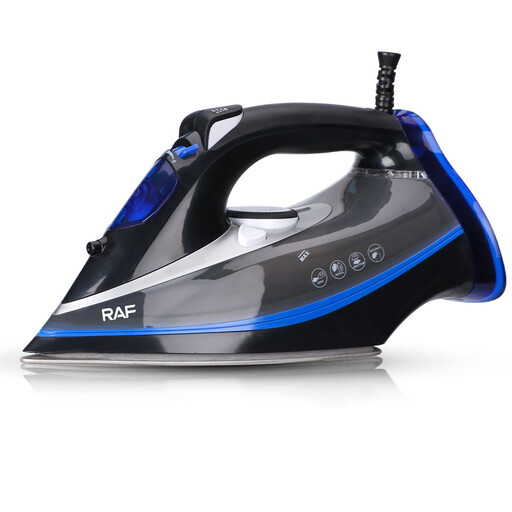
Why This Fits Their Persona: Ideal for families who regularly tackle large loads of laundry. The large water tank reduces the need for constant refilling, while the power is sufficient for most everyday fabrics, from cotton T-shirts to bed linens.
This model focuses on practical features rather than an exaggerated wattage. The combination of 2200 W of power and a 400 ml water tank is optimised for continuous use. The integrated self-cleaning function is a genuine maintenance tool.
Large water tank for long ironing sessions. The ceramic soleplate ensures a smooth glide, and the adjustable steam output (15-25 g/min) adapts to different fabrics.

Why This Fits Their Persona: For households with a very high volume of ironing or for those who regularly need to smooth heavy fabrics like linen, denim, or thick cotton. The steam generator iron delivers consistently high pressure and steam, drastically reducing ironing time.
Here, the high power of 3100 W is used effectively to generate an extremely powerful steam boost of 180 g/min. The external 1.5-litre water tank is the core feature of a true steam generator iron, not just a marketing gimmick.
Very high steam output for maximum efficiency. The removable water tank allows for easy refilling. Includes safety features like an auto-shutoff and drip-stop.

Why This Fits Their Persona: Perfect for business trips, holidays, or for those with limited storage space. This compact travel iron combines the function of an iron with that of a garment steamer for vertical steaming, making it extremely versatile.
This appliance doesn't promise performance it can't deliver. The focus is clearly on portability and 2-in-1 functionality. At 1200 W, it is appropriately powerful for its size and heats up quickly, without claiming to replace a full-sized station.
Very lightweight and compact. The 90° rotating head allows for both horizontal ironing and vertical steaming. The dual water tanks permit longer usage time.
If you're looking for other models with superior glide performance, we've curated a selection of products that meet our criteria for performance and durability.
1. How often should I descale my steam iron? The frequency heavily depends on the water hardness in your area and your usage. As a rule of thumb, it's recommended to use the self-cleaning function once a month. Hold the iron over a sink to catch the flushed-out scale particles. With very hard water, more frequent cleaning or using distilled water may be advisable.
2. Can I use regular tap water? Most modern steam irons are designed for use with tap water. However, always check the manufacturer's user manual. In areas with extremely hard water, a mixture of 50% tap water and 50% distilled water is often recommended. This protects the anti-calc system and extends the appliance's lifespan.
3. What is the difference between a steam iron and a steam generator iron? A classic steam iron is a compact appliance with a water tank integrated directly into the handset. A steam generator iron consists of two parts: the lightweight iron itself and a separate base station with a large water tank. This station generates steam under high pressure and directs it to the iron through a hose. As a result, it delivers a significantly higher and more consistent volume of steam, which considerably speeds up ironing.