Precision around cuffs
If you regularly iron narrow cuffs and the fabric around buttons, a tip that’s easy to guide and a suitable ironing surface are important factors. Philips recommends laying the cuff flat and undoing the buttons.


For a few cuffs and shirts, an ordinary steam iron is usually the more space-saving option. A steam generator iron is more likely to suit you if several people regularly have longer ironing sessions. Look for a well-shaped, easy-to-guide tip, a safe place to set the iron down and check the care label before comparing tank sizes or steam specifications. When sharing an appliance, clear controls and an agreed descaling routine matter too.
If you regularly iron narrow cuffs and the fabric around buttons, a tip that’s easy to guide and a suitable ironing surface are important factors. Philips recommends laying the cuff flat and undoing the buttons.
If you need to put the appliance and ironing board away after use, allow space for the base, hose and a safe place to set it down. Medion’s instructions specify a level, stable and dry surface for setting up the appliance.
If several people regularly iron a batch of shirts at once, refilling, clear settings and a shared care routine can all influence your choice. Braun Household Deutschland and Tefal Deutschland describe care and feature details that vary by model.
First, compare how often you iron with the space you have available. Then check which tip and care features are best suited to your shirts and to sharing the appliance.
| Priority | What to check when buying | Who is it important to? |
|---|---|---|
| Ironing cuffs precisely | Tip shape and how easy the iron is to guide; a flat, suitable ironing surface. | If I need to work around buttons and narrow cuffs, I want to be able to guide the tip easily. This is a priority for around 36% of consumers whose main concern is precise ironing. |
| Setting up and storing the appliance safely | Dimensions, cable and hose routing, and a level, stable and dry surface. | If we need to put the base and ironing board away after use, every bit of available space counts. Space is a top priority for around 29% of consumers. |
| Ironing several shirts in one go | Compare the tank size and refilling method for the specific model. | If we collect our shirts and iron them together in one session, I don’t want to keep stopping to refill the tank. Around 21% of consumers prioritise longer ironing sessions. |
| Sharing operation and care | Check the instructions, descaling method and any model-specific consumables. | If several people use the appliance, we need clear settings and a care routine we can coordinate. This matters to around 14% of consumers. |
Pressure and steam figures alone don’t tell you how easy the iron’s tip is to guide around a narrow cuff.
Check the tip shape and how easy it is to use for your needs. Tefal lists a precision tip and concentrated steam at the tip for the SV9202; this doesn’t mean other models are unsuitable.
An ordinary steam iron may be enough for short sessions. A steam generator iron also needs space for its base and hose.
Compare how often you iron with the available setup and storage space before choosing a separate steam generator iron.
You’ll need to allow extra room for the base, hose and a safe ironing surface.
A setting for ironable fabrics doesn’t override the iron or steam restrictions on the care label of the shirt you’re ironing.
Read the care label before ironing. GINETEX Germany explains that it specifies the maximum permitted treatment for the textile.
Steam generator irons can use different descaling methods, so one shared care routine won’t necessarily suit every model.
Check the instructions for your chosen model and agree who will look after it.
Everyone sharing the appliance will need to make time for its model-specific care as part of their routine.
The Express Protect SV9202 is a useful comparison if you’re looking for a model with a precision tip for narrow areas.
The CareStyle Compact IS 2144 BK could be worth comparing if you need to put your steam generator iron away after ironing.
The PerfectCare 6000 PSG6023/20 is a useful comparison if you’re looking for simple temperature settings and a descaling reminder.
The DBS 3749 is a useful comparison, with manually adjustable temperature and a removable tank.
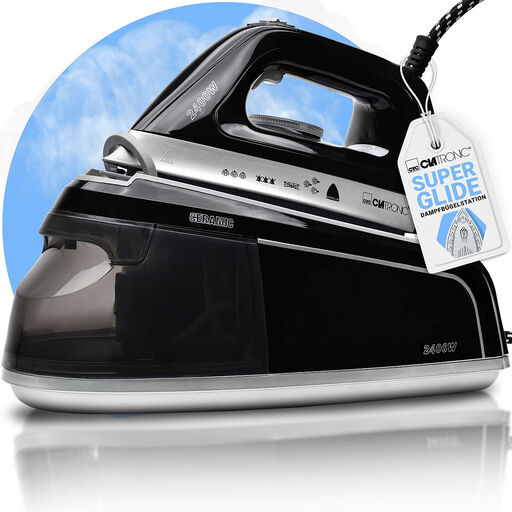
This selection includes a steam generator iron with a removable tank, which may suit longer shared ironing sessions.
 No image available
The removable tank can make refilling easier during longer shared ironing sessions. How it works in practice depends on the model you choose and what you’re ironing.
The product description lists a 1,2-l water tank, up to 80 minutes’ operating time, 3,5 bar and 2400 W.
If you’re buying a mains-powered appliance for use in Germany, check the applicable product information. CE marking is required where relevant EU legislation calls for it; it isn’t a rating of ironing performance.
Lay the cuff flat and undo the buttons if the care label allows ironing. Philips recommends ironing the inside first, then the outside, and carefully guiding the soleplate around the buttons.
Choose a level, stable and dry surface, and also follow the safety instructions in the manual for your specific model. Medion lists these requirements for the surface in its appliance instructions.
No, care depends on the model. Philips describes Smart Calc-Clean with a reusable container for the PSG6023/20, while Tefal lists a removable scale collector for the SV9202. Follow the instructions for the appliance you actually choose.
Your statutory consumer rights are not the same as a voluntary guarantee. If the appliance is faulty, contact the seller and distinguish your statutory rights from the terms of any additional guarantee.
No. According to information from the European Union, CE marking is required only for products covered by relevant EU legislation that requires it. It concerns compliance with that legislation; it isn’t a rating of how well the iron handles cuffs.
In Germany, electrical waste must not go in household rubbish. The German Environment Agency lists local collection points and, subject to the relevant take-back conditions, retailers as places to drop it off.